Introduction| What makes an exercise “Low impact”| Why joints and muscles gentler options at work| Benefits of a low impact office workout| Physical benefits| Mental benefits| Accessibility for all fitness levels| The research behind low impact movement| How gentle movement compares to intense workouts| Getting started with low impact exercise at work| Low impact warm up movements| Low impact seated exercises| Low impact standing exercises| Low impact strength exercises| Low impact stretching for flexibility| Quick low impact routines| Making low impact movement a daily habit| FAQS| Conclusion|
Introduction
Not everybody needs or wants a high intensity workout squeezed between meetings. A low impact office workout delivers real health benefits without straining your joints, raising your heart rate too fast, or leaving you sweaty at your desk. Whether you’re managing joint pain, recovering from an injury, or simply prefer gentler movement, research shows that low impact exercise supports joint health, improves circulation, and reduces cardiovascular risk just as effectively as more intense workouts. This guide covers exactly why gentle movement works, plus simple seated, standing, and stretching exercises you can do right at your desk — no jumping, running, or special equipment required.
What Makes an Exercise “Low Impact”
Low impact exercise means movement that avoids sudden jarring or repetitive pounding on your joints — think walking instead of running, or controlled squats instead of jump squats. Importantly, <cite index=”4-1″>low impact doesn’t mean low intensity</cite> — many low impact activities still build real strength, cardiovascular fitness, and endurance. The difference lies in how the movement lands on your joints, not in how effective it is.
Why Joints and Muscles Need Gentler Options at Work
Office workers often deal with stiff hips, tight shoulders, and cumulative strain from sitting. Low impact activities are ideal here because they <cite index=”4-1″>reduce stress on the knees, hips, ankles, and spine</cite>, making them accessible even for people managing joint discomfort, without sacrificing the benefits of regular movement.
Benefits of a Low Impact Office Workout
Physical Benefits
Research on low impact movement is remarkably consistent. One review found that <cite index=”1-1″>low impact exercise helps preserve joint tissue by reducing both inflammation and structural damage</cite>, with even short, consistent walking sessions triggering measurable anti inflammatory effects within a few weeks. Separately, physical therapists note that <cite index=”2-1″>low impact exercise supports joint health while improving strength and mobility</cite>, making it a sustainable long term option rather than a short term fix.
Mental Benefits
Movement doesn’t need to be intense to help your mood. Regular low impact activity is linked to <cite index=”4-1″>easing symptoms of anxiety and depression by improving sleep, boosting mood, and supporting emotional well being</cite> — a meaningful bonus during a demanding workday.
Accessibility for All Fitness Levels
Because low impact exercise is gentle by design, it works for nearly everyone — from someone new to movement, to an experienced athlete easing back in after an injury, to someone simply looking to counter a sedentary lifestyle without added joint strain.
The Research Behind Low Impact Movement
The evidence for low impact exercise extends well beyond general wellness claims.
A 12 week observational study of 48 middle aged and older adults with osteoarthritis showed that each swimming and cycling pack performed for 45 minutes per week for three days dramatically improved joint pain, stiffness, and quality of life.
2,A large study of over six hundred adults found that people who cycled frequently throughout their lives often cite less knee pain and osteoarthritis compared to non cyclists
Cardiovascular research shows that regular physical activity is strongly associated with reduced risk of cardiovascular mortality and disease, and it doesn’t always take a vigorous, overwhelming effort to see these benefits — walking on your feet significantly reduces heart and risk atherosclerosis
Studies also show that low impact exercise can increase back pain by reducing stiffness and increasing nutrient flow to the spine, which is especially true for all of us who can handle a reduction in stiffness from sitting all day.
How Gentle Movement Compares to Intense Workouts
The common fantasy is that only intense exercise “counts”. Really any hobby that increases your coronary fitness — vigorous cleaning, walking, swimming, or low impact aerobics — improves coronary fitness, and regular low-impact exercise often wins, simply because people like it longer.
Getting Started with Low Impact Exercise at Work
Create space without disrupting others.
Most low impact moves need only a couple of feet — a spot beside your desk or chair is enough.
Wear what’s comfortable.
No special clothing required; just loosen anything restrictive.
Choose natural pause points.
Between calls, after finishing a task, or during a scheduled break all work well.
Low Impact Warm Up Movements
Gentle neck and shoulder rolls
Slow circles, 8 to 10 reps each direction, to release tension before moving further.
Slow spinal rotations
Seated, gently twist your torso side to side, 8 reps each direction.
Breathing to prepare the body
Inhale for 4 counts, exhale for 6, repeated 5 times to calm the nervous system before exercise.
Low Impact Seated Exercises
Seated leg extensions
Straighten one leg, hold 3 to 5 seconds, lower slowly. 10 reps per leg to gently engage the quads without joint strain.
Seated marching
Lift knees alternately at a slow, controlled pace for 30 to 45 seconds to improve circulation.
Seated torso twists
Rotate gently toward one armrest, hold 10 seconds, switch sides, to ease lower back tension without sudden movement.
Low Impact Standing Exercises
Standing calf raises
Rise onto your toes slowly, hold 2 seconds, lower with control. 12 to 15 reps.
Standing side bends
Reach one arm overhead and lean gently sideways, 8 reps per side, to stretch the torso without strain.
Gentle standing balance poses
Hold onto your desk for support and lift one foot slightly off the floor, holding for 10 to 15 seconds per side to build stability safely.
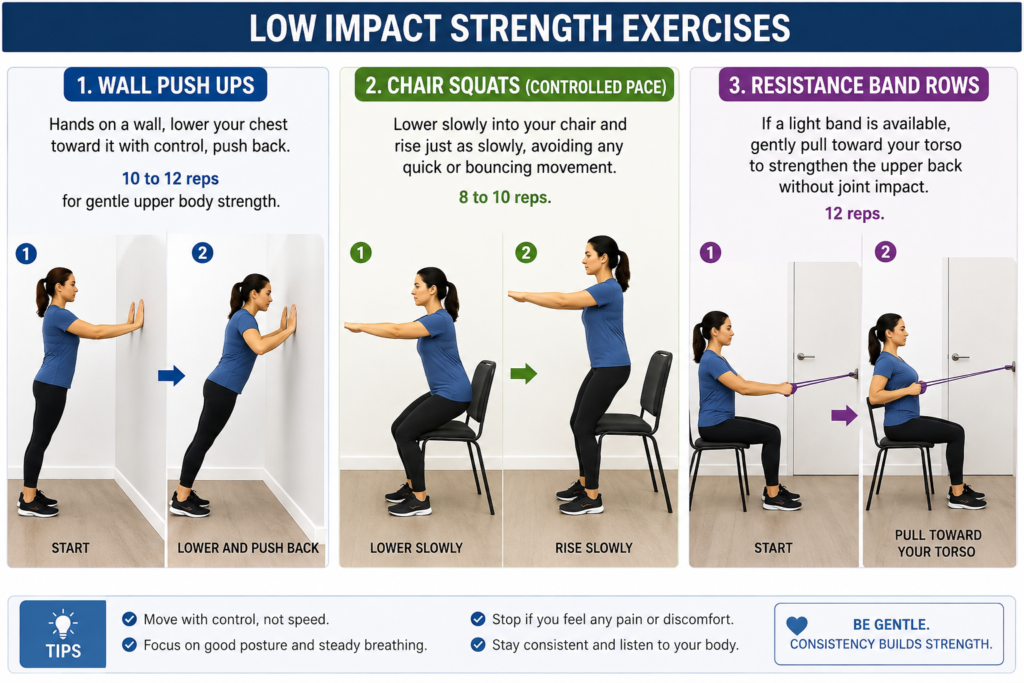
Low Impact Strength Exercises
Wall push ups
Hands on a wall, lower your chest toward it with control, push back. 10 to 12 reps for gentle upper body strength.
Chair squats (controlled pace)
Lower slowly into your chair and rise just as slowly, avoiding any quick or bouncing movement. 8 to 10 reps.
Resistance band rows
If a light band is available, gently pull toward your torso to strengthen the upper back without joint impact. 12 reps.
Low Impact Stretching for Flexibility
Neck and shoulder stretch
Tilt your head toward one shoulder, hold gently for 15 to 20 seconds each side.
Hip and lower back stretch
Cross one ankle over the opposite knee while seated, lean forward slightly, hold 20 seconds per side.
Wrist and forearm stretch
Extend one arm, gently pull fingers back with the other hand, hold 15 seconds each side.
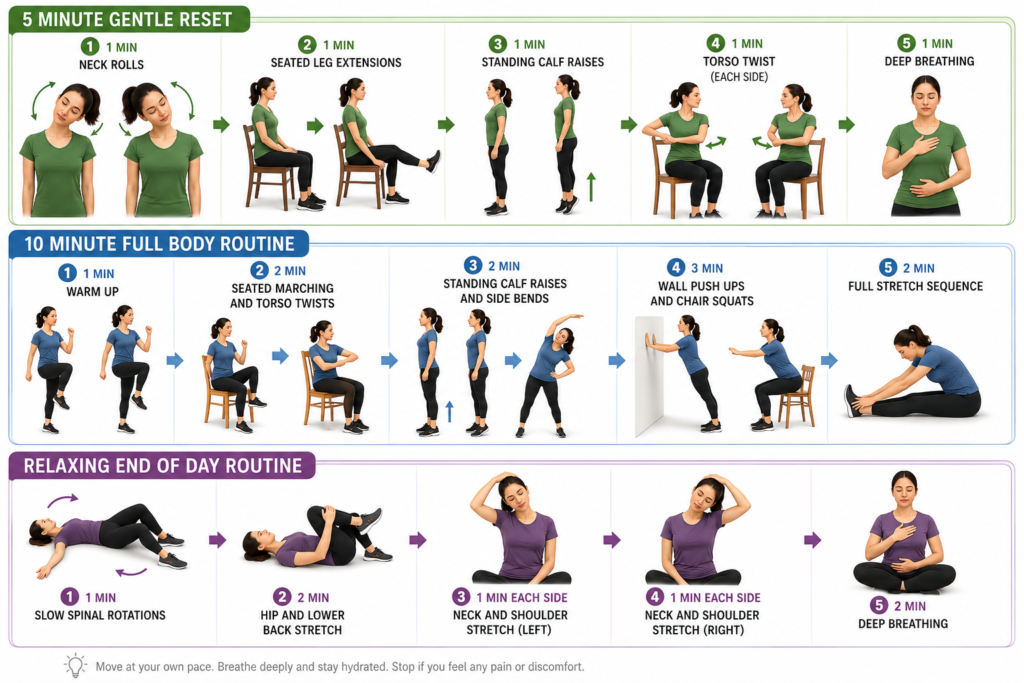
Quick Low Impact Routines
5 Minute Gentle Reset:
Neck rolls (1 min) → seated leg extensions (1 min) → standing calf raises (1 min) → torso twist (1 min each side) → deep breathing (1 min).
10 Minute Full Body Routine:
Warm up (1 min) → seated marching and torso twists (2 min) → standing calf raises and side bends (2 min) → wall push ups and chair squats (3 min) → full stretch sequence (2 min).
Relaxing End of Day Routine:
Slow spinal rotations (1 min) → hip and lower back stretch (2 min) → neck and shoulder stretch (1 min each side) → deep breathing (2 min).
Making Low Impact Movement a Daily Habit
Set reminders without overexertion.
A gentle alarm every 45 to 60 minutes is enough — low impact movement doesn’t need to feel like a workout to be effective.
Modify exercises for injuries or limitations.
Reduce range of motion or hold onto a stable surface as needed; low impact exercise is meant to adapt to you, not the other way around.
Stay consistent long term.
Since low impact exercise <cite index=”5-1″>feels comfortable and manageable, people are more likely to stick with it</cite> — and that consistency is what produces lasting results.
Frequently Asked Questions
1. What is a low impact office workout?
It’s a set of gentle exercises — seated, standing, or stretching — designed to improve strength, circulation, and flexibility without jarring or straining the joints.
2. Is low impact exercise as effective as high impact workouts?
Yes, in many ways. Research shows low impact activity delivers real cardiovascular, joint health, and strength benefits, and people are more likely to stay consistent with it long term.
3. Who should choose a low impact office workout?
Anyone managing joint pain, recovering from injury, new to exercise, or simply preferring gentler movement can benefit from low impact routines.
4. Can low impact exercise help with joint pain or arthritis?
Yes. Studies show low impact activities like walking, swimming, and cycling can significantly reduce joint pain, stiffness, and improve quality of life in people with osteoarthritis.
5. Do I need equipment for a low impact office workout?
No. Most exercises use only body weight and a chair, though a light resistance band can add variety for strengthening moves.
6. How often should I do low impact exercises at work?
A short 5 to 10 minute routine once or twice daily, combined with gentle movement breaks every 45 to 60 minutes, works well.
7. Can low impact exercise improve cardiovascular health?
Yes. Research shows any activity that raises your heart rate, including walking and low impact aerobics, meaningfully reduces cardiovascular disease risk.
8. Will low impact exercises help with lower back pain from sitting?
Yes. Gentle stretching and controlled movement can reduce stiffness and improve nutrient flow to the spine, easing lower back discomfort.
9. How is low impact exercise different from low intensity exercise?
Low impact refers to reduced stress on the joints, not necessarily lower effort, many low impact exercises can still be quite challenging and effective.
10. How do I stay consistent with a low impact routine?
Choose exercises that feel comfortable and sustainable, set gentle reminders, and build the routine gradually, consistency matters more than intensity for long term results.
Conclusion
A low impact office workout proves that you don’t need intensity to get real results. Backed by research on joint health, cardiovascular benefits, and mental well being, gentle seated and standing exercises can ease the strain of a sedentary lifestyle while protecting your joints rather than stressing them. Start with one short, gentle routine today, adjust it to fit your body’s needs, and build toward a consistent daily habit — because when movement feels manageable, it’s far easier to keep doing it.