
Introduction:
A 10 minute home workout can build strength, lift your energy and improve your stamina, as long as you push hard for the full ten minutes and repeat it most days. It will not replace a long gym session. It does beat doing nothing by a wide margin.
The best short routines use big, simple movements, a quick warm up and very little rest. Below you will find a beginner circuit, a cardio blast and a bodyweight strength session, plus a weekly plan that ties them together.
Key Takeaways
- Ten focused minutes, repeated most days, builds a real fitness habit.
- A good session has a two minute warm up and eight minutes of work, split into 40 second efforts and 20 second rests.
- Squats, push-ups, bridges and planks cover your whole body with no equipment.
- Weight loss depends on your overall week, so pair short workouts with daily walking and sensible eating.
- Every move has an easier version, so beginners and people with sore knees can start safely.
Why a 10 Minute Home Workout Is Worth Your Time
Most people do not skip exercise because they hate it. They skip it because the plan feels too big for a Tuesday evening. Ten minutes removes that excuse.
How short workouts fit into a busy American lifestyle
Commutes, long workdays, kids’ schedules and late dinners squeeze the day. A gym trip adds driving, changing and waiting for equipment. A short daily workout at home skips all of it.
You can finish a session before your coffee is done brewing, between video calls or while dinner is in the oven. Maira Sheikh, a health writer on Medium, built this plan to be followed, not admired.
What you can realistically achieve in 10 minutes
Ten minutes will not transform your body in a week. It can raise your heart rate, wake up your muscles and make exercise a daily default. Do it seven days a week and you collect 70 minutes of movement without ever blocking out a big chunk of time.
Here is what consistent short sessions can realistically do:
- Improve basic strength in your legs, chest and core.
- Raise your energy and sharpen your focus for the next few hours.
- Make longer workouts feel easier if you add them later.
What You Need Before You Start
Preparation takes about a minute. Skip it and you will find reasons to delay.
Space and equipment checklist
A quick home workout with no equipment needs only a patch of floor about the size of a yoga mat. Check this list first:
- A clear floor space with room to step back and sideways.
- Supportive sneakers if you will jump, or bare feet on a non-slip mat for floor work.
- A sturdy chair or countertop for incline push-ups and supported squats.
- A timer on your phone or an interval app.
- A water bottle within reach.
How to warm up safely in under two minutes
A warm up raises your body temperature and loosens your joints so the harder work feels smoother. Muscles that are warm contract and stretch more easily than cold ones, which is why even a short ramp-up matters when the main session is only eight minutes. Do each move for 30 seconds:
- March in place, lifting your knees to hip height.
- Make big arm circles, forward for 15 seconds and backward for 15.
- Circle your hips as if you were stirring a large pot.
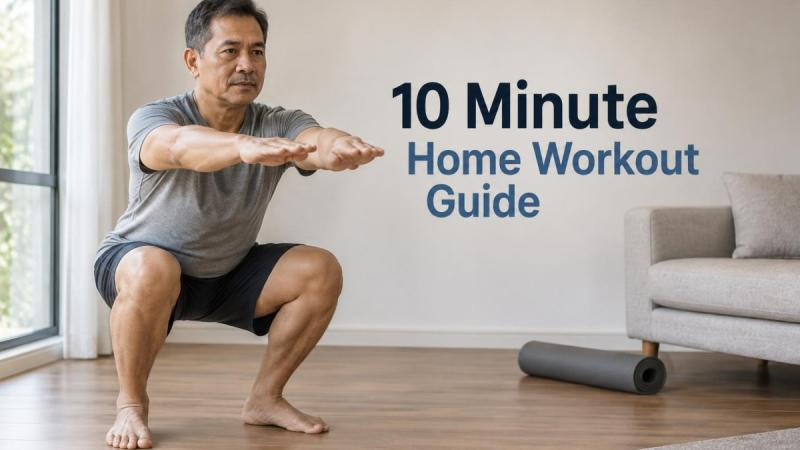
- Do slow, shallow bodyweight squats.
The Best 10 Minute Full Body Workout for Beginners
This 10 min full body workout is a solid 10 minute workout for beginners. Complete the warm up above, then work through eight exercises. Each runs 40 seconds on and 20 seconds off, so every exercise takes exactly one minute and the block adds up to eight minutes.
That 2 to 1 work-to-rest ratio is a standard interval format. Forty seconds is long enough to do a move with good form and short enough to keep effort high. Twenty seconds lets your breathing settle without letting your heart rate drop all the way.
Exercise list with reps and timing
Go at a pace where your form stays clean. Count reps if you like, but the clock is the real boss here.
- Chair squats: Sit back until you touch the chair, then stand. Aim for 10 to 15 reps.
- Incline push ups: Hands on a counter or sturdy table. Aim for 8 to 12 reps.
- Glute bridges: Lie on your back, feet flat, and lift your hips. Aim for 12 to 15 reps.
- Standing knee drives: Drive one knee up, then the other, at a steady beat.
- Bird dogs: On hands and knees, extend the opposite arm and leg. Alternate sides.
- Reverse lunges: Step back, lower, return. Hold a wall if your balance wobbles.
- Forearm plank on knees: Hold a straight line from head to knees.
- Step jacks: Step one foot out at a time while raising your arms overhead.
The order is deliberate. Big lower body and pushing moves come first while you are fresh, core and balance work sits in the middle, and the easy-to-scale step jacks finish the circuit when you are tired.
How to modify moves if you are new to working out
Beginners should shrink the move, not skip it. Shorten the range of motion, slow down or raise your hands higher on the incline. Take an extra 10 seconds of rest if your breathing gets ragged.
Next week, add a few reps or one extra second of effort. Small increases stack up quickly.
10 Minute Cardio Workout to Burn Calories at Home
Cardio means exercise that keeps your heart and lungs working hard for a sustained stretch. In a short window, intervals are your best tool. Interval training alternates hard effort with brief recovery, so you can work harder than you could nonstop.
High intensity intervals you can do in your living room
After the two minute warm up, pick four moves. Do each for 40 seconds, rest 20 seconds, and run the full list twice. Four moves at one minute each, repeated twice, gives you exactly eight minutes of work.
- High knees: Run in place and drive your knees up.
- Squat jumps: Drop into a squat and jump. Swap for fast bodyweight squats if you want low impact.
- Mountain climbers: From a plank, drive your knees toward your chest.
- Skater hops: Leap side to side, landing softly on one foot.
This works as a fast home exercise routine on days when you feel flat. It is also the most useful 10 minute workout to lose weight, because it burns more energy per minute than gentle movement.
How to track effort without a heart rate monitor
You do not need a chest strap or a smartwatch. Use the talk test and a simple effort scale.
- Talk test: During hard intervals, you should manage only short phrases. If you can sing, speed up.
- Rate of perceived exertion (RPE): This is a 1 to 10 scale of how hard the work feels. Aim for 7 to 8 during work periods and 3 to 4 during rest.
10 Minute Strength Workout Using Only Your Body Weight
Bodyweight strength training uses your own mass as resistance. Push-ups, squats and planks load your muscles well enough to build strength, especially if you are new. Choose either block below, or alternate them across the week.
Upper body moves
Do two rounds of these four moves after your warm up. Work 40 seconds, rest 20, and cycle through. That fills eight minutes.
- Push-ups: Full, incline or knee version, whichever lets you keep your body straight.
- Pike push-ups: Hips high in an inverted V, bending your elbows to lower your head toward the floor.
- Chair dips: Hands on the edge of a sturdy chair, lowering your hips toward the floor.
- Plank shoulder taps: Tap one shoulder, then the other, without rocking your hips.
Lower body and core moves
For legs and trunk, use the same 40 seconds on and 20 seconds off. Run all five moves once for five minutes, then repeat the first three to fill the remaining three.
- Bodyweight squats: Keep your chest tall and your weight in your heels.
- Reverse lunges: Alternate legs and keep your front knee tracking over your toes.
- Single-leg glute bridges: Drive through one heel while the other leg stays extended.
- Dead bugs: On your back, lower opposite arm and leg while your lower back stays pressed down.
- Full plank: Squeeze your glutes and breathe steadily.
How to Build a Weekly Schedule Around 10 Minute Workouts
A daily 10 minute exercise routine works best when the days vary. Hard sessions followed by easier ones give your muscles time to recover. The template below comes from a writer with two years of fitness content behind her, which shows in how plain it is:
| Day | Session |
|---|---|
| Monday | Full body circuit |
| Tuesday | Cardio intervals |
| Wednesday | Upper body strength |
| Thursday | Easy walk or stretching |
| Friday | Cardio intervals |
| Saturday | Lower body and core |
| Sunday | Rest |
Most beginners do well with three to five sessions a week. Add a daily 15 to 30 minute walk if your schedule allows. That walk matters more for weight management than most people expect.
Tips to Stay Consistent and See Real Results
Consistency beats intensity over any stretch longer than a month. Protect the habit first, then push the difficulty.
- Pick a fixed time. Tie the workout to something you already do, such as brushing your teeth or finishing your morning coffee.
- Lay out your gear the night before. Fewer decisions means fewer excuses.
- Track the streak. A paper calendar with an X for each completed day is surprisingly motivating.
- Progress gradually. Add reps, slow your tempo or shorten rest once a week.
- Eat with intent. Exercise helps, but food choices still drive most weight change.
- Forgive missed days. Restart the next morning, not next Monday.
Photos and measurements tell you more than the scale does. Check in every three to four weeks.
Frequently Asked Questions
1.Can a 10 minute home workout actually help me lose weight?
Yes, as part of a bigger picture. Ten minutes of hard intervals burns a modest amount of energy, but the real gain comes from doing it daily while staying active and eating sensibly. Think of it as a habit builder that supports weight loss, not a shortcut.
2.Is 10 minutes of exercise a day enough for a beginner?
For most beginners, it is a strong start. It builds the routine and improves basic fitness without overwhelming you. As the sessions feel easier, extend the work time or add a second short session.
3.What is the best 10 minute home workout with no equipment?
A full body circuit of squats, incline push-ups, glute bridges, lunges and planks is hard to beat. It hits every major muscle group and takes no gear. Run each move for 40 seconds with 20 seconds of rest after a two minute warm up.
4.How many days a week should I do a 10 minute workout?
Three to five days works well for most people, and some enjoy doing it daily with varied intensity. Alternate hard sessions with easier ones, and take at least one full rest day if you feel sore or tired. Listen to your body.
5.Can I do a 10 minute home workout if I have bad knees?
Often yes, with changes. Use chair squats, glute bridges, bird dogs and upper body moves, and skip jumping and deep lunges. If you feel sharp pain, stop and check with your doctor or a physical therapist.
6. Is a 10 Minute Workout Really Worth It, or Is It Too Short?
It is worth it. A 2016 study by Gillen and colleagues in PLoS ONE found that a 10-minute interval session, with just 60 seconds of hard effort, improved cardiorespiratory fitness and insulin sensitivity over 12 weeks to a similar degree as about 45 minutes of moderate cycling. Those were cycling intervals, not bodyweight moves, but they suggest brief, focused workouts can deliver real benefits. Consistency matters more than length.
7. Should I Do a 10 Minute Workout in the Morning or at Night?
Do it whenever you can stick with it. Mornings are popular because the day has not yet filled up, and a quick session can wake you up. Evenings work well if you have more energy then. If a late hard workout keeps you awake, move it earlier or choose a gentler, low-impact version before bed.
8. Do I Need to Warm Up Before a 10 Minute Workout?
Yes, but keep it short. Two minutes of marching in place, arm circles, hip circles, and a few slow squats raise your heart rate and loosen your joints. This lowers injury risk and helps you work harder during the circuit. If you are very short on time, shorten the circuit rather than skipping the warm-up.
9. How Can I Make a 10 Minute Workout Harder Over Time?
Change one thing at a time. You can extend work periods from 30 to 40 or 45 seconds, shorten rests, slow each rep to a three-second lowering phase, or add a backpack with books for squats and lunges. You can also move from incline to full push-ups. Adding a second short session on some days is another easy step up.
10. Is a 10 Minute Workout Enough to Meet Exercise Guidelines?
On its own, not quite, but it is a solid building block. The World Health Organization’s 2020 guidelines recommend 150 to 300 minutes of moderate activity per week, plus muscle-strengthening on two or more days. Ten minutes five days a week gives you 50 minutes, so add brisk walks, cycling, or active hobbies to close the gap. A 2022 Nature Medicine study by Stamatakis and colleagues also linked short bursts of vigorous activity with lower mortality risk, though that research was observational.
Conclusion
A 10 minute home workout proves that you do not need an hour, a gym, or any equipment to start getting fitter. A simple circuit of squats, incline push-ups, glute bridges, lunges, and planks trains your whole body, and doing it three to five days a week builds a habit that is easy to keep. Research on short interval training suggests that brief, focused efforts can improve fitness, though results vary from person to person.
Keep the workout sustainable. Warm up for two minutes, move with good form, and make it harder gradually by extending work time, slowing your reps, or adding a second session. If your goal is weight loss, pair your workouts with daily walking, balanced meals, and enough sleep, because a short workout works best as part of a bigger routine.
Pick a time, set a timer, and finish your first 10 minutes today. Small sessions repeated consistently add up to real change over weeks and months.