Introduction
This guide gives you a complete full body workout for beginners at home. It includes five foundational exercises, a 20-minute circuit, posture cues, and a weekly schedule you can follow without any gym membership or equipment. Research on resistance training consistently shows that full body workouts are one of the easiest and most sustainable methods for beginners to build strength. This is especially true when you compare them to complex multi-day splits.
This guide shows you why full body training works so well for beginners. You will also find a complete workout with posture tips for each exercise, a weekly schedule, and common mistakes to avoid. Start building real strength today, right from home.
Benefits of a Full Body Workout for Beginners at Home
Builds Strength Across All Major Muscle Groups
A single full body session hits your legs, chest, back, shoulders, arms, and core. This gives beginners a balanced foundation instead of overdeveloping one area while neglecting another.
Saves Time Compared to Split Routines
Rather than dedicating separate days to different body parts, full body training lets you get a complete workout in fewer overall sessions per week. That makes it ideal for anyone balancing exercise with a busy schedule.
Improves Fat Loss and Metabolism
Working multiple large muscle groups in one session burns more calories per workout. It also keeps your metabolism elevated afterward, compared to isolated, single-muscle training.
Reduces Injury Risk with Balanced Training
Full body routines naturally build in rest between sessions. Because no single muscle group is overloaded repeatedly without adequate recovery, your overuse injury risk stays low. This is especially important for beginners who are still learning proper form.
The Science Behind Full Body Training for Beginners
The research strongly supports full body training as the ideal starting point for beginners.
Strength research shows that full body training three times a week is usually the easiest path to consistent progress for beginners and intermediate trainees. It naturally spreads training volume across the week rather than concentrating it into long sessions that are harder to recover from. On frequency specifically, meta-analyses by Schoenfeld and Ralston et al. both found a modest but real strength benefit to training a muscle two or more times per week compared with once. Twice per week emerged as a practical minimum for steady progress.
A controlled study that followed untrained subjects for 11 weeks found that training three sessions per week leads to significant improvements in muscle thickness and strength. This confirms that beginners respond well to consistent, moderate frequency. Research also notes that beginners typically notice strength improvements within two to four weeks on a three to four day full body training program.
Recovery matters just as much as training itself. A large 2026 guide on beginner training frequency recommends leaving two repetitions in reserve on every set. This approach reduces soreness and dropout risk in the first 30 days. It is a useful reminder that beginners often do better starting slightly conservative rather than pushing to failure right away.
What You Need Before You Start
No equipment option:
Every exercise in this guide can be done with just your body weight.
Minimal equipment option:
A yoga mat and a pair of light dumbbells can add variety once you are comfortable with the basics.
Space:
A clear area roughly 6×6 feet is enough for this entire routine.
What to wear:
Comfortable, breathable clothing and supportive shoes or a non-slip surface for barefoot training.
Warming Up Before Your Workout
Dynamic stretches
Arm circles, leg swings, and torso twists for 1 to 2 minutes to activate muscles before loading them.
Light cardio
March in place or do slow high knees for 1 to 2 minutes to raise your heart rate gradually.
Mobility drills
Bodyweight squats and hip circles, 8 to 10 reps, to prepare your joints for the exercises ahead.
The Full Body Workout Routine for Beginners at Home
Upper Body Exercises
Push Ups
Posture cue: Keep your body in a straight line from head to heels, with hands slightly wider than shoulder width and your core braced throughout the movement. If a full push up is too challenging, drop to your knees while maintaining the same straight torso position.
Reps: 8 to 12
Shoulder Taps
Posture cue: Start in a plank position with feet slightly wider than hip width for stability. Tap your opposite shoulder with each hand while keeping your hips as still as possible, avoiding any side-to-side rocking.
Reps: 10 per side
Lower Body Exercises
Bodyweight Squats
Posture cue: Stand with feet shoulder width apart, chest lifted, and weight in your heels as you lower down as if sitting into a chair. Keep your knees tracking over your toes, not caving inward.
Reps: 12 to 15
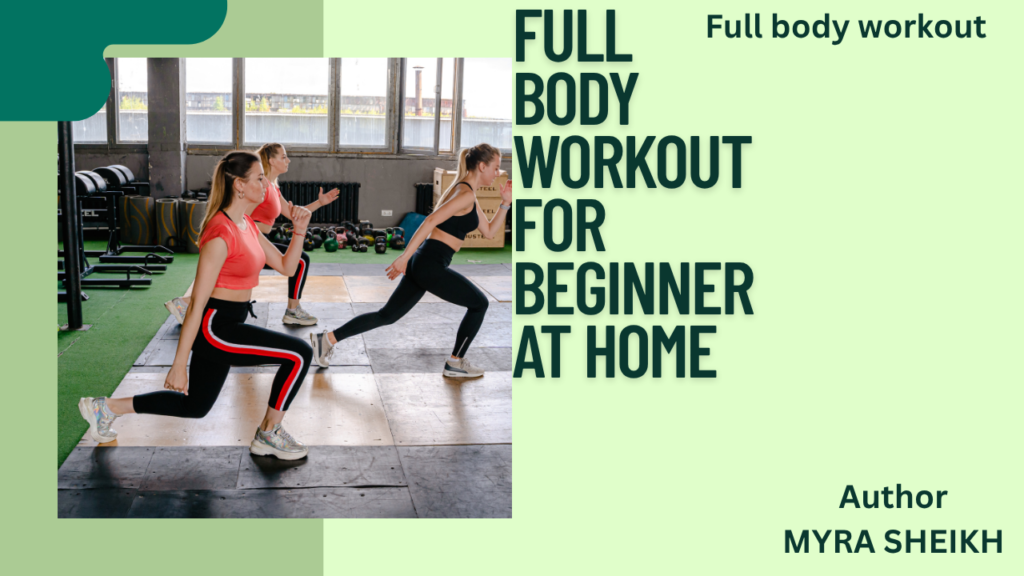
Walking or Stationary Lunges
Posture cue: Step forward into a lunge with your front knee stacked over your ankle and your back knee hovering just above the floor. Keep your torso upright throughout the movement.
Reps: 10 per leg
Core Exercises
Plank
Posture cue: Place your forearms on the ground with elbows under shoulders and your body in a straight line from head to heels. Avoid letting your hips sag or pike upward.
Hold: 20 to 30 seconds
Dead Bugs
Posture cue: Lie on your back with arms extended toward the ceiling and knees bent at 90 degrees. Slowly extend the opposite arm and leg while keeping your lower back pressed into the floor.
Reps: 10 per side
Cardio Bursts
Jumping Jacks
Posture cue: Land softly with slightly bent knees to protect your joints, keeping your core engaged throughout.
Reps: 30 seconds
High Knees
Posture cue: Drive your knees toward hip height while keeping your torso tall and core braced, landing lightly on the balls of your feet.
Reps: 30 seconds
Simple Beginner Workout Plan
20 Minute Full Body Circuit
Perform each exercise for the listed reps, resting 30 to 45 seconds between exercises, and repeat the full circuit 2 to 3 times:
Bodyweight squats, 12 reps
Push ups, 8 to 10 reps
Walking lunges, 10 reps per leg
Shoulder taps, 10 reps per side
Plank, 20 to 30 seconds
Jumping jacks, 30 seconds
Dead bugs, 10 reps per side
High knees, 30 seconds
Sets, Reps, and Rest Times Explained
Beginners generally do well with 2 to 3 sets per exercise and 30 to 60 seconds of rest between sets. That is enough to recover without losing the workout’s momentum. As strength improves, rest periods can shorten slightly to increase intensity.
How to Progress as You Get Stronger
Once the routine feels manageable, progress by adding a third circuit round or increasing your reps. You can also slow down the tempo of each movement or introduce light dumbbells. Avoid jumping straight to advanced exercises before you are ready.
Cool Down and Stretching After the Workout
Static stretches:
Hold a hamstring stretch, quad stretch, chest stretch, and shoulder stretch for 20 to 30 seconds each to aid recovery and flexibility.
Breathing exercises:
Slow, deep breaths for 1 to 2 minutes help lower your heart rate and shift your body out of workout mode.
Weekly Workout Schedule for Beginners
How Many Days a Week to Train
Three sessions per week is widely considered the sweet spot for beginners. It is frequent enough to build consistent strength, but it also leaves enough recovery time between sessions to avoid burnout.
Common Mistakes to Avoid
Doing Too Much Too Soon
Jumping into daily hard sessions is the fastest way to end up sore, tired, and discouraged. Start with two to three days a week and add volume slowly. Your muscles and joints adapt more slowly than your motivation.
Skipping the Warm Up
Cold muscles and stiff joints raise your injury risk. Five minutes of marching in place, arm circles, hip circles, and light squats prepares your body for the work ahead.
Letting Form Slip
Rushing through reps reduces results and puts stress on your joints. Move with control, keep your core braced, and stop the set when your form breaks down. Fewer clean reps beat many sloppy ones.
Never Making the Workout Harder
If every session feels easy, progress stalls. Add a few reps, an extra set, a slower lowering phase, or a harder variation, such as moving from incline to full push ups. Change only one thing at a time.
Skipping Rest Days
Muscles adapt during recovery, not during the workout. Leave at least one rest day between sessions and use off days for walking or light stretching.
Comparing Yourself to Others
Social media often shows edited or advanced routines. Compare yourself only to your own numbers from last week, such as reps completed or plank time.
Expecting Overnight Results
Early strength gains come mostly from your nervous system learning the movements, and visible changes usually take 8 to 12 weeks. Give your plan time before judging it.
Frequently Asked Questions
1. How Many Days a Week Should a Beginner Do a Full Body Workout at Home?
Two to three days a week, with at least one rest day between sessions, is the right range. This gives your muscles time to recover and adapt. Start with two if you feel unsure, then add a third once the routine feels easy.
2. Do I Need Any Equipment for a Full Body Workout at Home?
No. Bodyweight moves like squats, glute bridges, planks, and incline push-ups train your whole body. A mat and a sturdy chair add comfort and variety, but they are optional.
3. How Long Should a Beginner Home Workout Last?
Aim for 20 to 30 minutes, including a five minute warm up and a short cool down. That is enough to train every major muscle group without leaving you wiped out. Extend sessions gradually as your fitness improves.
4. What Are the Best Exercises for a Beginner Full Body Workout at Home?
Focus on simple movement patterns: bodyweight squats for the legs, wall or incline push ups for the chest and arms, glute bridges for the hips, bird dogs or dead bugs for the core, and a plank hold. Reverse lunges and backpack rows are good additions once the basics feel comfortable.
5. How Many Sets and Reps Should a Beginner Do?
Start with two sets of 8 to 12 repetitions per exercise, resting 60 to 90 seconds between sets. The American College of Sports Medicine’s 2009 position stand suggests novices begin with one to three sets of 8 to 12 reps. Add a third set after a few weeks.
6. Can I Lose Weight with a Beginner Home Workout?
It can help by burning energy, building muscle, and making you more active. Weight loss itself depends mainly on your overall eating habits, so pair your workouts with regular walking and balanced meals. Aim for gradual progress rather than quick changes.
7. Why Am I So Sore After My First Few Workouts?
That ache is called delayed onset muscle soreness. It usually peaks 24 to 48 hours after exercise and fades as your body adapts. Gentle walking, light stretching, water, protein, and good sleep help. Stop and check with a doctor if you feel sharp or joint pain.
8. How Long Does It Take to See Results?
Most beginners notice better energy and strength within two to four weeks. Visible changes usually take 8 to 12 weeks of consistent training, good sleep, and balanced eating. Track reps and hold times, since these often improve before the mirror changes.
9. How Do I Make My Home Workouts Harder?
Change one variable at a time. Add reps, add a set, slow each rep to a three second lowering phase, or shorten your rests. You can also hold a backpack with books during squats and lunges, or move to harder variations like full push ups.
10. How Do I Stay Motivated to Work Out at Home?
Schedule sessions like appointments and attach them to an existing habit, such as exercising right after your morning coffee. A 2002 study by Milne, Orbell, and Sheeran found that people who made a specific plan followed through far more often than those who only intended to (91 percent versus about 38 percent). Keep a simple log, and remember that a short session still counts on low-energy days.
Conclusion
A full body workout for beginners at home needs no gym, no equipment, and no perfect plan. Train two to three times a week, focus on good form, and make the routine harder in small, steady steps. Rest well, avoid the common mistakes above, and give yourself 8 to 12 weeks to see real change.
1 thought on “Full Body Workout for Beginners at Home: 5 Exercises for Healthy Life”