
Introduction:
A bodyweight workout plan is a schedule of exercises such as push-ups, squats and planks that uses your own weight as resistance. You can follow one at home with no equipment, three days a week, and see real strength gains within a month.
This guide gives you exactly that: a four week routine, the moves behind it, and the rules for making it harder over time. Each session fits in about 30 minutes.
No gym, no dumbbells, no excuses about space. A patch of floor and a sturdy chair will do.
Key Takeaways
- A full body workout at home, done three days a week, is enough to build strength as a beginner.
- Progress comes from making exercises harder (slower tempo, tougher variations, more reps), not from adding plates.
- Weeks 1 and 2 build form and a base. Weeks 3 and 4 add sets, pauses and harder variations.
- Fat loss still depends on your eating and daily movement. Training supports it.
- Write every session down. A log is the simplest way to know you are improving.
Why a Bodyweight Workout Plan Works at Home
Bodyweight training works because muscles respond to effort, not to the label on the equipment. If a set of squats or push-ups brings you close to your limit, your body gets the signal to adapt. Your living room can deliver that signal.
It also removes friction. No commute, no membership, no waiting for a rack. That matters more than any clever program design.
What You Can and Cannot Build Without Equipment
Bodyweight exercises build strength, muscular endurance, balance and body control very well, especially in the first months of training. They also grow muscle, provided the work stays challenging.
The limits show up later. Pulling movements are harder to load without a bar or bands, and very strong legs eventually outgrow squats and lunges. Advanced lifters chasing maximum size usually need added resistance.
Who This Plan Is Best For
This plan suits beginners, returning exercisers and anyone who wants a full body workout at home without buying gear. Fitness with Ms has been publishing for nine months, and this routine follows the same simple, start-from-zero approach.
Skip it for now if you have a recent injury or a medical condition that affects exercise. Check with a doctor first.
The Core Bodyweight Exercises You Need to Know
Good bodyweight exercises for beginners fall into four movement patterns: push, pull or hinge, squat or lunge, and core. Cover all four each week and you cover the whole body.
Push Exercises: Push-Ups and Their Variations
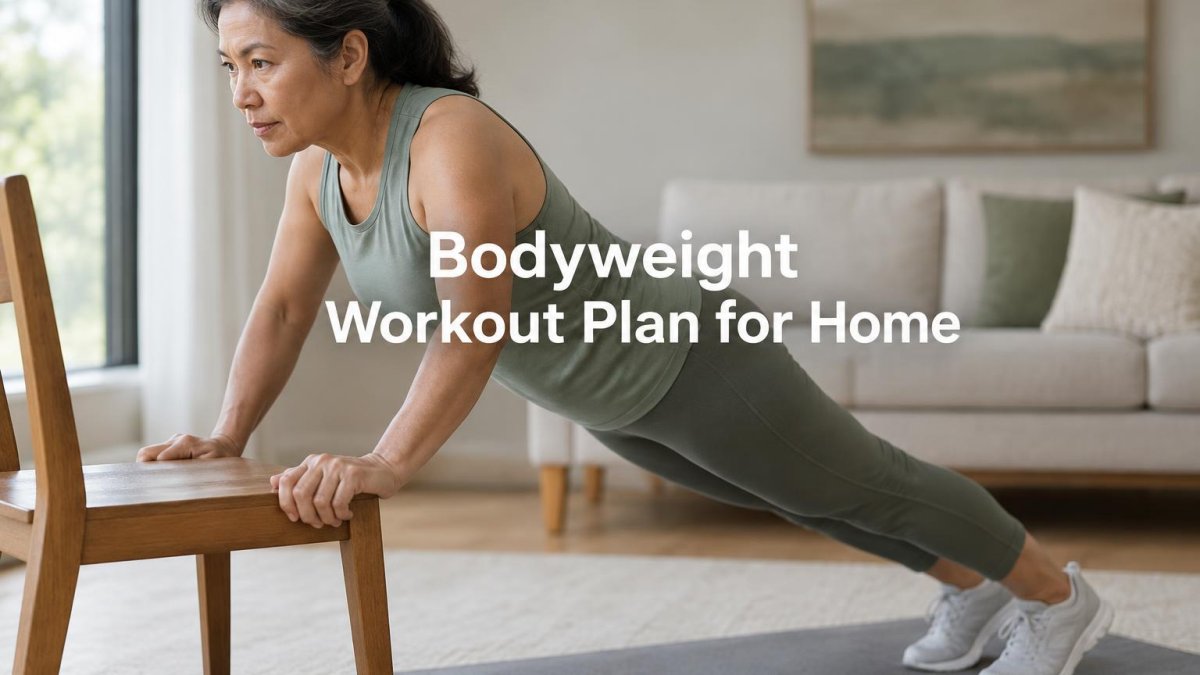
The push-up trains your chest, shoulders and triceps while your core holds you rigid. Keep your body in one straight line from head to heels.
- Incline push-up: hands on a counter or sturdy table. The easiest version.
- Knee push-up: knees on the floor, straight line from knees to head.
- Standard push up: hands under shoulders, chest nearly touching the floor.
- Diamond or decline push up: harder options for later weeks.
Pull and Hinge Movements Without a Bar
Pulling is the tricky part at home. A hinge means bending at the hips while your back stays flat, the pattern behind picking something off the floor.
- Table row: lie under a very sturdy table, grab the edge, and pull your chest up. Test the table’s strength first.
- Superman hold: lie face down and lift arms and legs a few inches.
- Glute bridge: lie on your back, feet flat, and drive your hips up.
- Single-leg hip hinge: a balance-heavy move that hits the hamstrings.
Squats, Lunges and Single Leg Work
Squats train the quads and glutes together. Lunges and split squats add balance and make each leg work alone, which makes them harder than they look.
Start with the basic squat, then move to the reverse lunge. Later, try the rear foot elevated split squat with your back foot on a chair. Single leg work is the main way to keep legs challenged without weights.
Core Exercises That Protect Your Back
A strong core resists movement. That is its main job. Planks, dead bugs and side planks teach your trunk to stay steady while your limbs move.
Avoid endless sit-ups. They are fine, but they do less for your lower back than the anti-movement drills above.
How to Structure Your Weekly Home Workout Schedule
A good schedule is one you can repeat. Pick a frequency, set a rep range, and leave enough rest so each session stays sharp.
Choosing Between 3, 4 and 5 Training Days
A bodyweight workout routine 3 days a week is the best starting point. Monday, Wednesday and Friday works well because each muscle gets a rest day between sessions.
- 3 days: full body each time. Ideal for beginners.
- 4 days: an upper and lower split. Good once you recover easily.
- 5 days: only if sessions are short or you mix in walking and mobility.
More days do not automatically mean better results. Recovery is where the adaptation happens.
Sets, Reps and Rest Periods That Make Sense
A rep is one full repetition of an exercise. A set is a group of reps done without stopping. Beginners do well with 2 to 3 sets of 8 to 15 reps, stopping with a couple of reps still in the tank.
Rest 45 to 90 seconds between sets. Use the longer end for hard moves like push-ups and split squats. If the plan feels easy, you probably need a slower tempo or a harder variation, not more time.
The 4 Week Bodyweight Routine
Do these workouts three days a week. Each one is a 30 minute bodyweight workout: 5 minutes of warm-up, about 20 minutes of work, and a short cool-down. Move through the exercises in order, finishing all sets of one move before starting the next.
Week 1 and 2: Building Your Foundation
Use 3 sets per exercise and rest 60 to 90 seconds.
- Bodyweight squat: 3 sets of 10 to 12
- Incline or knee push-up: 3 sets of 6 to 10
- Glute bridge: 3 sets of 12
- Table row (or superman hold): 3 sets of 8 to 10
- Reverse lunge: 3 sets of 8 per leg
- Plank: 3 holds of 20 to 30 seconds
Focus on clean form. Add one rep to each set in week 2 if the first week felt manageable.
Week 3 and 4: Adding Volume and Intensity
Move to 4 sets on the first three exercises and 3 on the rest. Rest 45 to 75 seconds.
- Tempo squat: 4 sets of 10 (3 seconds down)
- Standard push-up (or the hardest version you can control): 4 sets of 6 to 12
- Single-leg glute bridge: 4 sets of 8 per leg
- Table row with a pause at the top: 3 sets of 8 to 12
- Split squat: 3 sets of 8 per leg
- Plank plus dead bug: 3 rounds of 30 to 45 seconds plus 8 reps per side
This block also works as a bodyweight workout to lose weight, since the shorter rests keep your heart rate up.
How to Progress Without Adding Weights
Progressive overload means gradually asking your muscles to do more over time. With bodyweight training, you change the exercise rather than the load. This is also the answer to how to build muscle with bodyweight exercises: keep every set hard and keep making it harder.
Tempo, Pauses and Harder Variations
Tempo is the speed of each rep. Lower for three seconds, pause for one at the bottom, then stand up fast. The same squat suddenly feels very different.
Try these levers in order:
- Add reps until you hit the top of the range.
- Slow the lowering phase.
- Add a pause at the hardest point.
- Move to a harder variation, such as incline to standard push-ups.
- Shift to one-leg versions.
Tracking Your Workouts So You Keep Improving
Memory is unreliable. Write down the exercise, sets, reps and how hard it felt. I run this fitness site and write health articles on Medium.com, so I keep logs simple: a notes app and one line per exercise is enough.
Next session, beat one number. One more rep, one more second, or a slower lowering phase counts.
Warm-Up, Cool-Down and Recovery Basics
Training is only half the job. Warming up prepares your joints, and recovery turns the work into strength.
A 5 Minute Warm-Up Routine
Spend about 30 to 45 seconds on each move, no rest between them.
- March in place or jog lightly
- Arm circles
- Hip circles
- Bodyweight squats at an easy pace
- Cat-cow stretch on hands and knees
- Inchworm walkouts
Stretching, Sleep and Rest Days
A few gentle stretches for your hips, chest and hamstrings after training feel good and cost little time. Hold each one for 20 to 30 seconds without forcing it.
Sleep matters more than any stretch. Aim for a regular bedtime and enough hours that you wake up rested. On rest days, walk, do light mobility work, or do nothing at all.
Common Mistakes to Avoid and How to Stay Consistent
Most plateaus come from small errors, not big ones. Fix those, and the plan does the rest.
Form Errors That Slow Your Progress
- Sagging hips in push-ups: squeeze your glutes and brace your abs.
- Knees caving in squats: push them out in line with your toes.
- Rushing reps: speed hides weakness and cuts the work your muscles do.
- Arching the lower back in planks: tuck your ribs down.
- Skipping hard moves: pick an easier variation instead.
Building a Habit You Can Stick With
Schedule workouts like appointments. Pick the same three days and the same time, lay out your clothes, and keep the first session short if motivation is low.
Missed a day? Do not double up. Just do the next scheduled workout. Four honest weeks beat one heroic week.
Frequently Asked Questions
1.Can you really build muscle with a bodyweight workout plan?
Yes, especially as a beginner. Muscles grow when sets are challenging and become harder over time, whether the resistance is a barbell or your own body. Use slower tempos, pauses and one-leg variations to keep the work demanding.
2.How many days a week should I do bodyweight workouts at home?
Three days a week is the best starting point for most people. It gives you a rest day between full body sessions. Move to four days only if you recover well and your sessions feel easy.
3.Is a bodyweight workout enough to lose weight?
Training helps, but fat loss mainly depends on eating slightly fewer calories than you burn. Bodyweight workouts keep muscle, raise your activity and support that process. Add daily walking and steady eating habits for better results.
4.How long should a home bodyweight workout last?
About 30 minutes is plenty, including a 5 minute warm-up. Short sessions you repeat each week beat long ones you skip. Quality reps matter more than total time.
5.What should I do if regular push-ups are too hard for me?
Start with incline push-ups, hands on a counter or sturdy table. Lower the surface over the weeks until you can do the floor version. Knee push-ups and slow lowering reps are also solid options.