Introduction| Why stretching after a workout is matters| The role of cool down in muscle recovery| Research on stretching and muscle soreness| What you need before you start| Key principles for effective post workout stretching| Full body stretching routine breakdown| Simple full body stretching routine| Modification for tight and beginner bodies| How stretching fits into overall recovery| How often you should stretch for long flexibility| Nutrition tips to support HIIT training| Common mistakes to avoid| FAQS| Conclusion|
Introduction:
For years I stretched after every workout satisfied it’d stop me from subsequent day soreness, and truly, I changed into incorrect approximately why it mattered. A right full body stretching routine after workout without a doubt has real blessings, just now not always the ones we have been instructed. This guide breaks down the real studies behind published workout stretches, explains what an actual cool down stretching routine has to pay attention to, and covers proof based total stretches for muscle recuperation. You’ll also learn in which static stretching after workout helps and wherein it would not, plus a whole full body flexibility recurring you can begin using today.
Why Stretching After a Workout Matters (And Where It Doesn’t)
Here’s something that surprised me when I really looked into the research: stretching after a workout likely might not forestall you from being sore the next day. But that doesn’t imply it’s needless, it just means we’ve been specializing in the incorrect advantage.
The Role of Cool Down in Muscle Recovery
A cool down section, together with stretching, is suggested by means of each the American College of Sports Medicine and the American Heart Association as a part of an entire exercise shape, in most cases to regularly lessen coronary heart charge and assist long-time period variety of motion as opposed to to eliminate discomfort.
Static Stretching vs. Dynamic Stretching Explained
Dynamic stretching energetic, moving stretches, is high quality used earlier than exercising to prepare muscle tissues for activity. Static stretching, wherein you maintain a position without movement, is generally higher appropriate to after exercising, while your muscular tissues are warm and your goal shifts from activation to lengthening and relaxation.
Research on Stretching and Reduced Muscle Soreness
This is wherein I must be sincere, as it goes in opposition to a variety of common fitness recommendations. A complete systematic evaluate and meta analysis posted in Frontiers in Physiology, analyzing randomized controlled trials on put up exercise stretching, found that it does now not reliably reduce not on time-onset muscle pain (DOMS) or meaningfully speed up strength or variety of movement recuperation compared to just resting. Multiple older studies reached the identical end a long time earlier, an extensively cited 1989 examine found that neither static stretching nor warm up avoided DOMS following exhaustive exercising, and an extra latest study even found that a static stretching institution recovered from DOMS extra slowly than a no stretching manipulate institution.
So why still stretch? Because the actual, well supported benefit isn’t the same as what most people anticipate: constant put up exercising stretching improves lengthy time period flexibility and joint range of movement, which topics for damage prevention and movement satisfactory over months and years, even if it would not repair tomorrow’s pain
Once I stopped stretching purely to “prevent soreness” and started doing it purely for flexibility, I actually became more consistent with it, the expectation finally matched reality.
What You Need Before You Start
When to Stretch (Timing After Exercise)
Stretch at once after your exercising, whilst your muscle groups are still warm, for the reason that stretching bloodless muscle groups will increase injury threat and reduce the effectiveness of the stretch itself.
Optional Equipment (Mat, Strap, Foam Roller)
None of this is required, however a mat adds consolation for floor stretches, and a strap or towel permits you to reach further into hamstring and shoulder stretches if flexibility is restricted.
How Long a Post Workout Stretch Should Last
An entire full frame habitual usually takes 8 to 10 minutes, which is enough time to cope with each important muscle institution without turning your cool down into some other lengthy consultation.
Key Principles for Effective Post Workout Stretching
How Long to Hold Each Stretch
Research commonly supports holding static stretches for 20 to 30 seconds in keeping with muscle organization, long enough to provide an actual lengthening impact without having excessive time funding.
Breathing Techniques to Deepen a Stretch
Slow, consistent respiration during a stretch facilitates your anxious gadget loosening up into the location, regularly permitting a barely deeper stretch than in case you’re keeping your breath or respiration shallowly.
Stretching Without Bouncing or Overextending
Ballistic, bouncing stretches growth injury hazard without added advantage. Ease into each stretch step by step and hold steady, stopping at mild tension rather than ache.
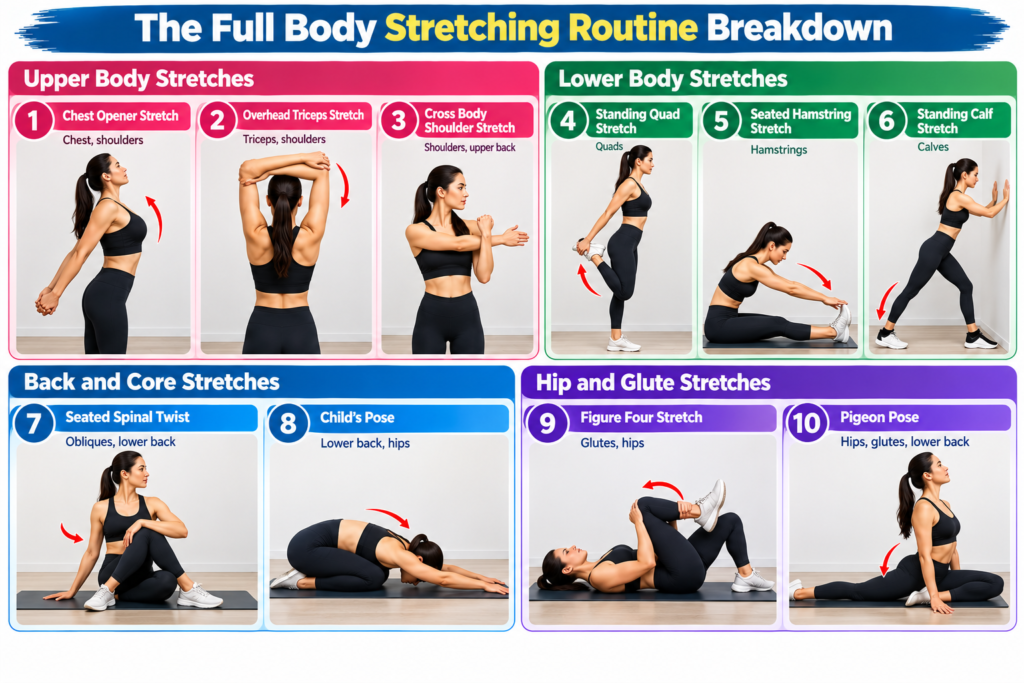
The Full Body Stretching Routine Breakdown
Upper Body Stretches
Chest Opener Stretch – Chest, shoulders. Clasp your hands in the back of your return, straighten your hands, and lightly carry your chest upward.
Overhead Triceps Stretch – Triceps, shoulders. Reach one arm overhead, bend the elbow, and use your different hand to gently press the elbow similarly returned.
Cross Body Shoulder Stretch – Shoulders, upper lower back. Bring one arm across your chest and use your different arm to softly pull it nearer.
Lower Body Stretches
Standing Quad Stretch – Quads. Standing on one leg, pull your other heel closer to your glutes, maintaining your knees near collectively.
Seated Hamstring Stretch – Hamstrings. Sit with one leg extended, gently hinge forward from your hips toward your toes.
Standing Calf Stretch – Calves. Step one foot back, press your heel into the floor, and lean forward slightly.
Back and Core Stretches
Seated Spinal Twist – Obliques, lower again. Sit tall, pass one leg over the opposite, and lightly twist your torso in the direction of the bent knee.
Child’s Pose – Lower returned, hips. Kneel and fold forward, reaching your hands out in front of you, letting your lower returned launch.
Hip and Glute Stretches
Figure Four Stretch – Glutes, hips. Lying on your back, go one ankle over the opposite knee and gently pull the uncrossed leg closer to your chest.
Pigeon Pose – Hips, glutes, lower lower back. From a lunge function, bring your front shin forward at an attitude and decrease your hips in the direction of the ground.
Simple Full Body Stretching Routine (Step with the aid of Step)
Hold every stretch for 20 to 30 seconds in line with an aspect wherein is relevant.
| Order | Stretch | Duration |
| 1 | Chest Opener Stretch | 30 sec |
| 2 | Overhead Triceps Stretch | 20 sec per side |
| 3 | Cross Body Shoulder Stretch | 20 sec per side |
| 4 | Standing Quad Stretch | 20 sec per side |
| 5 | Seated Hamstring Stretch | 20 sec per side |
| 6 | Standing Calf Stretch | 20 sec per side |
| 7 | Seated Spinal Twist | 20 sec per side |
| 8 | Figure Four Stretch | 20 sec per side |
| 9 | Pigeon Pose | 30 sec per side |
| 10 | Child’s Pose | 1 minute |
Total time: roughly 8 to 10 minutes.
Modifications for Tight or Beginner Bodies
Use a strap or towel around your foot during hamstring stretches if you can’t comfortably reach it
Skip Pigeon Pose initially and substitute a simpler seated figure four stretch until hip flexibility improves
Reduce preserve instances to 15 seconds initially, building in the direction of 20 to 30 seconds over a few weeks
How to Adjust the Routine by way of Workout Type
Leg Day:
Prioritize quad, hamstring, calf, and glute stretches; spend much less time on top frame
Upper Body Day:
Prioritize chest, shoulder, and triceps stretches; preserve decrease body stretches quick
Cardio Day:
Focus on calves, hip flexors, and a gentle full frame stretch to ease normal anxiety
How Stretching Fits Into Overall Recovery
Stretching vs. Foam Rolling vs. Massage
Research comparing recovery methods, including a 2025 randomized controlled trial published in Frontiers in Physiology, found that interventions like vibration therapy and functional electrical stimulation showed different specific benefits for markers like muscle contraction time and inflammation, suggesting no single recovery method, stretching included, is a complete solution on its own. A combination approach, using stretching for flexibility alongside other recovery tools as needed, tends to serve most people better than relying on any one method exclusively.
The Role of Hydration and Sleep in Recovery
Regardless of which recovery method you use, right hydration and adequate sleep stay the 2 elements with the most consistent research support for real muscle repair and healing.
How Often You Should Stretch for Long Term Flexibility
Since the actual gain of stretching lies in long time period flexibility rather than identical day soreness alleviation, consistency matters greater than any unmarried consultation, stretching after most exercises, numerous instances a week, produces meaningfully better flexibility results over months than sporadic, occasional stretching.
Nutrition Tips to Support HIIT Training
Fueling Before a Short, Intense Workout
A small carbohydrate primarily based snack 30 to 60 mins in advance than education can manual the explosive strength HIIT demands, with out weighing you down all through high intensity durations
Recovery Nutrition After HIIT
A post exercise meal with protein and carbohydrates helps muscle repair and replenishes the energy shops your frame used at some stage in the session.
Hydration Tips for High Intensity Training
Since HIIT elevates coronary heart charge and sweat output short, staying well-hydrated earlier than and after education allows each usual overall performance and recovery
Common Mistakes to Avoid
- Stretching cold muscle tissues without warming up first, This applies especially to pre exercising stretching, but even submitting exercising, avoid excessive intensity if your muscle groups have cooled extensively before you begin.
- Holding stretches too short to look beneficial, rushing through 5 second holds gives little significant improvement in flexibility through the years.
- Skipping stretching absolutely after severe exercising, Even despite the fact that stretching might not cast off pain, skipping it constantly sacrifices the lengthy time period flexibility and mobility benefits it does offer.
Frequently Asked Questions
1. Does stretching after a workout reduce soreness?
Research typically suggests static stretching does not meaningfully reduce time onset muscle pain (DOMS), notwithstanding this being a commonplace assumption. Its actual gain lies in improving flexibility and style of motion over the years.
2. How lengthy do a positioned up exercising stretch ordinary take?
An entire complete body stretching recurring commonly takes 8 to 10 minutes, masking all predominant muscle companies with 20 to 30 2nd holds according to stretch.
3. Is it terrible to bypass stretching after exercising?
Occasionally skipping it won’t cause damage, however continuously skipping stretching is missing out on its set up lengthy term flexibility and mobility blessings.
4. Should I stretch earlier than or after exercising?
Dynamic stretching is typically better earlier than an exercise to prepare muscles for motion, while static stretching is more suitable after a workout, when muscle tissues are warm.
5. How lengthy ought every stretch be held?
Research normally supports 20 to 30 seconds per stretch as an effective duration for enhancing flexibility with no need for excessive time.
6. Can stretching after exercising save you from injury?
Long term, consistent stretching supports better joint variety of motion and motion first rate, which could contribute to damage prevention through the years, although it does not prevent identical day soreness.
7. Is foam rolling higher than stretching for recuperation?
Neither is definitively “higher", they serve distinct purposes, and studies show combining recuperation strategies has a tendency to be extra effective than relying on any single technique by myself.
8. Why do I nevertheless experience soreness despite the fact that I stretch after each exercise?
This is anticipated. Research continually suggests stretching does not meaningfully reduce DOMS, so persevered pain despite stretching does not imply you’re doing something wrong.
9. Can stretching be executed every day?
Yes. Since the number one advantage is lengthy time period flexibility, each day stretching is each safe and powerful for most humans, especially after workout routines when muscles are already heated.
10. What’s the largest fable about put up workout stretching?
That it prevents muscle pain the next day. Research continually indicates this is not the case stretching’s actual fee lies in flexibility and mobility, no longer discomfort prevention.
Conclusion
A full frame stretching recurring after workout remains in reality worth doing, simply no longer for the purpose most of us were taught. The studies are clear that stretching won’t save you from feeling sore day after day, but it does meaningfully guide lengthy term flexibility, joint variety of motion, and motion first-class, which can be counted for injury prevention and standard physical characteristics over months and years. Once you prevent looking ahead to stretching to repair soreness and begin valuing it for what it certainly does, it turns into loads less difficult to stay steady with it. Spend the 8 to 10 minutes after your subsequent exercise at the recurring above, and accept as true that the advantage is building quietly over the years, even on the days your legs nevertheless feel it the following morning.
1 thought on “Full Body Stretching Routine: Best 4 Workout”
Comments are closed.