Introduction| Why a pull up bar is one of best fitness tools| Muscle workout just a pull up bar| Who this workout is for| What you need before you start| Grip types and what is research says| Warm up routine| Pull up bar safety and form basics| Full body pull up bar workout breakdown| Simple full body pull up bar workout plan| Progression plan for building strength over time| How often should you train on a pull up bar| Nutrition tips to support strength and recovery| Common mistakes to avoid|5 Minutes post workout stretch | FAQS| Conclusion|
Introduction:
A single pull up bar can build more functional strength than most gym machines combined. Research using surface electromyography confirms that pull ups activate the lats, traps, shoulders, biceps, forearms, and the entire anterior core simultaneously, making this one of the most efficient full body movements you can do with minimal equipment.
I remember hanging from a bar for the first time and realising I couldn’t complete a single rep. Not one. That moment was humbling, but it also taught me something most fitness guides skip: the path from zero reps to genuine pulling strength is methodical, not magical. This guide walks you through a complete full body pull up bar workout, explains the science behind each exercise, and gives you a realistic progression plan whether you’re starting from scratch or pushing past a plateau.
Why a Pull Up Bar Is One of the Best Home Fitness Tools
Most fitness equipment does one thing well. A pull up bar does many things well, and it does them with nothing more than a doorframe and your bodyweight.
Unlike cable machines or lat pulldown stations, a pull up bar requires your entire body to stabilize and generate force simultaneously. You’re not sitting in a fixed seat with a padded chest rest guiding the movement. Every rep demands that your shoulders, core, hips, and grip work together, mimicking the kind of real world pulling and climbing mechanics your body was built for.
The cost advantage is also significant. A quality doorway pull up bar costs between 20 and 50 dollars. A commercial lat pulldown machine costs thousands. The functional output per dollar comparison isn’t even close.
Muscles Worked With Just a Pull Up Bar
Here’s what EMG research actually shows about pull up muscle activation:
Latissimus dorsi:
Primary mover, responsible for the broad pulling motion
Lower and mid trapezius:
Activated when you retract and depress the shoulder blades before each rep
Biceps brachii and brachialis:
Secondary movers that contribute significantly depending on grip type
Forearms and grip muscles:
Under continuous load throughout every set
Anterior core (rectus abdominis, obliques):
Fires isometrically to prevent rib flare and lumbar hyperextension
A strict pull up genuinely functions as a core exercise, not just an upper body one. The entire front of your torso braces against the load every single rep.
Who This Full Body Pull Up Bar Workout Is For
This programme works across three distinct training levels.
Complete beginners who cannot yet complete a single unassisted rep will use dead hangs, scapular pull ups, and negative reps (controlled lowering) to build the foundational strength and tissue tolerance needed for real pull ups. Starting here is not a shortcut. It is the correct entry point.
Intermediate trainees with 3 to 10 clean reps can use this workout to increase training volume, add harder grip variations, and progress toward advanced movements like typewriter pull ups.
Minimalist home trainers who want a serious strength stimulus without a full gym setup will find that a doorway bar, a resistance band, and a structured plan deliver measurable results on a 2 to 3 day per week schedule.
What You Need Before You Start
Types of Pull Up Bars
Three main options exist, and each suits a different setup:
Doorway bars:
The most accessible and affordable option for home use. No installation required. Best for most beginners and intermediate trainees
Wall mounted bars:
More stable under heavy load and higher training volumes. Ideal if you’re adding weight or performing dynamic movements
Freestanding pull up stations: A solid option if you want a dedicated training space without drilling into walls or doorframes
Grip Types and What the Research Says
Grip selection changes which muscles do the most work. EMG studies comparing grip orientations found the following:
Overhand (pronated) grip:
Produces the greatest peak activation in the lats and lower traps. This is the standard grip for building back strength
Underhand (supinated) grip:
Used in chin ups. Increases biceps activation by approximately 10 to 15 percent compared to the overhand grip
Neutral grip (palms facing each other):
The most shoulder friendly option, distributing load across the lats, brachialis, and brachioradialis. A good choice if you have existing shoulder discomfort
In practice, rotating between all three grip types across your weekly training adds variety while reducing repetitive stress on any single joint angle.
Warm Up Routine (5 Minutes)
Never skip this. Cold shoulders and tight wrists are the two fastest routes to an overuse injury on a pull up bar.
Arm circles: 30 seconds forward, 30 seconds backward
Band pull apart or shoulder rolls: 60 seconds
Dead hangs: 20 to 30 seconds, focusing on relaxed shoulder positioning
Scapular pull ups: 60 seconds, squeezing shoulder blades down and together without bending the elbows
Cat cow stretch: 60 seconds to mobilize the thoracic spine
The scapular pull up is especially important. It teaches the exact shoulder mechanics you need for every rep of the workout.
Pull Up Bar Safety and Form Basics
Proper Grip and Shoulder Positioning
Before you pull a single inch, set your shoulders. Pull them down away from your ears and slightly back. This one cue is what shifts the working load into your lats and traps rather than dumping it onto the smaller shoulder and arm muscles. Skipping this step is the most common reason beginners feel the exercise in their biceps and neck rather than their back.
Grip the bar firmly without white-knuckling it. Your thumb should wrap around the bar, not rest alongside the fingers in a false grip.
How to Build Up to Your First Pull Up
Research on isometric and eccentric training methods shows that you can build measurable strength gains without completing a full range of motion rep. 3 specific methods are evidence supported:
Dead hangs: Build grip strength and shoulder stability. Aim for 3 sets of 20 to 30 seconds
Negative reps (eccentric pull ups): Step or jump to the top position, then lower yourself down in 3 to 5 seconds. This builds the exact strength you need for the concentric phase
Band assisted pull ups: Loop a resistance band over the bar and under your knee. As strength improves, move to a thinner band
What actually worked for me wasn’t grinding through ugly, momentum driven reps. It was six weeks of dead hangs and slow negatives before I attempted an unassisted pull up again. When it happened, it was clean and controlled. Patience was the method.
The Full Body Pull Up Bar Workout Breakdown
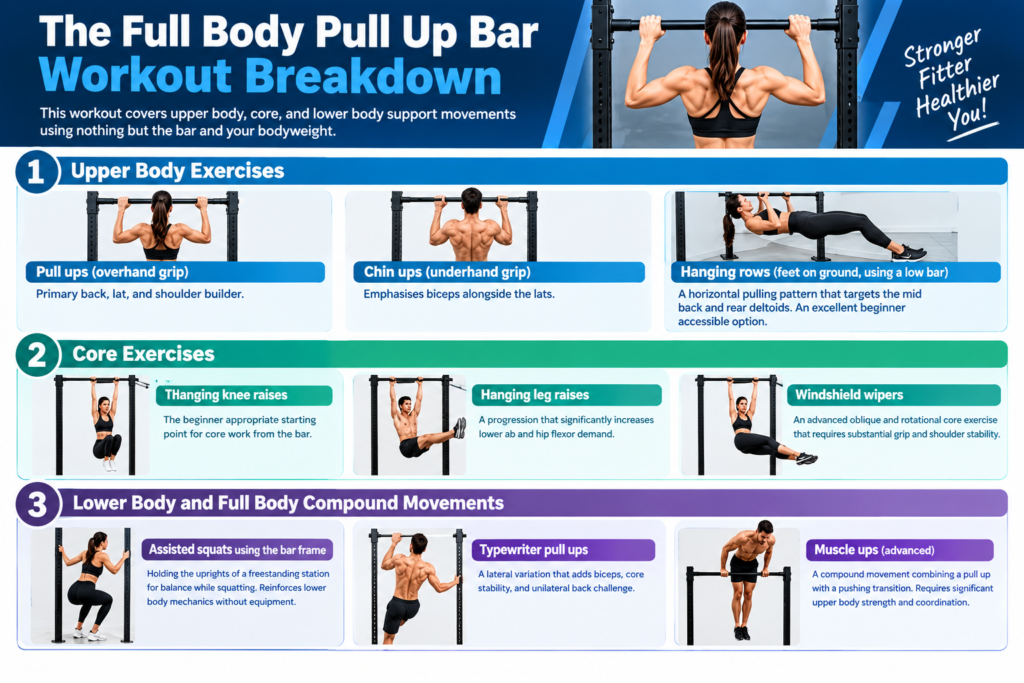
This workout covers upper body, core, and lower body support movements using nothing but the bar and your bodyweight.
Upper Body Exercises
Pull ups (overhand grip):
Primary back, lat, and shoulder builder
Chin ups (underhand grip):
Emphasises biceps alongside the lats
Hanging rows (feet on ground, using a low bar): A horizontal pulling pattern that targets the mid back and rear deltoids. An excellent beginner accessible option
Core Exercises
Hanging knee raises: The beginner appropriate starting point for core work from the bar
Hanging leg raises: A progression that significantly increases lower ab and hip flexor demand
Windshield wipers: An advanced oblique and rotational core exercise that requires substantial grip and shoulder stability
Lower Body and Full Body Compound Movements
Assisted squats using the bar frame:
Holding the uprights of a freestanding station for balance while squatting. Reinforces lower body mechanics without equipment
Typewriter pull ups:
A lateral variation that adds biceps, core stability, and unilateral back challenge
Muscle ups (advanced):
A compound movement combining a pull up with a pushing transition. Requires significant upper body strength and coordination
Simple Full Body Pull Up Bar Workout Plan
Complete this workout 2 to 3 times per week with at least one rest day between sessions.
Exercise Sets Reps or Duration Rest
Pull ups or band assisted pull ups 4 4 to 8 reps 90 seconds
Hanging rows 3 10 to 12 reps 60 seconds
Chin ups 3 5 to 8 reps 90 seconds
Hanging knee raises 3 10 to 12 reps 45 seconds
Dead hang holds 3 20 to 30 seconds 45 seconds
Windshield wipers 2 8 reps per side 45 seconds
Beginner Modifications
If you cannot yet complete pull ups with full bodyweight, use these substitutions without any guilt:
Perform negative reps by jumping to the top position and lowering slowly over 3 to 5 seconds
Use a looped resistance band under your knee or foot to reduce effective bodyweight
Replace hanging leg raises with hanging knee raises until grip and core strength catch up
Progression Plan for Building Strength Over Time
Structure matters more than intensity in the early weeks. Here is a realistic phase by phase approach:
Weeks 1 to 3:
Focus entirely on dead hangs, scapular pull ups, and negative reps. Build time under tension and joint tolerance before attempting unassisted reps.
Weeks 4 to 6:
Introduce band-assisted pull ups, using the thickest band available. Gradually reduce band thickness as your strength improves. Aim to complete your target rep range with control before moving to a lighter band.
Week 7 onward:
Attempt unassisted reps. Build volume incrementally once you achieve your first clean pull up. Add one additional rep or one additional set every one to two weeks.
A 2023 study on pull up training frequency found that participants training three times per week over five weeks improved their pull up performance from an average of roughly 10 reps to nearly 17 reps to failure. That is a 70 percent improvement in five weeks with consistent, moderate-frequency training. No exotic programming required.
How Often Should You Train on a Pull Up Bar?
Two to three sessions per week is the research supported sweet spot for building both pulling strength and grip endurance.
Grip and forearm muscles fatigue faster and recover more slowly than larger muscle groups. This makes spacing your sessions important. Training six days per week on a pull up bar almost always produces more fatigue accumulation than strength gain, especially in the first two months.
You’re ready to add harder variations (typewriter pull ups, weighted reps, L-sit pull ups) when you can consistently hit your target rep range with full range of motion and controlled form across all working sets.
Nutrition Tips to Support Strength and Recovery
Protein Intake
Your lats, biceps, forearms, and grip muscles all experience microscopic damage during pull up training. Consistent protein intake drives the repair process. A practical target for strength focused trainees is 1.6 to 2.2 grams of protein per kilogram of bodyweight per day, a range supported by the International Society of Sports Nutrition’s 2017 position on protein and exercise.
Pre and Post Training Nutrition
A light snack combining carbohydrates and protein 60 to 90 minutes before training supports work capacity and grip endurance during your session. A full post workout meal within two hours helps initiate the recovery process. Prioritize whole food sources over supplements wherever possible.
Hydration
Even mild dehydration (1 to 2 percent of bodyweight) measurably reduces grip strength and joint lubrication quality. Both matter significantly during hanging and pulling movements. Drink enough water throughout the day to keep your urine pale yellow.
Common Mistakes to Avoid
These errors consistently prevent progress on pull up bar training:
Using momentum or kipping:
Swinging your hips to complete a rep removes the eccentric load that builds strength. Every rep should begin from a dead hang
Skipping the shoulder setup:
Failing to depress and retract the shoulder blades before each rep offloads the lats and overloads the smaller rotator cuff muscles
Ignoring grip recovery:
Grip fatigue accumulates silently. If your forearms feel chronically tight, you need more rest, not more volume
Progressing too fast:
Adding weight or advancing to harder variations before mastering the basics leads to compensation patterns that become harder to unlearn over time
Neglecting horizontal pulling:
Vertical pulling (pull ups) and horizontal pulling (rows) complement each other. Rows train the mid-back and rear deltoids in a way pull ups alone cannot replicate
5 Minute Post Workout Stretch
End every session with this short cool down to protect shoulder health and maintain grip flexibility:
Doorway chest and shoulder stretch: 30 seconds
Lat stretch (arm overhead and tilted to the side): 30 seconds per side
Wrist and forearm stretch (palm extended forward, fingers pointing down): 30 seconds per hand
Child’s pose: 60 seconds, focusing on thoracic and lat lengthening
Key Takeaways
A full body pull up bar workout targets the lats, traps, biceps, forearms, and anterior core simultaneously, making it one of the most efficient strength training tools available
Grip type (overhand, underhand, neutral) meaningfully changes which muscles do the most work, and rotating between them reduces overuse risk
Beginners should start with dead hangs, scapular pull ups, and negative reps before attempting full pull ups
Training two to three times per week at moderate volume produces measurable strength gains within five to six weeks
Shoulder setup (depressing and retracting the scapulae before each rep) is the single most important form cue for effective, injury free pull up training
Frequently Asked Questions
Can a pull up bar give you a full body workout?
Yes, when programmed with hanging leg raises, rows, and lower body assistance movements, a pull up bar delivers a genuine full body training stimulus. Pull ups and chin ups train the upper body pulling muscles, hanging knee and leg raises target the core, and bar-assisted squats address the lower body. The key is intentional exercise selection, not just doing sets of pull ups.
How many pull ups should a beginner aim for?
Beginners should focus on quality over quantity. Even one to three strict, full range of motion pull ups is a legitimate starting point. Research on strength training progression consistently shows that training close to your actual capacity with good form produces better long-term results than chasing numbers with poor technique. Use negatives and band assistance to build up gradually.
How long does it take to see results from pull up bar training?
Most people notice measurable strength improvements within 4 to 6 weeks of consistent training at 2 to 3 sessions per week. The 2023 frequency study referenced earlier showed a 70 percent improvement in pull up performance in just five weeks. Visible muscle development in the back and biceps typically follows within eight to twelve weeks, depending on training consistency and protein intake.
Can a full body pull up bar workout replace going to the gym?
For upper body and core training, yes, to a significant degree. A well structured full body pull up bar workout can build real strength in the back, arms, shoulders, and core. It won’t fully replace dedicated lower body training like heavy squats or deadlifts, so pairing it with basic leg work is worth considering for a truly complete routine.
What’s the ideal rep and set range for a full body pull up bar workout?
For strength and muscle growth, 3 to 5 sets of 4 to 10 reps per exercise, with 60 to 90 seconds of rest between sets, works well for most people. Beginners using assisted variations can adjust reps based on what’s achievable with good form rather than forcing a specific number.
Do I need a full body pull up bar workout every day to see progress?
No. Training 2 to 3 times per week with rest days in between is generally more effective than daily training, since muscles need recovery time to adapt and grow stronger between sessions.
Can women benefit from a full body pull up bar workout the same way men do?
Yes. Muscle and strength adaptations from pull-up bar training follow the same physiological principles regardless of gender. Progress may start from a different baseline due to typical differences in upper body strength, but the training response itself is comparable.
What if I can’t do a single pull up yet — can I still get a full body pull up bar workout?
Yes. Substituting negative reps, band assisted pull ups, and dead hangs still provides a genuine training stimulus for the same muscle groups, even before your first unassisted rep. The core and lower body components of the workout are also fully accessible regardless of pull up ability.
Does a full body pull up bar workout help with posture?
Yes, often significantly. Since pull ups and rows strengthen the upper back and rear shoulder muscles that counteract the forward hunched posture common from desk work and phone use, consistent training tends to improve posture over time.
Is it normal for one side to feel weaker during a full body pull up bar workout?
Yes, mild strength imbalances between sides are common and usually not a cause for concern. If the difference is significant or accompanied by pain, it’s worth paying closer attention to form or consulting a professional, but a small imbalance typically evens out with consistent, balanced training.
Conclusion
A full body pull up bar workout proves that real, comprehensive strength training doesn’t require a room full of machines, just one bar, thoughtful exercise selection, and consistency over time. From pull ups and rows that build the back and arms, to hanging leg raises that carve out genuine core strength, to bar assisted lower body work rounding things out, this simple piece of equipment can deliver a training stimulus that rivals far more complicated setups. The research backs this up clearly: measurable strength gains show up within weeks, not months, and meaningful muscle development follows soon after for those who stay consistent. Whether you’re working toward your very first pull up or looking to add real depth to an existing routine, the path forward is the same quality reps, patient progression, and showing up regularly. Start where you are, trust the process, and let a single bar do far more for your strength than you might expect.