Introduction| Why 10 standing desk workout exercises matter| Warm up prep your body in 60 seconds| Lower body standing desk exercises| Upper body standing desk exercises| Core strengthening standing desk exercises| Standing desk stretches for better posture| Quick 5 minutes standing desk workout routine| Staying consistent| Common mistakes to avoid| FAQS| Conclusion|
Introduction:
10 best standing desk workout are one of the simplest ways office workers can fight the effects of a sedentary workday without ever leaving their desks. If you’ve swapped your chair for a sit stand desk but still feel stiff, sluggish, or achy by 3 p.m., standing alone isn’t enough — you need movement built into your day. This guide walks you through practical desk exercises, a full office workout routine, and standing desk stretches you can do in minutes, no gym required. Whether you’re managing back pain, chasing better workplace fitness, or simply trying to reduce sedentary behavior, these moves are designed for any ergonomic workstation and require little to no equipment. We’ll also cover what current research says about sit stand desks, a ready to use 5 minute routine, and answers to the questions people ask most about exercising at their desks.
Why 10 Standing Desk Workout Exercises Matter
The average office worker spends close to <cite index=”3-1″>2,000 hours a year seated at a desk</cite>, and decades of research link that much sitting to back pain, poor circulation, and metabolic problems. Simply standing more helps, but the real gains come from adding movement.
A few findings worth knowing:
- Alternating between sitting and standing, combined with short movement breaks, has been shown to <cite index=”3-1″>lower post meal blood sugar spikes by roughly 11% and improve insulin resistance by as much as 23%</cite>.
- A year long, Steelcase sponsored study led by Mount Sinai researchers found sit-stand desk users sat <cite index=”4-1″>17% less overall, and nearly half reported less back, shoulder, or neck pain after 12 months</cite>.
- A 2024 study of older adults recorded <cite index=”1-1″>meaningful drops in systolic blood pressure over a six month period of reduced sitting time</cite>.
- Not every claim holds up equally well — a large 2024 analysis of UK Biobank data found that <cite index=”2-1″>standing for more than two hours a day did not, on its own, lower the risk of stroke or heart attack compared with sitting</cite>.
The takeaway: standing desks help, but pairing them with structured exercise is what actually moves the needle on pain relief, energy, and long term health.
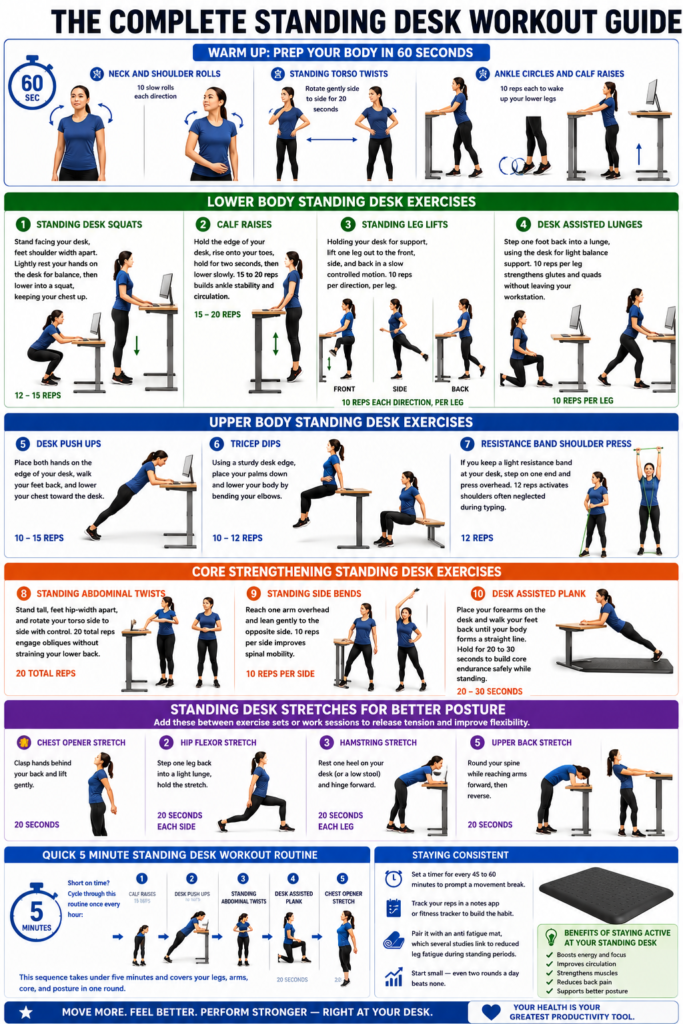
Warm Up: Prep Your Body in 60 Seconds
Before jumping into exercises, loosen up with these:
- Neck and shoulder rolls — 10 slow rolls each direction
- Standing torso twists — rotate gently side to side for 20 seconds
- Ankle circles and calf raises — 10 reps each to wake up your lower legs
Lower Body Standing Desk Exercises
1. Standing Desk Squats
Stand facing your desk, feet shoulder width apart. Lightly rest your hands on the desk for balance, then lower into a squat, keeping your chest up. Do 12 to 15 reps.
2. Calf Raises
Hold the edge of your desk, rise onto your toes, hold for two seconds, then lower slowly. 15 to 20 reps builds ankle stability and circulation.
3. Standing Leg Lifts
Holding your desk for support, lift one leg out to the front, side, and back in a slow controlled motion. 10 reps per direction, per leg.
4. Desk Assisted Lunges
Step one foot back into a lunge, using the desk for light balance support. 10 reps per leg strengthens glutes and quads without leaving your workstation.
Upper Body Standing Desk Exercises
5. Desk Push Ups
Place both hands on the edge of your desk, walk your feet back, and lower your chest toward the desk. 10 to 15 reps works chest, shoulders, and arms.
6. Tricep Dips
Using a sturdy desk edge, place your palms down and lower your body by bending your elbows. 10 to 12 reps target the back of the arms.
7. Resistance Band Shoulder Press
If you keep a light resistance band at your desk, step on one end and press overhead. 12 reps activates shoulders often neglected during typing.
Core Strengthening Standing Desk Exercises
8. Standing Abdominal Twists
Stand tall, feet hip-width apart, and rotate your torso side to side with control. 20 total reps engage obliques without straining your lower back.
9. Standing Side Bends
Reach one arm overhead and lean gently to the opposite side. 10 reps per side improves spinal mobility.
10. Desk Assisted Plank
Place your forearms on the desk and walk your feet back until your body forms a straight line. Hold for 20 to 30 seconds to build core endurance safely while standing.
Standing Desk Stretches for Better Posture
Long stretches of typing tighten the chest, hips, and hamstrings. Add these between exercise sets or work sessions:
- Chest opener stretch — clasp hands behind your back and lift gently
- Hip flexor stretch — step one leg back into a light lunge, hold 20 seconds
- Hamstring stretch — rest one heel on your desk (or a low stool) and hinge forward
- Upper back stretch — round your spine while reaching arms forward, then reverse
Quick 5 Minute Standing Desk Workout Routine
Short on time? Cycle through this routine once every hour:
- Calf raises — 15 reps
- Desk push ups — 10 reps
- Standing abdominal twists — 20 reps
- Desk assisted plank — 20 seconds
- Chest opener stretch — 20 seconds
This sequence takes under five minutes and covers your legs, arms, core, and posture in one round.
Staying Consistent
- Set a timer for every 45 to 60 minutes to prompt a movement break
- Track your reps in a notes app or fitness tracker to build the habit
- Pair it with an anti fatigue mat, which several studies link to reduced leg fatigue during standing periods
- Start small — even two rounds a day beats none
Common Mistakes to Avoid
- Skipping the warm up
- before push ups or squats, which raises injury risk
- Slouching during exercises
- which cancels out the posture benefits
- Using an unstable desk
- for dips or push ups — confirm it can hold your weight first
- Overdoing it on day one
- build up reps gradually over a few weeks
Frequently Asked Questions
1. Can standing desk exercises and sports activities really build muscle?
They build and maintain useful flow, especially in the legs, midsection, and shoulders, but they can’t replace dedicated strength training for key muscle gains
2. How often should I do those exercises?
Aim for short 3 to 5 minute sessions every hour, or longer 10 minute sessions throughout the workday.
3. Do I want a system for a practice scoreboard?
Not most physical activities make the best use of your frame weight and the board itself; Resistance band optionally available than useful.
4. Table push on each table U.S.A. Is it safe to do?
Only if the board is strong and should not tip or slip. Try it with a gentle tension before including the full frame load
5. Can physical games help with less pain again?
Well, the waist and hip flexor diagram in this exercise specifically targets the common causes of the table related to back pain.
6. Will just positioning all day improve my fitness?
Research shows that standing for more than two hours a day does not in itself significantly reduce the risk of cardiovascular disease, and that’s why I personally put exercise goals above pose.
7. How long before I see profit?
Many people record much less stiffness and improved flow within a week or two of breaking up daily every day movement.
8. Are standing tables enough without sports activities?
Stretching improves flexibility and posture however should be mixed with power movements such as squats and push u.S.For full benefit.
9. Can beginners do this exercise?
Indeed. Start with fewer reps and shorter plank holds, then boom step by step as the flow builds.
10. What is a quality time of day for an exercise table?
Mid morning and midday naps are perfect examples when it comes to easing the pace to counteract the power dip that many humans feel after dinner.
Conclusion
Standing desk workout exercises turn dead time at your desk into a genuine opportunity for better health. You don’t want a health club membership or more hours to your day – just a strong desk, a few minutes every hour and consistency. Start with the repeatable 5 minutes above, layer in the stretches for the pose, and regulate the intensity as the energy builds. Small, repetitive movements at some stage of your workday for real, research backed increases in pain, energy, and long term well being.