Introduction| Why a 5 day gym workout plan works| Key benefits backed by research| 5 day workout splits overview| Nutrition and recovery| Key recovery habits| How to track progress and stay motivated| FAQS| Conclusion|
Introduction:
Bored of going to a health club without a real plan? The 5 day gym workout plan gives shape to your workout, helps you target each muscle group, and keeps you consistent. Whether the goal is to build muscle, lose weight, or enhance general health, a beautifully designed weekly gym schedule takes the guesswork out. Studies show that those who follow a structured exercise program are 40% more likely to stick with it long term. This guide breaks down effective 5 day training breaks supported by the use of training techniques suitable for advanced lifters through beginners.
Why a 5 Day Gym Workout Plan Works
Research published in the journal Strength and Conditioning Research confirms that training each muscle fast with sufficient frequency (2 to three sessions to fit the week) maximizes hypertrophy and strength gains. 5-day breaks allow you to hit each basic muscle group at least twice a week.
Key benefits backed by research:
Muscles recover within 48 to 72 hours, making 5 day splits optimal for frequency.
Progressive overload, gradually increasing weight or reps — is the #1 driver of muscle growth.
Structured rest days (2 per week) reduce injury risk by up to 30% compared to daily training.
Dedicated muscle group days allow higher volume per session for better stimulus.
A consistent weekly gym schedule improves adherence and long term habit formation.
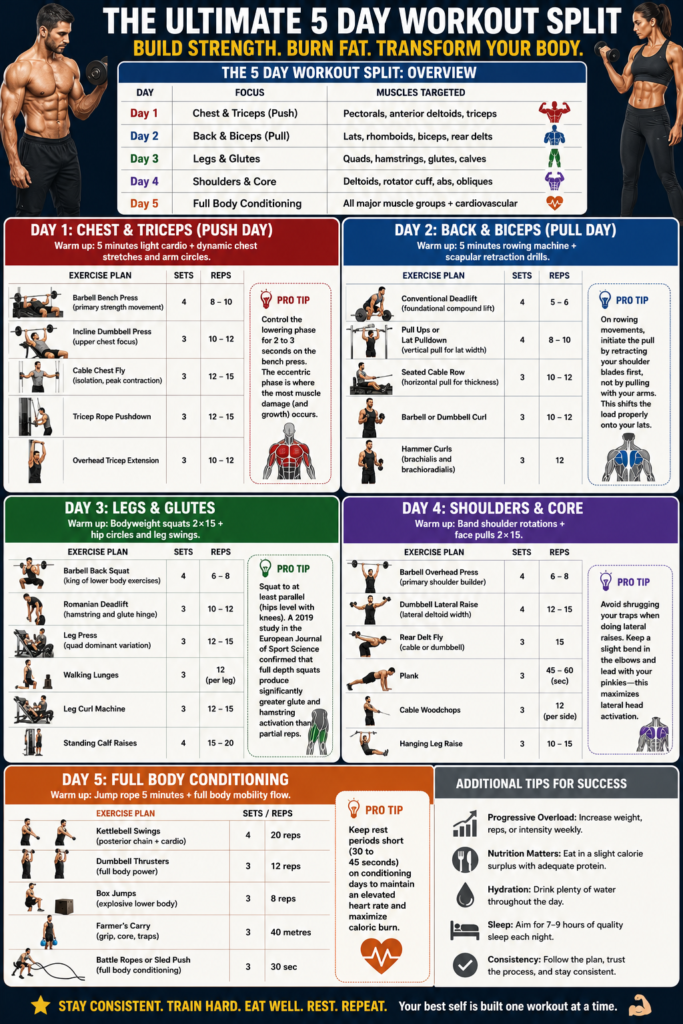
The 5 Day Workout Split: Overview
This plan follows a Push/Pull/Legs + Shoulders/Core + Full Body Conditioning structure, one of the most research supported splits for natural lifters.
Day Focus Muscles Targeted
Day 1 Chest & Triceps (Push) Pectorals, anterior deltoids, triceps
Day 2 Back & Biceps (Pull) Lats, rhomboids, biceps, rear delts
Day 3 Legs & Glutes Quads, hamstrings, glutes, calves
Day 4 Shoulders & Core Deltoids, rotator cuff, abs, obliques
Day 5 Full Body Conditioning All major muscle groups + cardiovascular
Day 1: Chest & Triceps (Push Day)
Warm up: 5 minutes light cardio + dynamic chest stretches and arm circles.
Exercise Plan
Barbell Bench Press
4 sets × 8 to 10 reps (primary strength movement)
Incline Dumbbell Press
3 sets × 10 to 12 reps (upper chest focus)
Cable Chest Fly
3 sets × 12 to 15 reps (isolation, peak contraction)
Tricep Rope Pushdown
3 sets × 12 to 15 reps
Overhead Tricep Extension
3 sets × 10 to 12 reps
Pro Tip:
Control the lowering phase for 2 to 3 seconds on the bench press. The eccentric phase is where the most muscle damage (and growth) occurs.
Day 2: Back & Biceps (Pull Day)
Warm up: 5 minutes rowing machine + scapular retraction drills.
Exercise Plan
Conventional Deadlift
4 sets × 5 to 6 reps (foundational compound lift)
Pull Ups or Lat Pulldown
4 sets × 8 to 10 reps (vertical pull for lat width)
Seated Cable Row
3 sets × 10 to 12 reps (horizontal pull for thickness)
Barbell or Dumbbell Curl
3 sets × 10 to 12 reps
Hammer Curls
3 sets × 12 reps (brachialis and brachioradialis)
Pro Tip:
On rowing movements, initiate the pull by retracting your shoulder blades first, not by pulling with your arms. This shifts the load properly onto your lats.
Day 3: Legs & Glutes
Warm up: Bodyweight squats 2×15 + hip circles and leg swings.
Exercise Plan
Barbell Back Squat
4 sets × 6 to 8 reps (king of lower body exercises)
Romanian Deadlift
3 sets × 10 to 12 reps (hamstring and glute hinge)
Leg Press
3 sets × 12 to 15 reps (quad dominant variation)
Walking Lunges
3 sets × 12 reps per leg
Leg Curl Machine
3 sets × 12 to 15 reps
Standing Calf Raises
4 sets × 15 to 20 reps
Pro Tip:
Squat to at least parallel (hips level with knees). A 2019 study in the European Journal of Sport Science confirmed that full depth squats produce significantly greater glute and hamstring activation than partial reps.
Day 4: Shoulders & Core
Warm up:
Band shoulder rotations + face pulls 2×15.
Exercise Plan
Barbell Overhead Press
4 sets × 6 to 8 reps (primary shoulder builder)
Dumbbell Lateral Raise
4 sets × 12 to 15 reps (lateral deltoid width)
Rear Delt Fly (cable or dumbbell)
3 sets × 15 reps
Plank
3 sets × 45 to 60 seconds
Cable Woodchops
3 sets × 12 reps per side
Hanging Leg Raise
3 sets × 10 to 15 reps
Pro Tip:
Avoid shrugging your traps when doing lateral raises. Keep a slight bend in the elbows and lead with your pinkies — this maximizes lateral head activation.
Day 5: Full Body Conditioning
Warm up:
Jump rope 5 minutes + full body mobility flow.
Exercise Plan
Kettlebell Swings
4 sets × 20 reps (posterior chain + cardio)
Dumbbell Thrusters
3 sets × 12 reps (full body power)
Box Jumps
3 sets × 8 reps (explosive lower body)
Farmer’s Carry
3 rounds × 40 metres (grip, core, traps)
Battle Ropes or Sled Push
3 rounds × 30 seconds
Pro Tip:
Keep rest periods short (30 to 45 seconds) on conditioning days to maintain an elevated heart rate and maximize caloric burn.
Nutrition & Recovery: Make the Plan Work
Your gym workout cut up is only as good as the nutrients and recovery that surround it. The American College of Sports Medicine recommends between 1.6 and 2.2 grams of protein equivalent to kilograms of body weight daily for those on the dependent electricity program.
Key Recovery Habits
Sleep between 7 and 9 hours a night, increasing hormone peaks at some stage of deep sleep.
Eat enough calories to treat muscle tissue as total performance gas.
Drink 35 to 45 ml of water daily, equivalent to kilograms of body weight.
On relaxing days, you can use invigorating therapy: walking, light yoga or swimming.
Track your pledge weekly to ensure revolutionary overweight training is underway.
How to Track Progress and Stay Motivated.
How to Track Progress and Stay Motivated
The biggest reason for human failure is not always lack of experience, but by far loss of scale. Use a handy workout log (pocketbook or app) to record sets, reps, and weight for each consultation. Every 3 to 4 weeks, aim to increase both weight lifted or reps completed. It is progressive overload training in motion, and is non-negotiable for lasting effects.
Take culture photos every 4 weeks (same light, same time of day).
Measure key body parts month by month: chest, waist, arms, thighs.
Try your 1 rep max on big lifts every eight to 12 weeks.
Use a fitness app like Strong, Heavy, or a simple spreadsheet.
Frequently Asked Questions (FAQs)
1. Is a 5 day health club training program suitable for beginners?
Yes, with changes. Allow beginners with a lighter load, recognition of the study sheet and more rest (2 to 3 min) between units. Gradually increase the intensity after 4 to 6 weeks.
2. Can I drop pounds on a 5 day gym workout plan?
definitely. Combine this plan with some caloric deficit (300 to 500 kcal during maintenance). Resistance school boosts your resting metabolic charge, making fat loss more sustainable than cardio alone.
3. What if I could handiest do four days instead of five?
Skip 5 days (conditioning) or integrate shoulders and entire frame into one consultation. However, the four happy times according to the week give a tremendous effect.
4. How do you make a complete rest in the unit?
For heavy compound lifts (squats, deadlifts, bench presses), rest for 2 to 3 minutes. 60 to 90 seconds is enough for solo play (curls, side lifts).
5. Should I do aerobics on rest days?
Short cardio (20 to 30 minute walks or bike rides) on rest days promotes blood flow and speeds muscle recovery without interfering with electrical gain.
6. How long will it take to see results?
Most people observe improved energy within 2 to a few weeks. Visible muscle adaptations are usually seen after 6 to eight weeks of regular schooling and proper nutrition.
7. Do I need supplements for this plan?
Supplementation is not mandatory. A weight loss plan rich in whole foods, protein sources, and greens will cover most needs. Creatine monohydrate (3 to 5g per day) is the supplement with the most research support for electrolyte benefits.
8. What is the best time of day to do a workout?
Beautiful timing is in any case, that you could be maximally consistent. Research shows that exercises in the afternoon and early evening are correlated with height, muscle strength and frame temperature, yet morning exercise is equally effective if received regularly.
9. Can girls check out this 5 day gym workout plan?
Indeed. The principles of innovative overload, compound movement, and yoke therapy follow all genders equally. Women no longer want to bulk up to lift more weight, which requires extra calories and years of dedicated schooling.
10. How do you avoid hitting a plateau?
Change your exercise activity every 6 to 8 weeks, alternating rep increments (e.g. switching from 8 to 12 to 4 to 6 for the strength block), and making sure you are taking in and listening carefully. Loading weeks (50% width, same frequency) every 8 to 10 weeks will keep you from overtraining.
Conclusion
It is a nicely organized 5 day gym workout plan that you can use to transform your body and health. By following this weekly gym routine that includes pushes, pulls, legs, shoulders, core, and full body conditioning, you’ll ensure that every muscle system is taught with enough frequency and volume to get stronger and leaner.
Stability of the key itself. Show up, observe modern overweight training week after week, consume adequate protein, sleep well, agree with the method. Whether you’re a beginner building your foundation or an accomplished lifter pursuing a new private major, this plan will adapt to your level and deliver results.