Introduction| Why long sitting hours are hurting you| Research on it| Good news: Small movements make a big difference| Warm up: prep your body| Sitting exercises you can do right now| Standing desk exercises| Stretching routine for problem areas| A simple 5 Minutes micro workout| Building movements into your workday| Weekly plan at a glance| FAQS| Conclusion|
Introduction
If your activity keeps you glued to a chair for 7 plus hours a day, office workout for long sitting hours, it is a fitness necessity. New research shows that sitting 7+ hours a day increases cholesterol and BMI even in people who already exercise frequently, and that regular exercise guidelines aren’t enough to undo the damage of a sedentary lifestyle. Useful information? You don’t want a gym. Short bursts of tabletop physical games, stretching, and movement breaks throughout the workday can protect your coronary artery, spine, and metabolism This booklet gives you science-assisted, easy-to-follow exercises for active living without ever leaving your desk.
Why Long Sitting Hours Are Hurting You
Sitting isn’t just a posture problem, it’s a full body health risk. A large JAMA Network Open study following over 480,000 people for nearly 13 years found that people who mostly sit at work face a <cite index=”6-1″>16% higher risk of all cause mortality</cite> compared to those who move more. A separate 2024 analysis of nearly 90,000 UK Biobank participants found that <cite index=”2-1″>higher sedentary time was linked to a greater risk of atrial fibrillation, heart failure, heart attack, and cardiovascular death</cite> after eight years of follow up, with average sedentary time measured at 9.4 hours a day.
Research on it:
In 2024, researchers behind UC Riverside and the University of Colorado Boulder, who followed more than 1,000 adults, including identical twins, will conclude that sitting for 8 or more hours a day raises cholesterol levels in obese and obese people. be.
Takeaway: An ergonomic workplace makes it possible, but posture change alone is not enough. You want real speed.
The Good News: Small Movements Make a Big Difference
The good news: small movements make a big difference
You don’t want to fight your back for an hour at the gym. A 2023 Columbia University overview found that just five minutes of gentle hobbies every 30 minutes reduced blood sugar spikes by about 60%And a scientific evaluation of sedentary challenge studies confirmed that between periods of sitting or standing with short periods of measurementb improved and therefore “exercise snacks” — short, public breaks in movement, actually advocated over a long exercise session at the end of the day
Warm Up: Prep Your Body (2 Minutes)
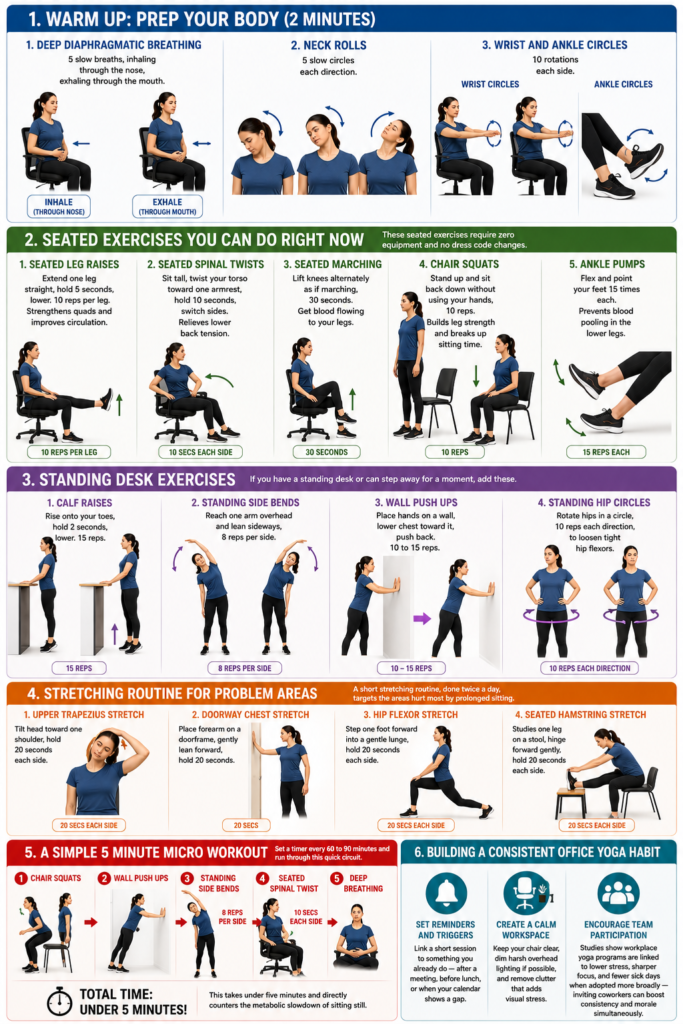
Before diving into desk exercises, loosen up:
- Deep diaphragmatic breathing – 5 slow breaths, inhaling through the nose, exhaling through the mouth.
- Neck rolls – 5 slow circles each direction.
- Wrist and ankle circles – 10 rotations each side.
Seated Exercises You Can Do Right Now
These seated exercises require zero equipment and no dress code changes.
- Seated leg raises – Extend one leg straight, hold 5 seconds, lower. 10 reps per leg. Strengthens quads and improves circulation.
- Seated spinal twists – Sit tall, twist your torso toward one armrest, hold 10 seconds, switch sides. Relieves lower back tension.
- Seated marching – Lift knees alternately as if marching, 30 seconds. Get blood flowing to your legs.
- Chair squats – Stand up and sit back down without using your hands, 10 reps. Builds leg strength and breaks up sitting time.
- Ankle pumps – Flex and point your feet 15 times each. Prevents blood pooling in the lower legs.
Standing Desk Exercises
If you have a standing desk or can step away for a moment, add these:
- Calf raises – Rise onto your toes, hold 2 seconds, lower. 15 reps.
- Standing side bends – Reach one arm overhead and lean sideways, 8 reps per side.
- Wall push ups – Place hands on a wall, lower chest toward it, push back. 10 to 15 reps.
- Standing hip circles – Rotate hips in a circle, 10 reps each direction, to loosen tight hip flexors.
Stretching Routine for Problem Areas
A short stretching routine, done twice a day, targets the areas hurt most by prolonged sitting:
- Upper trapezius stretch – Tilt head toward one shoulder, hold 20 seconds each side.
- Doorway chest stretch – Place forearm on a doorframe, gently lean forward, hold 20 seconds.
- Hip flexor stretch – Step one foot forward into a gentle lunge, hold 20 seconds each side.
- Seated hamstring stretch – Extend one leg on a stool, hinge forward gently, hold 20 seconds each side.
A Simple 5 Minute Micro Workout
Set a timer every 60 to 90 minutes and run through this quick circuit:
- Chair squats 10 reps
- Wall push ups 10 reps
- Standing side bends 8 reps per side
- Seated spinal twist 10 seconds each side
- Deep breathing 5 breaths
This takes under five minutes and directly counters the metabolic slowdown of sitting still.
Building Movement Into Your Workday
- Set a phone or app reminder to stand every 30 to 60 minutes.
- Take walking meetings or phone calls whenever possible.
- Use the stairs instead of the elevator.
- Keep resistance bands or a small balance cushion at your desk.
- Pair an ergonomic workspace (correct chair height, monitor at eye level) with movement breaks — research on sit-stand desks shows they meaningfully cut sitting time, especially when combined with reminders or coaching, though standing alone isn’t a full substitute for actual movement.
Weekly Plan at a Glance
| Day | Focus |
| Mon | Seated exercises + neck/shoulder stretch |
| Tue | Standing desk exercises + hip flexor stretch |
| Wed | 5 minute micro workout every 90 minutes |
| Thu | Seated exercises + hamstring stretch |
| Fri | Standing exercises + full stretching routine |
Frequently Asked Question
- What is a good workplace that allows you to stretch for long hours?
A mix of seated play, stance stretches and short movements breaks every 30 to 60 minutes of quality work. More consistency issues than depth.
- How often should I take travel discounts at my desk?
Aim to get up and walk around for at least 2 to 5 minutes for every 30 to 60 minutes of sitting.
3. Can tabletop physical activity arguably replace going to the gym?
No, however, they greatly reduce the health risks of sitting for long periods of time and prefer to completely replace it instead of supplementing with regular exercise.
4. What are the seat games for beginners?
Increasing your sitting legs, sitting high, and rotating your spine are gentle, effective starting points.
5. Does the table I just stood at solve the problem of sitting down?
Not quite. Standing desks reduce sitting time and while long-term standing offers limited benefits, you may not want to be moved.
6. How long should a stretching routine take at the office?
Five to ten minutes, done once or twice daily, is enough to relieve tension in the neck, back, and hips.
7. Can office workouts help with lower back pain?
Yes. Seated spinal twists, hip flexor stretches, and improved ergonomic workspace setup can meaningfully reduce lower back discomfort.
8. What equipment do I need for desk exercises?
None required. Optional tools like resistance bands or a balance cushion can add variety.
9. Is it better to exercise in the morning or spread movement throughout the day?
Spreading movement throughout the day, every 30 to 60 minutes — is more effective at controlling blood sugar and circulation than one long session alone.
10. How much sitting time is considered risky?
Research links roughly 8 hours or more of daily sitting, and especially over 10 hours of total sedentary time, with meaningfully higher cardiovascular and metabolic risk.
Conclusion
An office workout does not require special equipment, membership in the health association or possibly giving up the chair. What it does require is consistency — getting up, stretching out, briefly throughout the day and shifting in regular bursts. The research is clear: Prolonged sitting increases real health risks, but even small amounts of exercise reduce them significantly. Pairing a properly ergonomic workstation with light exercise and a handful of quiet physical activity can keep your heart, reverse, and energy levels much more effective than a long workout during the break of the day.
Start small: Choose a seated workout or five-minute micro workout today, set a reminder to repeat every 30 to 60 minutes, and then build. Over time, those small behaviors add up to real, lasting safety against the dangers of a sedentary lifestyle — and you’ll reportedly notice a greater posture, less pain, and more consistent flow within just a few weeks.