Introduction| Why belly fat builds up from desk jobs| The link between stress, cortisol and belly fat| Common office habits that contribute the body gain| Can you really loose bally fat with your office workout| What science says about spot reduction| How consistent movement supports fat loss| Setting realistic expectations| Benefits of exercising at your desk| Best office workouts that reduced belly fat| Standing desk exercises| Isometric exercises for the core| 10 Minutes office workout routine| Simple way to stay active during meetings| Nutrition tips to support belly fat loss at your home| Tool and accessories that helps| Common mistakes to avoid when doing office workout| FAQS| Conclusion|
Introduction:
If you spend eight or more hours a day at a desk, you know how difficult it is to keep the center looking. Office workout to reduce belly fat may not require you to give up the gym, special clothes, or even your workout chair. It certainly methods the use of short, deliberate bursts of movement – center press, standing extension, seated twist – to break long stretches of sitting, activate your abdominal muscle, and help fat loss alongside a healthy weight loss program cussed belly fat maximum struggle people board. Detailed information: Short, steady pace breaks sometimes during the workday can offset the threat in a meaningful way. This booklet gives you technical knowledge, first-class desk friendly sports activities, ready made repetitive and realistic behavior that helps you feel lighter, more energetic and more, that on top of your health issues, no system or extra hours are required.
Why Belly Fat Builds Up From Desk Jobs
How Prolonged Sitting Slows Your Metabolism
Sitting for hours at a time reduces muscle activity in your legs and core, which lowers the enzyme activity responsible for breaking down fat in your bloodstream. Researchers studying U.S. adults found that sedentary time may involve molecular responses that suppress a key muscle enzyme tied to fat metabolism, a change linked to poor lipid processing and abdominal fat accumulation (PMC, University of Massachusetts research review). In simple terms: the less your muscles move, the harder it is for your body to process fat efficiently, and that fat tends to settle around your abdomen.
A large UK study using MRI scans reinforced this. Researchers from the University of Leicester found that longer periods of sedentary time were more strongly associated with fat deposited around internal organs, and this connection held true even after accounting for age, ethnicity, and overall physical activity levels — with the strongest link seen in people who didn’t meet weekly exercise recommendations (published in the journal Obesity).
The Link Between Stress, Cortisol, and Belly Fat
Office life often means deadlines, back to back meetings, and constant notifications — all of which raise cortisol, your body’s primary stress hormone. Elevated cortisol encourages your body to store fat preferentially around the abdomen rather than the hips or thighs. Combined with sitting for long periods, this creates a cycle where stress and inactivity reinforce each other, making belly fat more stubborn than fat elsewhere on the body.
Common Office Habits That Contribute to Weight Gain
- Sitting for 6+ hours without a movement break
- Mindless snacking during meetings or while emailing
- Skipping lunch, then overeating in the evening
- Poor posture that weakens core muscles over time
- Relying on caffeine instead of water for energy
Can You Really Lose Belly Fat With Office Workouts?
What Science Says About Spot Reduction
It’s important to set honest expectations. A landmark 1980s University of Massachusetts study tracking participants through thousands of sit ups found that targeted abdominal exercise did not selectively burn fat from the abdomen compared to other body parts. More recent reviews confirm this: fat loss tends to occur across the whole body rather than in one isolated area, even when exercises target that specific spot. So, no single desk exercise will “melt” belly fat on its own.
How Consistent Movement Supports Fat Loss
That doesn’t mean office workouts are pointless — quite the opposite. According to fat loss researchers at the University of Sydney, while you may not lose weight from a specific spot through targeted exercise, all physical activity helps burn body fat and preserve muscle mass. Office workouts raise your total daily calorie burn, strengthen your core so your midsection looks tighter, counteract the metabolic slowdown caused by sitting, and build the consistency habit that drives long-term fat loss. Interrupting sitting also has direct benefits: even simple leg movement during prolonged sitting has been shown to protect cardiovascular function that sitting alone impairs.
Setting Realistic Expectations
Think of an office workout to reduce belly fat as one piece of a larger puzzle — alongside nutrition, sleep, and overall activity — rather than a standalone fix. Consistency over weeks and months, not intensity in a single session, is what produces visible results.
Benefits of Exercising at Your Desk
Improved Posture and Reduced Back Pain
Strengthening your core stabilizes your spine, easing the lower back strain that comes from hours of sitting.
Better Focus and Productivity
Short movement breaks increase blood flow to the brain, helping you return to tasks with sharper focus.
Boosted Energy Levels Throughout the Day
Brief bursts of activity fight the mid afternoon slump better than another cup of coffee, without the crash.
Best Office Workouts to Reduce Belly Fat (No Equipment Needed)
Seated Core Exercises
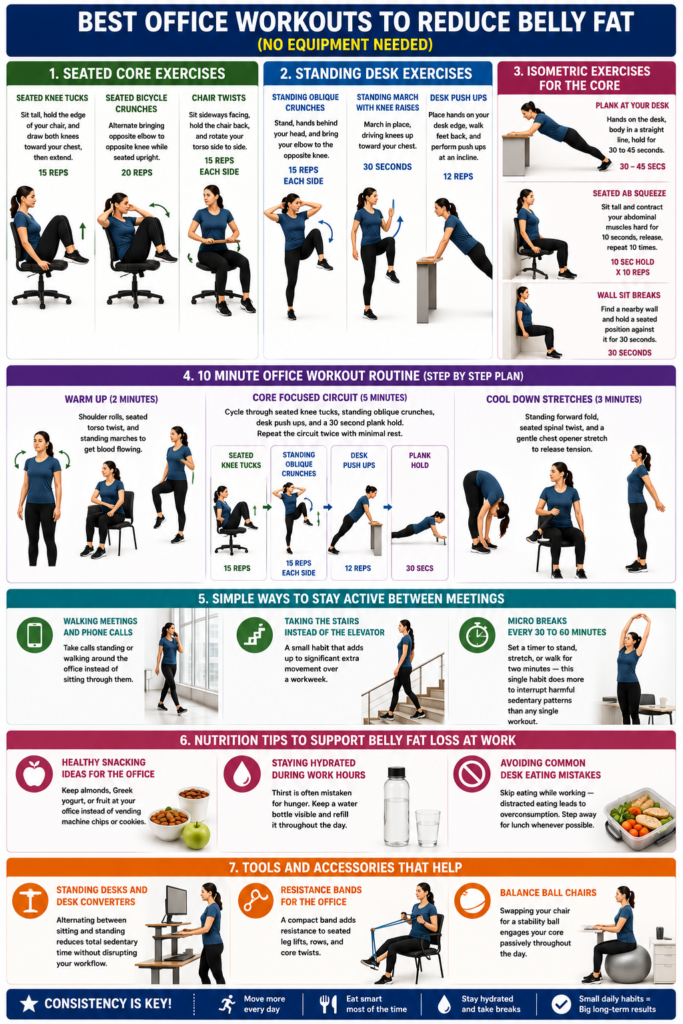
- Seated Knee Tucks — Sit tall, hold the edge of your chair, and draw both knees toward your chest, then extend. 15 reps.
- Seated Bicycle Crunches — Alternate bringing opposite elbow to opposite knee while seated upright. 20 reps.
- Chair Twists — Sit sideways facing, hold the chair back, and rotate your torso side to side. 15 reps per side.
Standing Desk Exercises
- Standing Oblique Crunches — Stand, hands behind your head, and bring your elbow to the opposite knee. 15 reps per side.
- Standing March with Knee Raises — March in place, driving knees up toward your chest. 30 seconds.
- Desk Push Ups — Place hands on your desk edge, walk feet back, and perform push ups at an incline. 12 reps.
Isometric Exercises for the Core
- Plank at Your Desk
- Hands on the desk, body in a straight line, hold for 30 to 45 seconds.
- Seated Ab Squeeze
- Sit tall and contract your abdominal muscles hard for 10 seconds, release, repeat 10 times.
- Wall Sit Breaks
- Find a nearby wall and hold a seated position against it for 30 seconds.
10 Minute Office Workout Routine (Step by Step Plan)
Warm Up (2 Minutes)
Shoulder rolls, seated torso twists, and standing marches to get blood flowing.
Core Focused Circuit (5 Minutes)
Cycle through seated knee tucks, standing oblique crunches, desk push ups, and a 30 second plank hold. Repeat the circuit twice with minimal rest.
Cool Down Stretches (3 Minutes)
Standing forward fold, seated spinal twist, and a gentle chest opener stretch to release tension.
Simple Ways to Stay Active Between Meetings
Walking Meetings and Phone Calls
Take calls standing or walking around the office instead of sitting through them.
Taking the Stairs Instead of the Elevator
A small habit that adds up to significant extra movement over a workweek.
Micro Breaks Every 30 to 60 Minutes
Set a timer to stand, stretch, or walk for two minutes — this single habit does more to interrupt harmful sedentary patterns than any single workout.
Nutrition Tips to Support Belly Fat Loss at Work
Healthy Snacking Ideas for the Office
Keep almonds, Greek yogurt, or fruit at your desk instead of vending machine chips or cookies.
Staying Hydrated During Work Hours
Thirst is often mistaken for hunger. Keep a water bottle visible and refill it throughout the day.
Avoiding Common Desk Eating Mistakes
Skip eating while working — distracted eating leads to overconsumption. Step away for lunch whenever possible.
Tools and Accessories That Help
Standing Desks and Desk Converters
Alternating between sitting and standing reduces total sedentary time without disrupting your workflow.
Resistance Bands for the Office
A compact band adds resistance to seated leg lifts, rows, and core twists.
Balance Ball Chairs
Swapping your chair for a stability ball engages your core passively throughout the day.
Common Mistakes to Avoid When Doing Office Workouts
Overexerting Without Proper Form
Rushing through reps with poor form increases injury risk and reduces effectiveness — slow, controlled movement matters more than speed.
Ignoring Posture During Exercises
Slouching during seated exercises reduces core engagement. Keep your spine tall throughout each movement.
Relying Only on Workouts Without Diet Changes
Exercise alone can’t outpace a calorie surplus. Pair your office workout to reduce belly fat with mindful eating for real results.
Frequently Asked Questions (FAQ)
1. Can I lose belly fat by doing the most effective exercises at my desk?
While desk workouts help burn energy and strengthen the center of gravity, belly fat loss ultimately depends on general caloric balance, sleep, and diet — no longer a frame component or type of workout .
2. How regularly should office exercises be conducted?
Aim for a quick break every 30 to 60 minutes, as well as a focused 10 to 15 minute core circuit a few times during the workday.
3. What is the first class time of the day to do physical activity?
Mid morning and mid afternoon slumps are ideal times, moreover split resting time to get a power boost.
4. Are office exercises powerful for beginners?
Indeed. Seated and standing bodyweight bodyweight exercises are low impact and beginner enjoyable, and can be scaled up as strength improves.
5. Will I need any equipment for those workouts?
No, each exercise in this manual uses only your body weight, a chair, and your desk.
6. Will these games tone your stomach, or just burn fat?
Both, over time. They improve and tone the underlying core muscle tissue even supporting the calorie burn required for normal fat loss.
7. How long before I see results?
Most people notice improved posture and energy within 1 to 2 weeks, while visible fat loss typically takes 6 to 8 weeks of consistent movement and healthy eating.
8. Can standing desks alone reduce belly fat?
Standing desks reduce total sitting time, which helps, but they work best when combined with regular movement breaks and core exercises, not as a standalone solution.
9. Is it okay to do these exercises in work clothes?
Yes, all the exercises in this routine are low-impact and discreet enough to do in office attire.
10. What if I don’t have privacy at my desk?
Choose subtler options like seated ab squeezes, chair twists, or standing calf raises, or use a break room or stairwell for more active moves.
Conclusion: Build a Sustainable Office Fitness Routine
Belly fat is not solved through any one exercise, but office workout to reduce belly fat, done consistently — makes it easier to counteract metabolic decline caused by sitting, strengthens your core, and builds momentum towards sustainable habits Break up short movements paired with conscious hydration and you can’t do anything good eating, flow, attention, and how your clothes fit long before dimensions pick up Start today with just one or two games, build an addiction and let consistency do the rest.