Introduction| Why a body weight home workout plan actually works| Who can follow this plan| A complete 4 week Full body weight workout plan| Weekly workout schedule at a glance| Nutrition tips to maximize your home workout results| Common mistakes that kills your progress| FAQS| Conclusion|
Introduction:
Looking for an effective bodyweight home workout plan that delivers real results without buying a single piece of equipment? You are in the right place. Millions of people worldwide are discovering that a structured no equipment fitness guide is all they need to get stronger, leaner, and healthier. Whether you are a busy parent, a travelling professional, or simply someone who hates gyms, a well designed at-home bodyweight exercise routine fits perfectly into your life. This guide covers everything — from beginner calisthenics workout routines to intermediate progressions, fat burning circuits, and expert tips.
Why a Bodyweight Home Workout Plan Actually Works
Many people assume you need heavy weights or expensive machines to build a strong, toned body. The truth is, your own bodyweight provides more than enough resistance to trigger muscle growth and fat loss, when applied correctly.
Here is why bodyweight training is one of the most effective fitness methods available:
Constant resistance
your body provides natural load on every rep
Compound movements
exercises like push ups and squats work multiple muscles simultaneously
Progressive overload is possible
add reps, change angles, or slow down tempo
No injury risk from dropping weights
much safer for joints and connective tissue
Backed by science
studies show calisthenics builds lean muscle and improves cardiovascular health
Zero cost
no gym fees, no equipment purchases, ever
Pro Tip:
The key to making bodyweight training work is progressive overload — always push a little further than last time, even by a single rep.
Benefits of Training at Home with No Equipment
Before diving into the workout plan itself, it is worth understanding exactly what you gain by committing to a home based, no equipment routine:
Freedom
work out at any time, morning, lunch, or midnight
Privacy
no judgement, no distractions, no waiting for machines
Consistency
removing the commute removes the most common excuse
Adaptability
every exercise can be made easier or harder instantly
Full body results
strength, flexibility, balance, and cardio in one plan
These are not small advantages. Research shows that people who work out at home are more likely to stay consistent over six months compared to gym goers, simply because the barrier to starting is so much lower.
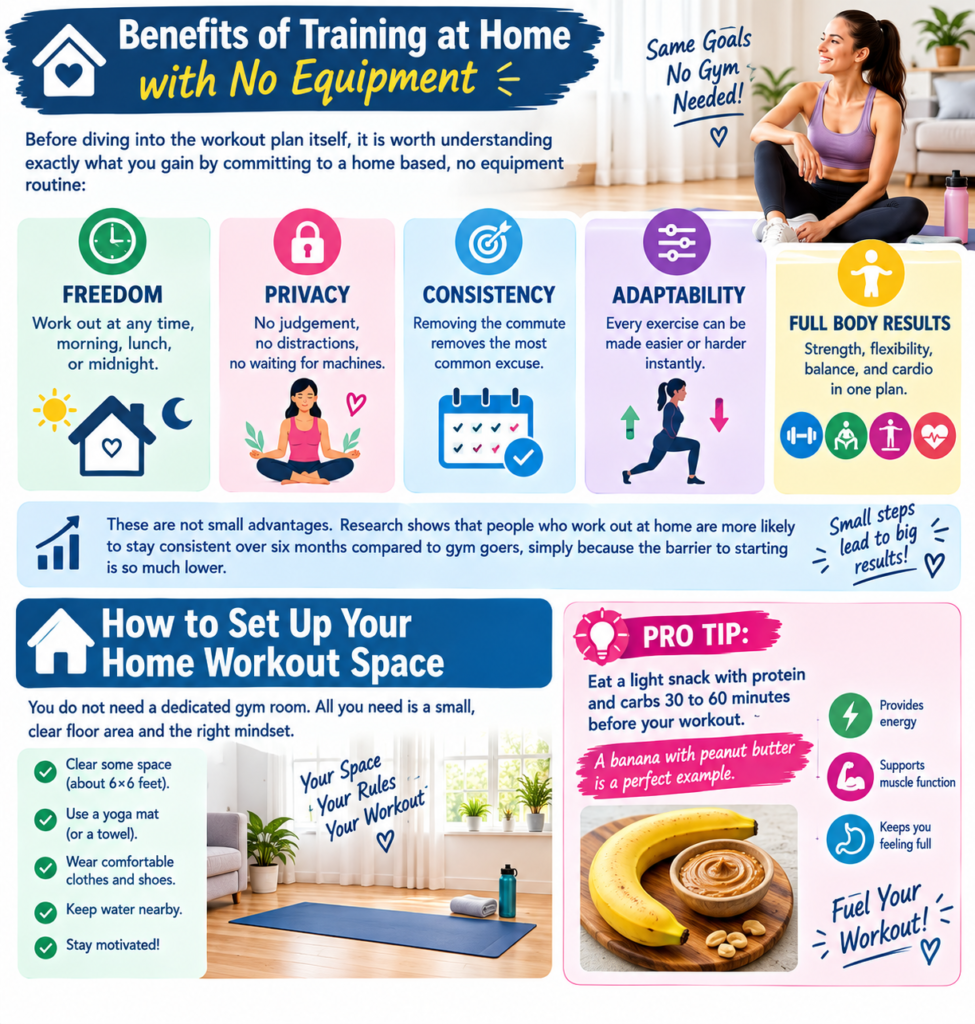
How to Set Up Your Home Workout Space
You do not need a dedicated gym room. All you need is a small, clear floor area and the right mindset.
Pro Tip:
Eat a light snack with protein and carbs 30 to 60 minutes before your workout. A banana with peanut butter is a perfect example.
Common Mistakes That Kill Your Progress
Skipping rest days
muscles repair and grow during rest, not during training
Ignoring form to chase reps
bad form reduces results and causes injury
Doing the exact same workout every week
your body adapts; vary the exercises
Not sleeping enough
aim for 7 to 9 hours; this is when growth hormone is released
Comparing your week one to someone else’s year 3
focus on your own progress
Giving up too soon
visible results take four to eight weeks; stay patient
Frequently Asked Questions (FAQs)
Q1. Can I build real muscle with a bodyweight home workout program?
Yes, and it’s one of the biggest misconceptions in all of fitness. Bodyweight sports activities such as push ups, dips, squats, and planks cause significant mechanical stress and metabolic stress on your muscle mass, the same drivers cause muscle growth with weights Elite gymnasts and calisthenics athletes are some of the most muscular humans globally, not to mention often associated with barbells and carbohydrates.
Q2 How many days per week should I keep this plan?
To allow full recovery, beginners start three days corresponding to the week. Increase up to 3 weeks and then up to 4 or 5 days. Always cover at least one full day of rest to fit the week. More is not consistently better – first class and consistency beats volume anytime.
Q3 How long should each home practice consultation be required?
A nice structured consultation that requires a warm-up and cool down 30 to 45 minutes to spare. You can achieve amazing results in as little as 25 minutes if you raise the relaxation time quickly and deeply. It no longer feels like a long session is consistently better.
Q4 Is this plan suitable for complete beginners?
definitely. This plan is a less difficult beginner version of each exercise. For example, if all the pushing is too hard on the user, start with knee pushes. If squats cause discomfort, start with chair squats. The plan builds gradually over four weeks, so you have time to propose your framework carefully.
Q5 How quickly do I see results from bodyweight training?
You’ll probably notice electricity, better sleep, and a reduction in pressure for the first two weeks ahead. Visible physical changes, improved muscle tone, reduced frame fat, and tall posture — after about 4 to eight weeks of daily schooling s
Q6. Can bodyweight exercises help me lose belly fat?
Well, albeit with an essential explanation: you can’t lose fat in a specific area. High-intensity bodyweight circuits burn calories and reduce general frame fat, which includes belly fat over the years. Combine this plan with a moderate calorie deficit for first-rate fat loss results.
Q7 Should I warm up before a home workout?
Yes, without exception. A thorough warm up for 5 minutes raises muscle temperature, improves range of motion, turns on anxiety-inducing machinery, and significantly reduces the threat of injury. Skipping it is by far the most common mistake beginners make and one of the top causes of muscle strain and joint pain.
Q8 What if I skip a training day?
Leave it alone and move on. Try not to double the next day. Consistency of things over the years far more than perfection in any given week. If at some point you miss, actually continue with the next scheduled session. Missing a consultation has 0 negative impact on your progress — 3 weeks absence.
Q9 Is this plan safe for the elderly?
Indeed. Bodyweight training is one of the safest forms of exercise for the elderly because there are no heavy hundreds on the back or joints. Movements like chair squats, wall push ups, and status planks are quality entry factors. As always, if you have any current health conditions, consult your doctor before starting any new exercise program.
Q10. How are you doing after four weeks?
After completing this four week program, strengthen it by increasing repetitions, decreasing rest periods, reducing speed longer under stress, or progressing to harder exercise variations, such as flowing from standard push American to archer push-ups, or pistol squats to body weight only squats.
Conclusion
A bodyweight home workout plan is not a compromise — it is a powerful, proven, and sustainable path to real fitness. No machine is necessary and the gym doesn’t want it, there really is no standing between you and your desired results. You now have a complete No System Health Manual that includes an approachable 4-week plan, professional form guidelines, restorative techniques, vitamin recommendations, and answers to the most common questions faced by beginners.