Introduction| Why office workers needs a no equipment workout routine| Best office workout exercises without equipment| Quick no equipment office workout routines| Best times to fit in your office workout| Tips to stay consistent| Mistakes to avoid when exercising at your desk| FAQS| Conclusion|
Introduction:
If your job keeps you glued to a chair for 8 hours a day, you’re not alone, and you don’t want a health club fighting your back. An office workout without equipment, is one of the best ways to disrupt sedentary time, increase flow, and maintain your long-term fitness every time you leave your desk. Research shows that people in the workplace spend more than 60% of the workday sitting, a habit linked to obesity, coronary heart disease or rapid cognitive decline The incentive element: a couple of minutes of body weight.
Why Office Workers Need a No Equipment Workout Routine
Sitting uninterrupted for long periods of time does more damage than most people realize. A 2025 assessment of Alzheimer’s dementia confirmed that sedentary behavior in adults is turning into a bona fide risk element for cognitive decline — a separate meta analysis of workplace based total interventions even among people meeting general exercise guidelines confirmed that long term sitting syndrome reduces it. And it increases the risk of all cause death, regardless of how active you are outside of work hours.
The takeaway from this research is simple: exercising once a day isn’t enough if you then sit for ten hours straight. Breaking up sitting time with short bursts of movement, even two minutes every hour — is what actually protects your body. That’s exactly what a desk based, equipment free routine is designed to do.
Best Office Workout Exercises Without Equipment
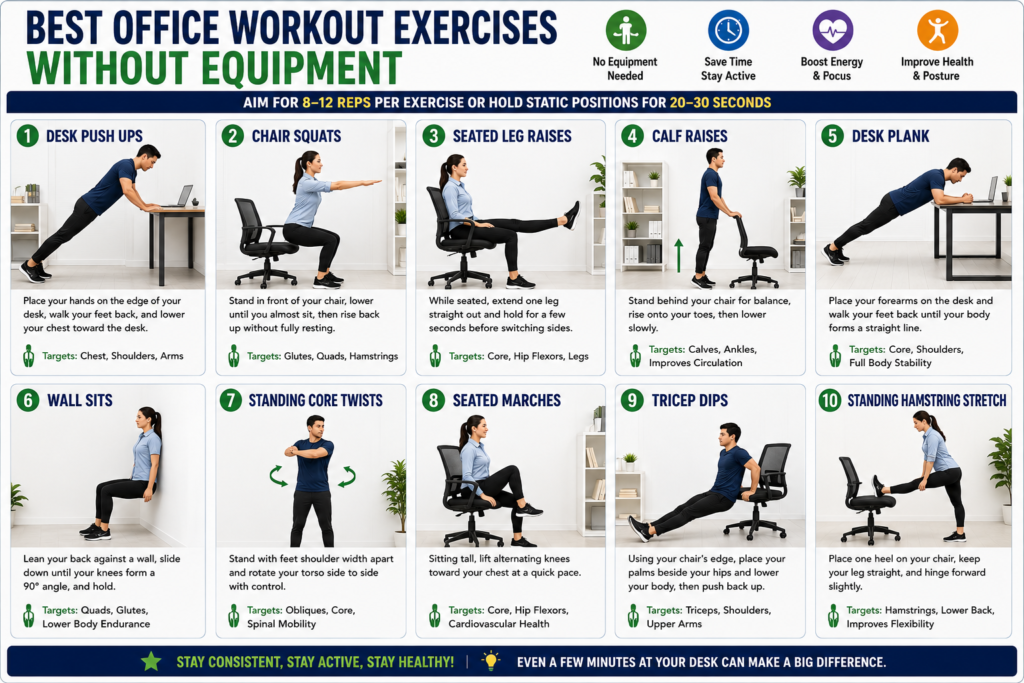
You don’t need space, gear, or even privacy for most of these. Aim for 8 to 12 reps per exercise, or hold static positions for 20 to 30 seconds.
1. Desk Push Ups
Place your hands on the edge of your desk, walk your feet back, and lower your chest toward the desk. This builds chest, shoulder, and arm strength without floor space.
2. Chair Squats
Stand in front of your chair, lower until you almost sit, then rise back up without fully resting. This strengthens glutes, quads, and hamstrings.
3. Seated Leg Raises
While seated, extend one leg straight out and hold for a few seconds before switching sides. This activates your core and improves circulation in your legs.
4. Calf Raises
Stand behind your chair for balance, rise onto your toes, then lower slowly. Great for circulation during long calls.
5. Desk Plank
Place your forearms on the desk and walk your feet back until your body forms a straight line. Hold to engage your entire core.
6. Wall Sits
Lean your back against a wall, slide down until your knees form a 90 degree angle, and hold. This builds lower body endurance.
7. Standing Core Twists
Stand with feet shoulder width apart and rotate your torso side to side with control. This works your obliques and improves spinal mobility.
8. Seated Marches
Sitting tall, lift alternating knees toward your chest at a quick pace. A discreet way to raise your heart rate at your desk.
9. Tricep Dips
Using your chair’s edge, place your palms beside your hips and lower your body, then push back up. This isolates the triceps effectively.
10. Standing Hamstring Stretch
Place one heel on your chair, keep your leg straight, and hinge forward slightly. Counteracts the tightness caused by hours of sitting.
Quick No Equipment Office Workout Routines
- 5 Minute Morning Routine: Chair squats, desk push ups, calf raises — 2 rounds.
- 15 Minute Full Body Routine: All 10 exercises above, 1 round each, minimal rest.
- 2 Minute Meeting Break: Standing core twists and seated marches whenever you stand up.
Best Times to Fit In Your Office Workout
Spacing movement throughout the day matters more than doing one long session. Try a short warm up when you arrive, a few exercises before lunch, and a stretch sequence before logging off. Even walking meetings count as informal cardio and help meet daily activity targets without feeling like “exercise” at all.
Tips to Stay Consistent
- Set a recurring reminder every 60 to 90 minutes to stand and move.
- Pair an exercise with a habit you already have, like calf raises during phone calls.
- Track movement breaks the same way you’d track tasks, so consistency becomes visible.
Mistakes to Avoid When Exercising at Your Desk
Avoid rounding your back during desk push ups or planks — poor posture cancels out the benefit and risks strain. Don’t overexert yourself in restrictive work clothing; modify range of motion if needed. And never skip a light warm up, even a 30 second one, before pushing into squats or wall sits.
FAQs: Office Workout Without Equipment
1. Can I really get in shape without the health club program?
Indeed. Bodyweight exercise programs build strength, mobility, and cardiovascular fitness when completed consistently.
2. How regularly should I exercise at work?
Aim for short exercise breaks every hour, and one focused 10 to 15 minute consultation a day.
3. Are board game programs enough to replace a fitness center?
They significantly reduce dormant dangers, however a school of power in some other place does add a greater advantage.
4. What is an extraordinary discretionary exercise for open jobs?
Seated leg raises and calf raises are subtle enough for any workplace.
5. Can those sports activities help with back pain?
Yes, centering movements like plank twists help stabilize the spine and reduce stiffness.
6. Do I need workout clothes for an office workout?
No, most exercises here work fine in regular office attire.
7. How long before I see results?
Most people are aware of improved strength and posture within 2 to three weeks of consistency.
8. Can beginners do this exercise?
Absolutely start with fewer reps and build step by step.
9. What are the practical benefits of staying as long as the visit is made?
Yes, it reduces normal sitting time and mildly increases calorie burning.
10. What if I actually have a table access with no privacy at all?
It clings to those who sit and the position becomes a stretch; Save dynamic activity for breaks or restrooms.
Conclusion
An office workout without equipment isn’t about changing the gym, it’s about interrupting hours of sitting with short, steady movements. Backed by research linking sedentary behaviors to serious fitness risks, these desk physical activities and chair based routines offer a realistic, decidedly relaxed way to protect your body during the time of the workday Starting with just one or physical activity in a day will build a habit.