Introduction| What is full body circuit training| How full body circuit training is differs from traditional workout| Key benefits of full body circuit training for every fitness level| Why a 20 minutes full body circuit training workout plan| The science behind short, high intensity works| The three design principles that make 20 minutes enough| | Who should start 20 minutes circuit training routine| Essential equipment for full body circuits training| Equipment that amplifies your circuits training results| The 20 minutes full body circuit training plan| The circuit training exercises| Warm up and cool down| How to progress your full body circuit training over time| Common mistakes that cause of slow results| Key takeaways| FAQS| Conclusion|
Introduction:
Most people waste 60 minutes in the gym and still leave undertrained. Full body circuit training can deliver a comparable stimulus in 20 minutes flat, and the science to back that claim is overwhelming. If time is the reason you skip workouts, this guide removes that excuse entirely.
What Is Full Body Circuit Training?
Full body circuit training is a structured workout method where you perform a series of exercises back to back, targeting multiple muscle groups with minimal rest between movements. The word “circuit” refers to completing one full round of all exercises in sequence, then repeating that sequence for additional rounds.
That definition matters because a lot of people misuse the term. Doing three random sets of bicep curls with a rest between each one is not a circuit. A true circuit has a specific architecture, and that architecture is precisely what makes it so effective.
The core principles that define a well-built circuit include:
- Sequencing:
Exercises alternate between muscle groups, reducing localised fatigue while keeping overall intensity high.
- Minimal rest:
Rest periods between exercises stay short, typically 10 to 30 seconds, which keeps your heart rate elevated throughout.
- Variety:
A properly designed circuit includes pushing movements, pulling movements, lower body exercises, and core work.
- Scalability:
The same structure can be made easier or harder depending on exercise selection and load.
According to the American College of Sports Medicine (ACSM), circuit training combines cardiovascular and resistance training in a single format that improves muscular endurance, aerobic capacity, and body composition simultaneously. That three-in-one benefit is what makes this training style so time-efficient and so consistently recommended by certified fitness professionals.
How Full Body Circuit Training Differs from Traditional Workouts
Traditional workout structures, such as a bodybuilding split or a standard cardio session, tend to isolate either a specific muscle group or a single energy system. A chest-and-triceps day focuses almost entirely on pushing muscles. A 45 minute treadmill session builds cardiovascular endurance without meaningful resistance training. Each approach works, but each requires a significant time investment to cover the full spectrum of fitness.
Full body circuit training flips that model entirely. A single circuit might sequence a squat variation, a push-up, a row, and a plank hold. In those four movements, you have trained your quads, glutes, chest, shoulders, triceps, back, biceps, and core. Achieving that same breadth with traditional training methods would take considerably longer.
The other major difference is the metabolic response. Because circuit exercises are performed in rapid succession, your body must work harder to supply oxygen and fuel to multiple muscle groups at once. This produces what researchers call excess post-exercise oxygen consumption (EPOC), meaning your body continues burning calories at an elevated rate for hours after the workout ends. A 2012 study published in the Journal of Strength and Conditioning Research found that circuit training produced significantly higher EPOC values compared to traditional moderate intensity steady-state cardio.
In practice, this means you are not just burning calories during the session. You are creating a metabolic effect that extends well beyond it.
Key Benefits of Full Body Circuit Training for Every Fitness Level
The research and real world application consistently point to the same conclusion: circuit based training delivers meaningful benefits regardless of where you are starting from. Here is what the evidence and practical experience show:
- Time efficiency:
- You accomplish in 20 minutes what a traditional split approach might take 60 minutes to achieve.
- Improved cardiovascular fitness:
- Short rest periods and sustained intensity give your aerobic system a genuine training stimulus, not just a warm-up.
- Increased strength and muscle tone:
Resistance based circuits stimulate muscle fibres for both growth and definition over time.
- Fat loss support:
The EPOC effect and the caloric burn during the session combine to create a meaningful energy deficit across the week.
- Flexibility for all levels:
Circuit training for beginners works beautifully with bodyweight only, while advanced athletes can load every exercise with weights or resistance bands.
- Mental engagement:
The variety of movements reduces boredom significantly. Research from the University of Florida found that people who reported enjoying their workouts were 83 percent more likely to maintain consistency over six months.
That last point matters more than most fitness content acknowledges. A workout you will actually repeat is always superior to a perfect programme you abandon after two weeks.
Why a 20 Minute Full Body Circuit Training Plan Works
Twenty minutes sounds short. The skepticism is understandable. But the physiological case for short, high intensity training has been building for decades and is now well established.
The Science Behind Short, High Intensity Workouts
A landmark 2006 study by Dr. Martin Gibala at McMaster University demonstrated that six sessions of high intensity interval training, totalling roughly 15 minutes of actual work, produced physiological adaptations comparable to moderate intensity endurance training that totalled 10.5 hours over the same period. That research fundamentally changed how exercise scientists think about training volume relative to intensity.
When those principles are applied to a full body strength circuit, the results are similar. By keeping rest periods short and selecting exercises that challenge large muscle groups, you generate a training stimulus in 20 minutes that rivals much longer sessions performed at lower intensities.
Research published in the Journal of Sports Science and Medicine confirms this further. Full body resistance circuits performed three times per week for eight weeks produced statistically significant improvements in strength, endurance, and body composition in previously untrained adults. The sessions in that study averaged under 25 minutes each.
The Three Design Principles That Make 20 Minutes Enough
Not every 20 minute workout earns its time slot. The mistake most people make is treating duration as the main variable. What actually drives results is how intelligently those 20 minutes are structured. Three principles determine whether a short circuit delivers:
- Exercise selection:
Choose compound movements that recruit multiple muscle groups at once. A Romanian deadlift works your hamstrings, glutes, lower back, and core simultaneously. A burpee challenges your full body and spikes your heart rate. Isolation exercises like a bicep curl have no place in a 20-minute circuit designed for maximum output.
- Work to rest ratio:
A 40 second work period followed by a 20 second rest is a format that keeps intensity high while allowing just enough recovery to maintain safe, effective form. This 2:1 ratio is a reliable starting point for intermediate exercisers.
- Progressive overload:
Even inside a short workout, you can increase difficulty over time by adding load, reducing rest intervals, or increasing total reps completed in each work period. That ongoing challenge is what drives continued adaptation and prevents plateaus.
Who Should Try a 20 Minute Full Body Circuit Training Routine
The honest answer is almost anyone. Full body circuit workouts adapt to nearly every context and constraint. In practice, the people who benefit most include:
- Busy parents with a narrow window between the school run and work
- College students using small dorm gyms or open outdoor spaces
- Older adults seeking low impact, time efficient movement that supports bone density and cardiovascular health
- Athletes using circuits as conditioning work during the off season
- Complete beginners who want a structured starting point that requires no gym membership or complicated equipment
The 20 minute format removes the most common barrier to exercise, which is time. When a workout fits inside a lunch break or a pre work morning slot, adherence rates climb sharply. The best circuit training programme is the one you will consistently show up for.
Essential Equipment for Full Body Circuit Training
One of the genuine strengths of circuit training is that it adapts to whatever resources you have available. You do not need a commercial gym or an expensive home setup to get a high quality session.
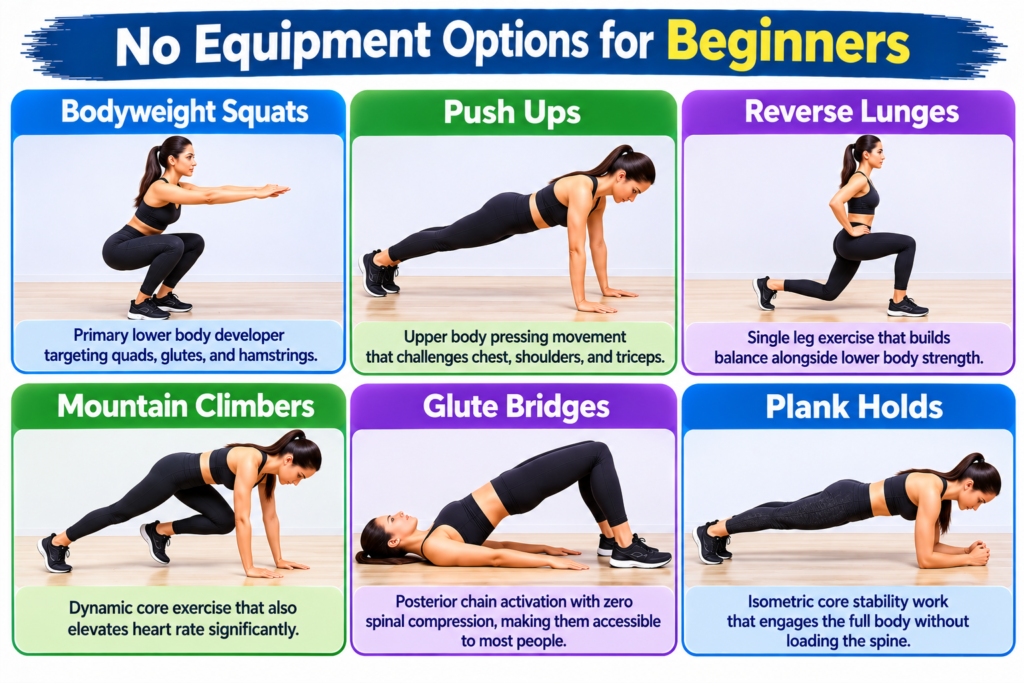
No Equipment Options for Beginners
Circuit training for beginners can be built entirely around bodyweight movements. These foundational exercises require nothing but floor space:
- Bodyweight squats:
Primary lower body developer targeting quads, glutes, and hamstrings.
- Push ups:
Upper body pressing movement that challenges chest, shoulders, and triceps.
Reverse lunges: Single leg exercise that builds balance alongside lower body strength.
- Mountain climbers:
Dynamic core exercise that also elevates heart rate significantly.
- Glute bridges:
Posterior chain activation with zero spinal compression, making them accessible to most people.
- Plank holds:
Isometric core stability work that engages the full body without loading the spine.
A bodyweight only circuit built from these six movements is genuinely demanding. Do not let the absence of equipment fool you into underestimating it.
Equipment That Amplifies Your Circuit Training Results
When you are ready to progress, a small collection of equipment opens up a much wider range of stimulus options without requiring a full gym setup:
- Resistance bands: Portable, affordable, and highly versatile. You can add meaningful load to squats, rows, presses, and hip hinge movements with a single set of bands.
- Dumbbells:
A pair of adjustable dumbbells covers the full spectrum from beginner to advanced. Movements like the dumbbell thruster (a squat to press combination) are among the most time efficient exercises in existence.
- Kettlebells:
Particularly well suited to circuit training because they combine strength and cardiovascular demand in a single movement. The kettlebell swing, for example, is a full body conditioning exercise that few other tools replicate.
- A pull up bar:
Pulling strength is underrepresented in most home workouts. A doorframe bar fixes that gap immediately and costs very little.
The 20 Minute Full Body Circuit Training Workout Plan
This is the practical core of everything discussed above. The plan below works for intermediate exercisers. Beginners should replace loaded exercises with bodyweight equivalents. Advanced athletes should add load or reduce rest intervals.
Circuit Structure
- Format: 3 rounds of 6 exercises
- Work period: 40 seconds per exercise
- Rest between exercises: 20 seconds
- Rest between rounds: 60 seconds
- Total workout time: Approximately 20 minutes
The Circuit Exercises
Round structure (repeat 3 times):
- Goblet squat or bodyweight squat –
- Drive through your heels, keep your chest tall, and reach full hip extension at the top of every rep. This primes your posterior chain and elevates your heart rate from the first movement.
- Push up (standard or elevated) –
Maintain a rigid plank position throughout. If standard push-ups compromise your form, elevate your hands on a bench or step. Form always outranks volume.
- Dumbbell Romanian deadlift or single leg glute bridge
Hinge at the hip, not the lower back. This movement targets the hamstrings and glutes directly while reinforcing posterior chain mechanics that carry over to almost every other exercise.
- Bent over dumbbell row or resistance band row –
Anchor your core before each rep. Pulling movements are systematically neglected in beginner programmes, which creates muscular imbalances over time. This exercise corrects that.
- Reverse lunge to knee drive –
Step back, lower your rear knee close to the floor, then drive that knee forward as you stand. The added knee drive turns a basic lunge into a full-body coordination and balance challenge.
- Mountain climbers –
Run your knees toward your chest in a controlled rhythm. Keep your hips level and your core tight. This exercise bridges the gap between strength work and cardiovascular conditioning within a single movement.

Warm Up and Cool Down (Built Into Your 20 Minutes)
Spending two to three minutes warming up is not optional, it is the reason you avoid injury and perform at your peak from the first exercise.
Warm up (2 to 3 minutes):
- 30 seconds of arm circles and shoulder rolls
- 30 seconds of hip circles
- 30 seconds of bodyweight squats at half pace
- 30 seconds of alternating leg swings
- 30 seconds of slow inchworm walkouts
Cool down (2 minutes):
- 30 second hold: standing quad stretch each side
- 30 second hold: seated hamstring stretch
- 30 second hold: chest opener with hands clasped behind the back
- 30 second hold: child’s pose for spinal decompression
Adjust your working rounds from three to two if you need to accommodate both the warm up and cool down within a hard 20 minute cap.
How to Progress Your Full Body Circuit Training Over Time
The mistake most people make with circuit training is repeating the same workout indefinitely and wondering why results slow. Your body adapts to any consistent stimulus within three to four weeks. Progression keeps the adaptation process moving forward.
Progression Methods for Beginners
If you are new to full body circuit workouts, your first progression goal is simply consistency. Completing three sessions per week for four consecutive weeks builds the aerobic base and movement competency that make later progressions safe and effective.
After that foundation is established, try these steps in order:
- Add one additional round (moving from 3 rounds to 4 rounds)
- Increase the work period from 40 seconds to 45 seconds
- Reduce the rest between exercises from 20 seconds to 15 seconds
- Introduce light resistance with a band or pair of dumbbells
Progression Methods for Intermediate and Advanced Athletes
Once bodyweight circuits feel controlled and manageable, the most effective progressions involve adding meaningful load and complexity:
- Load progression:
Increase dumbbell or kettlebell weight by the smallest available increment every one to two weeks on the core strength movements.
- Density progression:
Complete the same total volume in less time. If 3 rounds took you 18 minutes last week, aim for 16 minutes this week with the same exercises and weights.
- Exercise complexity:
Replace a goblet squat with a dumbbell thruster. Replace a standard push-up with a push up to renegade row. More complex movements recruit more muscle and demand greater coordination.
Common Mistakes That Undermine Full Body Circuit Training Results
Understanding what works is only half the picture. Knowing what derails progress saves you weeks of wasted effort.
Skipping the Warm Up
The warm up is not a courtesy ritual. It prepares your joints, activates your nervous system, and increases muscle temperature so that your first working set delivers meaningful training output rather than a stiff, under performed imitation of the movement.
Choosing Exercises That Do Not Complement Each Other
A circuit built from five quad dominant exercises is not a full body workout. It is an overuse injury in waiting. Each circuit should distribute load across opposing muscle groups: push and pull, anterior and posterior chain, upper and lower body.
Treating Every Session as a Maximum Effort
High intensity circuit training is demanding. Performing at maximum intensity seven days per week leads to accumulated fatigue, declining performance, and increased injury risk. Two to three sessions per week with genuine recovery between them outperforms daily grinding every time.
Ignoring Form Under Fatigue
The final seconds of a 40 second work period are where form typically breaks down. That breakdown is where injuries happen. Reduce your pace before you reduce your technique. A slightly lower rep count with perfect mechanics is always the better trade.
Key Takeaways
- Full body circuit training combines resistance and cardiovascular training into a single session, producing strength, endurance, and fat loss benefits simultaneously.
- The EPOC effect means your body continues burning calories at an elevated rate for hours after a circuit session ends, making 20 minutes more metabolically productive than it appears.
- Effective circuits are built on compound movements, a smart work-to-rest ratio, and the principle of progressive overload applied consistently over time.
- Circuit training for beginners requires zero equipment and zero gym experience. Bodyweight-only circuits are genuinely demanding when programmed correctly.
FAQ: Full Body Circuit Training
1. How Often Should I Do Full Body Circuit Training Each Week?
For most people, two to three sessions per week with at least one rest day between sessions is the optimal starting frequency. This allows enough recovery for your muscles to repair and adapt while maintaining a training stimulus across the week. Athletes with a strong fitness base can push to four sessions, but quality of movement and recovery should guide that decision, not ambition alone.
2. Can Full Body Circuit Training Replace Both Cardio and Strength Training?
Yes, in most practical contexts it can. Because a well designed circuit keeps your heart rate elevated throughout while using resistance-based movements, it trains both your cardiovascular system and your musculoskeletal system in the same session. That said, if your specific goal is maximal strength development or competitive endurance performance, dedicated training for those goals will still outperform circuit training in the long run. For general fitness, fat loss, and health improvement, circuit training covers the full spectrum effectively.
3. Is Full Body Circuit Training Suitable for Beginners with No Gym Experience?
Absolutely. Circuit training for beginners using only bodyweight movements is one of the most accessible and effective ways to start exercising. You need no equipment, no gym membership, and no prior experience. The key is starting with movements you can perform with good form, keeping the intensity manageable in the first two to three weeks, and building gradually from there. The structure of a circuit also teaches beginners how to manage effort and recovery, which is a skill that transfers to every other type of training.
4. How Long Should a Full Body Circuit Training Session Last?
Most people do well with 20 to 40 minutes, including a 5 minute warm up and a short cool down. A typical circuit of six to eight exercises, repeated for three rounds, fits comfortably in that window. Beginners can start with 15 to 20 minutes and add rounds over time. Because circuits keep rest short, longer sessions tend to cause form to slip, so it is better to stay shorter and keep the quality high.
5. What Is the Best Work to Rest Ratio for Circuit Training?
Beginners usually do best with 30 seconds of work and 30 seconds of rest. As your fitness improves, you can move to 40 seconds on and 20 seconds off, or even 45 on and 15 off. Choose the ratio that lets you keep good form through the last round. If your technique breaks down, lengthen the rest or shorten the work time rather than pushing through.
6. How Many Exercises and Rounds Should a Circuit Include?
Six to eight exercises per circuit is a good range, covering lower body, upper body push, upper body pull, and core. Aim for three rounds to start, then build to four or five as your conditioning improves. Arrange the moves so that consecutive exercises work different muscle groups, such as a squat followed by a push-up, so one area can recover while another works.
7. Is Full Body Circuit Training Good for Weight Loss?
It can be a helpful tool, because circuits raise your heart rate and burn a meaningful amount of energy in a short time. However, weight loss depends mainly on your overall calorie balance across the week, so training works best alongside balanced eating, daily walking, and good sleep. Circuits also help you hold on to muscle while losing fat, which supports a healthier body composition. Expect gradual progress rather than quick changes.
8. Can Full Body Circuit Training Build Muscle?
It can, especially for beginners and people returning to exercise. Adding tempo, extra reps, short pauses, or external load such as dumbbells or a loaded backpack makes bodyweight moves harder and encourages muscle growth. If your main goal is maximum muscle size, heavier lifting with longer rests will eventually work better, but circuits are a solid way to build a base of strength and muscle endurance.
9. Do I Need Equipment for Full Body Circuit Training?
No. Bodyweight exercises like squats, lunges, push ups, glute bridges, planks, and mountain climbers make an effective circuit on their own. Inexpensive extras such as a mat, resistance band, a pair of dumbbells, or a kettlebell add variety and let you progress later. A sturdy chair and a towel also open up moves like step ups, dips, and sliding exercises.
10. Should I Do Full Body Circuit Training Before or After Other Workouts?
On its own, a circuit works well as a stand-alone session. If you combine it with heavy lifting, do the lifting first while you are fresh, then finish with a short circuit. If your main goal is improving cardio fitness, put the circuit first. Avoid hard circuits the day before a long run or a heavy leg day, since fatigue carries over and can hurt your performance.
now add its conclusion as well on this topic
Conclusion
Full body circuit training is one of the most practical ways to build fitness when time, space, or experience is limited. By moving quickly between exercises that work different muscle groups, you train your heart, muscles, and endurance in a single short session. Two to three sessions a week, with rest days in between, is enough for most people to see steady progress.
The key is to keep the structure simple. Choose six to eight exercises that cover your legs, push, pull, and core, start with a 30 second work and 30-second rest rhythm, and begin with three rounds. Prioritize clean form over speed, and make the workout harder gradually by adding a round, lengthening the work time, slowing the tempo, or adding light weight. Research on short interval and bodyweight training suggests that brief, focused efforts can deliver real fitness benefits, though results vary from person to person.
Pair your circuits with daily walking, balanced meals, and 7 to 9 hours of sleep so your body can recover and adapt. Pick one circuit, put it on your calendar, and finish your first session this week. Stay consistent for 8 to 12 weeks, and you will likely notice more energy, better stamina, and strength you did not have before.
1 thought on “Full Body Circuit Training: A 20 Minute Best Plan”
Comments are closed.