Introduction| Why sitting too long is hurting your body| Top office workout for beginners| Beginners office workout routine| Pro tips to stay consistent with your workplace fitness routine| Office ergonomics: The hidden part of fitness| FAQS| Conclusion|
Introduction
Do you spend eight+ hours a day sitting at a desk? You are not myself. Millions of employees in workplaces across the United States, United Kingdom, Australia, Canada and beyond face the same problems — a sedentary lifestyle that quietly undermines their fitness. An office workout For beginners, is the best, most sensible answer. With just a few minutes between meetings or through lunch, you can strengthen muscle tissue, increase posture, increase strength, reduce stress — all from your workplace chair or standing desk This booklet has clean board body games for beginners, establish routines that are really instructional and outside doubt where it is globally located by your office.
Why Sitting Too Long Is Hurting Your Body
Research published through the American Journal of Epidemiology shows that adults who sit for more than 6 hours depending on the day have a markedly higher risk of heart disease, weight problems, and type 2 diabetes, compared to individuals who sit for much less than three hours at a time, because heat is a major factor in mortality.
Here is what prolonged sitting does to your body:
- Weakens core muscles — Your back and abdominal muscles switch off while seated.
- Tightens hip flexors — Hours of sitting shorten these muscles, causing lower back pain.
- Slows metabolism — Your body burns fewer calories when seated for long periods.
- Increases mental fatigue — Poor circulation reduces oxygen flow to the brain.
The solution is not quitting your desk job. It is adding smart, beginner friendly movement into your workday.
Top Office Workouts for Beginners (No Equipment Needed)
1. Seated Leg Raises
Target: Core and quadriceps
How to do it:
Sit upright in your chair. Straighten one leg and hold it up for 5 seconds. Lower it slowly. Repeat 10 to 15 times on each side.
Why it works:
It activates your lower abs and quads without leaving your seat — the perfect beginner desk exercise.
2. Desk Chair Squats
Target:
Glutes, hamstrings, and thighs
How to do it:
Stand in front of your chair. Lower your body slowly as if you are about to sit, stop just before the seat, hold for 2 seconds, and stand back up. Repeat 10 to 12 times. Why it works:
A 2019 study in the Journal of Physical Activity and Health confirmed that short bodyweight squat breaks during office hours reduce blood sugar spikes after meals.
3. Seated Torso Twists
Target:
Obliques and spine mobility
How to do it:
Sit straight, cross your arms over your chest, and rotate your upper body to the right, hold for 3 seconds, return to center, then twist to the left. Repeat 10 times each side.
Why it works:
This chair exercise for office workers relieves spine compression and prevents back stiffness caused by hours of desk sitting.
4. Desk Push Ups
Target:
Chest, shoulders, and triceps
How to do it:
Place both hands on the edge of your desk, shoulder width apart. Step back until your body is at a 45 degree angle. Lower your chest toward the desk, then push back up. Do 10 to 15 reps.
Why it works:
A practical beginner desk fitness move that builds upper body strength with zero equipment and zero sweat.
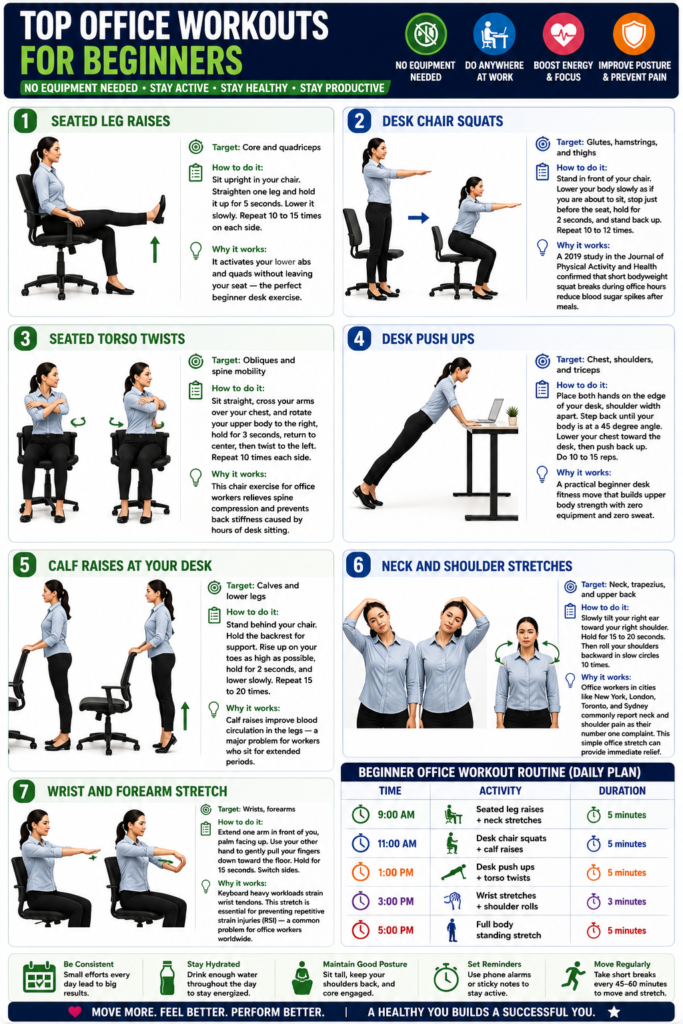
5. Calf Raises at Your Desk
Target:
Calves and lower legs
How to do it:
Stand behind your chair. Hold the backrest for support. Rise up on your toes as high as possible, hold for 2 seconds, and lower slowly. Repeat 15 to 20 times.
Why it works:
Calf raises improve blood circulation in the legs — a major problem for workers who sit for extended periods.
6. Neck and Shoulder Stretches
Target:
Neck, trapezius, and upper back
How to do it:
Slowly tilt your right ear toward your right shoulder. Hold for 15 to 20 seconds. Then roll your shoulders backward in slow circles 10 times.
Why it works:
Office workers in cities like New York, London, Toronto, and Sydney commonly report neck and shoulder pain as their number one complaint. This simple office stretch can provide immediate relief.
7. Wrist and Forearm Stretch
Target:
Wrists, forearms
How to do it:
Extend one arm in front of you, palm facing up. Use your other hand to gently pull your fingers down toward the floor. Hold for 15 seconds. Switch sides.
Why it works:
Keyboard heavy workloads strain wrist tendons. This stretch is essential for preventing repetitive strain injuries (RSI) — a common problem for office workers worldwide.
Beginner Office Workout Routine (Daily Plan)
| Time | Activity | Duration |
| 9:00 AM | Seated leg raises + neck stretches | 5 minutes |
| 11:00 AM | Desk chair squats + calf raises | 5 minutes |
| 1:00 PM | Desk push ups + torso twists | 5 minutes |
| 3:00 PM | Wrist stretches + shoulder rolls | 3 minutes |
| 5:00 PM | Full body standing stretch | 5 minutes |
Total daily movement: 23 minutes — broken into simple, manageable sessions that fit any schedule.
Pro Tips to Stay Consistent With Your Workplace Fitness Routine
1. Set phone reminders every hour.
The easiest way to build a seated workout at work habit is to set recurring alarms with labels like “Stand and stretch.”
2. Start small.
Beginners should start with just 2 to 3 exercises per day. Increase gradually every week. Overdoing it on day one leads to soreness and quitting.
3. Use your lunch break.
A 10 minute lunchtime workout at work boosts afternoon productivity and burns extra calories without cutting into work hours.
4. Tell a coworker.
Accountability works. Offices in cities like Dubai, Singapore, and Chicago have seen a rise in “wellness culture” where teams do short group stretches — try starting one.
5. Stay hydrated.
Drinking enough water naturally forces you to take more bathroom breaks — adding steps to your day without any extra effort.
Office Ergonomics: The Hidden Part of Your Fitness
No beginner desk fitness plan is complete without good posture. Research from Cornell University’s Human Factors and Ergonomics Lab shows that poor workstation setup is responsible for 60% of office-related musculoskeletal disorders.
Quick ergonomic setup checklist:
- Monitor at eye level — no neck craning up or down
- Feet flat on the floor or on a footrest
- Back supported by the chair’s lumbar cushion
- Elbows at 90 degrees when typing
- Screen at arm’s length distance (approximately 20 to 28 inches)
Good posture amplifies every office workout for beginners because your muscles engage correctly during each movement.
10 Frequently Asked Questions (FAQs)
Q1 . Can an office exercise program help me lose pounds?
Yes, but most effectively as part of a comprehensive healthy lifestyle. Office physical activity burns calories and boosts metabolism, but weight loss programs additionally play a major role in weight loss.
Q2 How regularly should a beginner practice at the desk during the day?
Start with 3 quick classes of 5 minutes each. As you build endurance, exercise destroys the objective every 60 to 90 minutes.
Q3 Are workplace exercises safe for people with back pain?
Most sedentary desk physical activity is decreasing surface enjoyment, however generally if you have existing accidents consult your healthcare professional or physical therapist first.
Q4 Do I need a system to get started?
Not at all now. All of the physical games in this guide make the most efficient use of your body weight and your desk or chair.
Q.5 If I stretch at my desk, will my co-workers recognize the awkward spot?
Most of the game activities in this guide are discrete. Lifting your legs, extending your wrists, and growing your calves while sitting are virtually invisible to partners.
Q.6 How long before I see the results of the desktop game?
With daily consistency, most beginners notice an improvement in strength levels within 1 to two weeks and physique increases within 4 to 6 weeks.
Q7 Is it better to exercise in the office in the morning or afternoon?
Morning exercises give you energy for the day. Afternoon sessions (round 2 to a few PM) best combat the put up lunch energy drop.
Q8 Which office stretches to renew my terrible physique?
They help remarkably, especially when mixed with ergonomic workstation layout. Consistency is key.
Q9 What is a pleasant office exercise for a person with no health history?
Start by lifting your sitting legs, stretching your neck and rolling your shoulders. These are less intensive, safe from injury and relatively powerful for true beginners.
Q10. Can I do office exercises if I work from home?
Definitely. All of the physical games in this manual work equally well for remote employees worldwide, whether you’re in London, Lahore, Los Angeles, or Lagos or not.
Conclusion
An office workout for beginners, is one of the smartest fitness investments you can make. Now, you don’t have to revamp your schedule, join a gym, or buy expensive equipment. All it takes is a few minutes of intentional movement for the duration of the workday. From seated foot lifts to desks pushes American states to simple office extensions, even the busiest experts can create a sustainable place of occupational health recovery that protects their fitness longer.
Start with one exercise today. Add another the next day. Rebuild the habit one at a time. Your body and your productivity will thank you.