Introduction| Why sitting all day is hurting your health| Best desk exercises for busy professionals| Seated leg raises| Chair squats| Desk push ups| Neck and shoulder rolls| Quick desk workout routine by time available| 10 Minutes lunch break routine| Work from home exercises| How to built a sustainable desk workout habit| GEO Optimizer note for office professionals worldwide| FAQS| Conclusion|
Introduction
Are you a busy professional in New York, London, Dubai, or Karachi spending 8 to 10 hours glued to your desk? You are not alone. Millions of office workers worldwide struggle to stay active due to packed schedules and back to back meetings. The good news is that a desk workout for busy professionals does not require a gym membership or extra hours in your day.
Research from the World Health Organization confirms that physical inactivity is one of the leading causes of global health issues. But with simple office exercises and movement breaks built into your workday, you can boost energy, improve posture, and increase productivity — all without leaving your chair. This guide gives you everything you need to start today.
Why Sitting All Day Is Hurting Your Health
A landmark study published in the Annals of Internal Medicine (2017) found that prolonged sitting is linked to cardiovascular disease, type 2 diabetes, and even early death, even in people who exercise regularly outside of work.
In cities like Chicago, Mumbai, Toronto, or Riyadh, office professionals average over 9.5 hours of sitting daily. This “sitting disease” quietly damages your spine, slows your metabolism, and clouds your thinking.
Key health risks of long sitting hours:
- Lower back and neck pain
- Poor blood circulation in legs
- Weakened core muscles
- Reduced metabolism and weight gain
- Increased stress and anxiety levels
The fix? Strategic workplace fitness through short, consistent movement breaks — proven by research to counteract the effects of sedentary work.
Best Desk Exercises for Busy Professionals
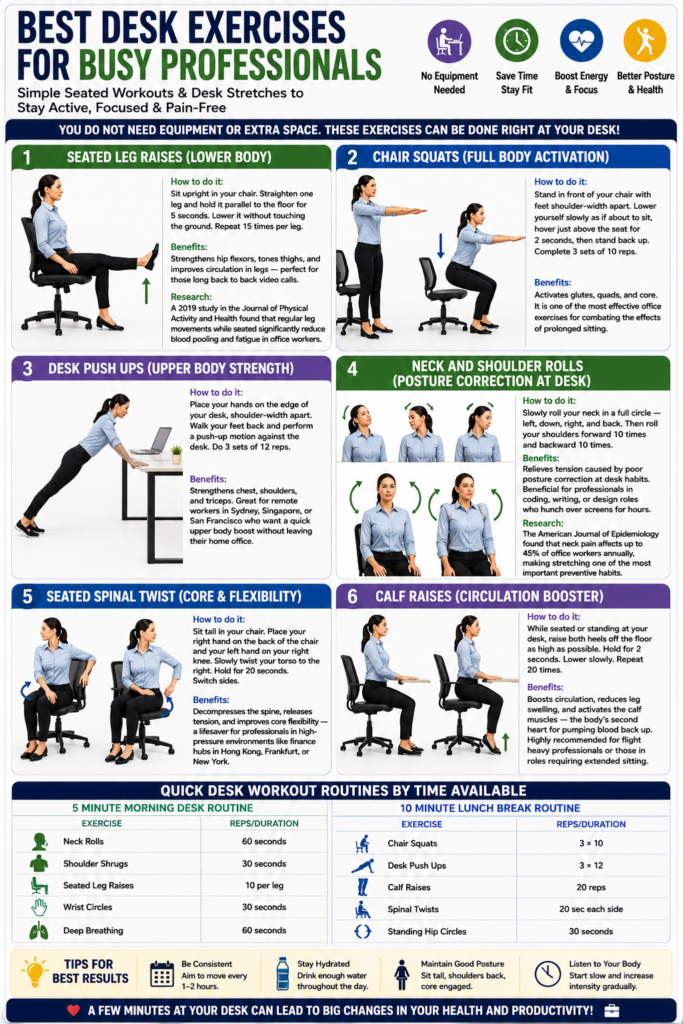
You do not need equipment or extra space. Here are the most effective seated workouts and desk stretches you can do right now.
Seated Leg Raises (Lower Body)
How to do it:
Sit upright in your chair. Straighten one leg and hold it parallel to the floor for 5 seconds. Lower it without touching the ground. Repeat 15 times per leg.
Benefits:
Strengthens hip flexors, tones thighs, and improves circulation in legs — perfect for those long back to back video calls.
Research:
A 2019 study in the Journal of Physical Activity and Health found that regular leg movements while seated significantly reduce blood pooling and fatigue in office workers.
Chair Squats (Full Body Activation)
How to do it:
Stand in front of your chair with feet shoulder-width apart. Lower yourself slowly as if about to sit, hover just above the seat for 2 seconds, then stand back up. Complete 3 sets of 10 reps.
Benefits:
Activates glutes, quads, and core. It is one of the most effective office exercises for combating the effects of prolonged sitting.
Desk Push Ups (Upper Body Strength)
How to do it:
Place your hands on the edge of your desk, shoulder-width apart. Walk your feet back and perform a push-up motion against the desk. Do 3 sets of 12 reps.
Benefits:
Strengthens chest, shoulders, and triceps. Great for remote workers in Sydney, Singapore, or San Francisco who want a quick upper body boost without leaving their home office.
Neck and Shoulder Rolls (Posture Correction at Desk)
How to do it:
Slowly roll your neck in a full circle — left, down, right, and back. Then roll your shoulders forward 10 times and backward 10 times.
Benefits:
Relieves tension caused by poor posture correction at desk habits. Particularly beneficial for professionals in coding, writing, or design roles who hunch over screens for hours.
Research:
The American Journal of Epidemiology found that neck pain affects up to 45% of office workers annually, making stretching one of the most important preventive habits.
Seated Spinal Twist (Core and Flexibility)
How to do it:
Sit tall in your chair. Place your right hand on the back of the chair and your left hand on your right knee. Slowly twist your torso to the right. Hold for 20 seconds. Switch sides.
Benefits:
Decompresses the spine, releases tension, and improves core flexibility — a lifesaver for professionals in high-pressure environments like finance hubs in Hong Kong, Frankfurt, or New York.
Calf Raises (Circulation Booster)
How to do it:
While seated or standing at your desk, raise both heels off the floor as high as possible. Hold for 2 seconds. Lower slowly. Repeat 20 times.
Benefits:
Boosts circulation, reduces leg swelling, and activates the calf muscles — the body’s second heart for pumping blood back up. Highly recommended for flight heavy professionals or those in roles requiring extended sitting.
Quick Desk Workout Routines by Time Available
5 Minute Morning Desk Routine
| Exercise | Reps/Duration |
| Neck Rolls | 60 seconds |
| Shoulder Shrugs | 30 seconds |
| Seated Leg Raises | 10 per leg |
| Wrist Circles | 30 seconds |
| Deep Breathing | 60 seconds |
10 minute Lunch Break Routine
| Exercise | Reps/Duration |
| Chair Squats | 3 × 10 |
| Desk Push Ups | 3 × 12 |
| Calf Raises | 20 reps |
| Spinal Twists | 20 sec each side |
| Standing Hip Circles | 30 seconds |
Work From Home Exercises: Tips for Remote Professionals
Work from home exercises require extra self discipline since there is no office environment to provide structure. Whether you are working remotely in Berlin, Lagos, Melbourne, or Lahore, these tips help:
- Set a movement timer every 45 minutes using your phone or apps like Stand Up! or Stretchy.
- Habit stack your exercises — do calf raises while on calls, stretch during email loading screens.
- Create a micro-workout corner with a resistance band and yoga mat near your desk.
- Schedule lunch break movement — even a 10 minute walk counts as meaningful activity.
A 2021 Stanford University study confirmed that remote workers who incorporated movement breaks into their day reported 34% higher productivity and significantly lower reported stress levels.
How to Build a Sustainable Desk Workout Habit
The biggest reason most desk workout plans fail is complexity. Keep it simple with these steps:
- Start with just 5 minutes a day. Consistency beats intensity.
- Anchor it to existing habits — stretch every time you refill your water bottle.
- Use visual cues — a resistance band on your monitor reminds you to move.
- Track your streak using a habit tracker app or simple calendar marking.
- Invite a colleague — workplace fitness accountability increases follow through by 65%, according to the American Society of Training and Development.
Geo Optimized Note for Office Professionals Worldwide
Whether you are an IT professional in Bangalore, a lawyer in London, a marketer in Dubai, a banker in New York, or a designer in Karachi — the human body responds the same way to sitting too long. The desk workout strategies in this guide are designed to work in any time zone, office type, or work culture. No gym, no commute, no equipment needed. Just your desk, your chair, and a commitment to your health.
10 FAQs
Q1: What is the best desk workout for busy professionals with no time?
A: The 5 minute morning routine using neck rolls, leg raises, and deep breathing is ideal for professionals with extremely tight schedules.
Q2: Can desk exercises help with lower back pain?
A: Yes. Seated spinal twists, hip flexor stretches, and regular posture correction exercises significantly reduce lower back pain from prolonged sitting.
Q3: How often should office workers take movement breaks?
A: Research recommends a 2 to 3 minute movement break every 30 to 45 minutes of sitting for optimal health and focus.
Q4: Are desk workouts effective for weight loss?
A: While desk exercises are not a replacement for cardio, consistent movement breaks increase your daily calorie burn and support weight management when combined with a healthy diet.
Q5: What are the best desk exercises for neck and shoulder pain?
A: Neck rolls, shoulder shrugs, chest opener stretches, and seated side stretches are most effective for relieving tension from screen heavy work.
Q6: Can I do desk workouts while on a video call?
A: Absolutely. Seated leg raises, calf raises, and subtle core engagement exercises can all be done silently during calls without anyone noticing.
Q7: What equipment do I need for a desk workout?
None is required. Optional accessories like a resistance band, desk pedal exerciser, or balance cushion can enhance your routine.
Q8: Are desk workouts good for remote workers?
Yes. Work from home exercises are especially important for remote professionals who lack the incidental movement of commuting and walking around an office.
Q9: How do I fix my posture while working at a desk?
Adjust your chair so your feet are flat on the floor, keep your monitor at eye level, and incorporate posture correction stretches like chest openers and spinal twists throughout the day.
Q10: What is the 20,20,20 rule and how does it help office workers?
Every 20 minutes, look at something 20 feet away for 20 seconds. This reduces eye strain from screens and naturally creates a micro break habit during your workday.
Conclusion
A desk workout for busy professionals is not about squeezing a full gym session into your lunch break. It is about making small, consistent movements throughout the day that add up to a healthier, more energized, and more productive version of you.
From a quick 5 minute morning stretch in your home office in Lahore to a set of chair squats between meetings in a London high rise, these office exercises, desk stretches, and movement breaks are universally accessible and scientifically proven to work.
Start small. Pick one exercise from this guide. Do it today. Your spine, your brain, and your productivity will thank you. Over time, these micro habits compound into a powerful workplace fitness routine that fits seamlessly into even the busiest professional life.