Introduction| Why sitting all day causes back pain| Signs you need to move more at your desk| Best office exercises for back pain (No equipment needed)| Quick 5 minutes desk stretching routine| Ergonomic tips to reduce back pain at home| Additional tips for long term back health| FAQS| Conclusion|
Introduction:
If you spend eight hours a day hunched over a keyboard, you know that stupid pain that creeps back into your lows around noon. The top news is that office exercise for back pain doesn’t even need to leave the gym, yoga mat, or chair for recurring pain. With a handful of desk stretches, taller sitting posture, small ergonomic tweaks, and regular movement breaks, you can alleviate workplace back pain and protect your back in the long run Research shows that 23% to 38% of office workers experience significant pain reduction in a year or more and its amazing currency sits long. This guide walks you through why desk jobs cause back pain, great stretches and strengthening movements you can do without equipment, and easy habits to prevent the pain from coming back.
Why Sitting All Day Causes Back Pain
Your spine is built to move, not to stay locked in one position for hours. When you sit for long stretches, several things happen at once, and they compound over a workday.
Poor Posture and Spinal Compression
Slouching forward toward a screen flattens the natural curve of your lower back and shifts pressure onto the discs between your vertebrae. Over time, this compression irritates the muscles and ligaments that support your spine.
Weak Core Muscles
Your abdominal and lower back muscles act like a natural corset, holding your spine upright. Sitting for hours without engaging them lets these muscles weaken, so your spine relies more on ligaments and less on muscle support — a setup for strain.
Tight Hip Flexors and Hamstrings
Sitting keeps your hip flexors in a shortened position all day. Tight hips pull on the pelvis and lower back, which can throw off your posture even when you’re standing.
<cite index=”4-1″>More than 1 in 4 working adults report current back pain, and both work related and non work related episodes can contribute to missed workdays and difficulty resuming normal tasks.</cite> A lab based study on office workers found something striking: <cite index=”8-1″>low back pain prevalence rose from 15% to 40% after just 30 minutes in one position, whether sitting or standing.</cite> The takeaway is simple — the problem isn’t the chair itself, it’s staying still for too long.
Signs You Need to Move More at Your Desk
Not all back pain is the same, and recognizing your symptoms helps you choose the right response.
Common signs of desk related back pain include:
- A dull, aching stiffness that builds throughout the day
- Tightness that eases slightly when you stand or walk
- Discomfort that’s worse in the afternoon than the morning
- Reduced flexibility when reaching or twisting
See a doctor or physical therapist if you experience:
- Sharp, shooting pain down one leg
- Numbness, tingling, or weakness in your legs or feet
- Pain that wakes you up at night
- Back pain following a fall or injury
For everyday stiffness and tension without these red-flag symptoms, the exercises below are a safe and effective starting point.
Best Office Exercises for Back Pain (No Equipment Needed)
These desk stretches and strengthening moves target the muscles that tighten up most from sitting: your lower back, hips, hamstrings, and upper back. Do each one slowly, breathe steadily, and stop if anything feels sharply painful — mild stretching tension is fine, pain is not.
1. Seated Spinal Twist
Sit tall, place one hand on the opposite knee, and gently twist your torso toward the back of your chair. Hold for 15 to 20 seconds, then switch sides. This restores rotation to a spine that’s been locked facing forward.
2. Chair Cat Cow Stretch
Place your hands on your knees. Inhale as you arch your back and lift your chest (cow), then exhale as you round your spine and tuck your chin (cat). Repeat 8 to 10 times to loosen the entire length of your spine.
3. Seated Forward Fold
Sitting at the edge of your chair, hinge forward from your hips and let your arms hang toward the floor. Hold for 20 to 30 seconds. This releases tension in your lower back and hamstrings simultaneously.
4. Desk Plank
Place your hands on the edge of a sturdy desk, step back, and hold a straight line from head to heels for 15 to 20 seconds. This builds core strength without ever getting on the floor.
5. Standing Back Extension
Stand up, place your hands on your lower back, and gently lean backward while looking slightly upward. Hold for 5 seconds and repeat 5 times. This counteracts hours of forward flexion.
6. Standing Hip Flexor Stretch
Step one foot back into a gentle lunge, keeping your back heel lifted, and tuck your pelvis slightly forward. Hold 20 seconds per side to release tight hip flexors that pull on your lower back.
7. Shoulder Blade Squeezes
Sit or stand tall, pull your shoulder blades together as if pinching a pencil between them, and hold for 5 seconds. Repeat 10 times to strengthen the upper back muscles that support good posture.
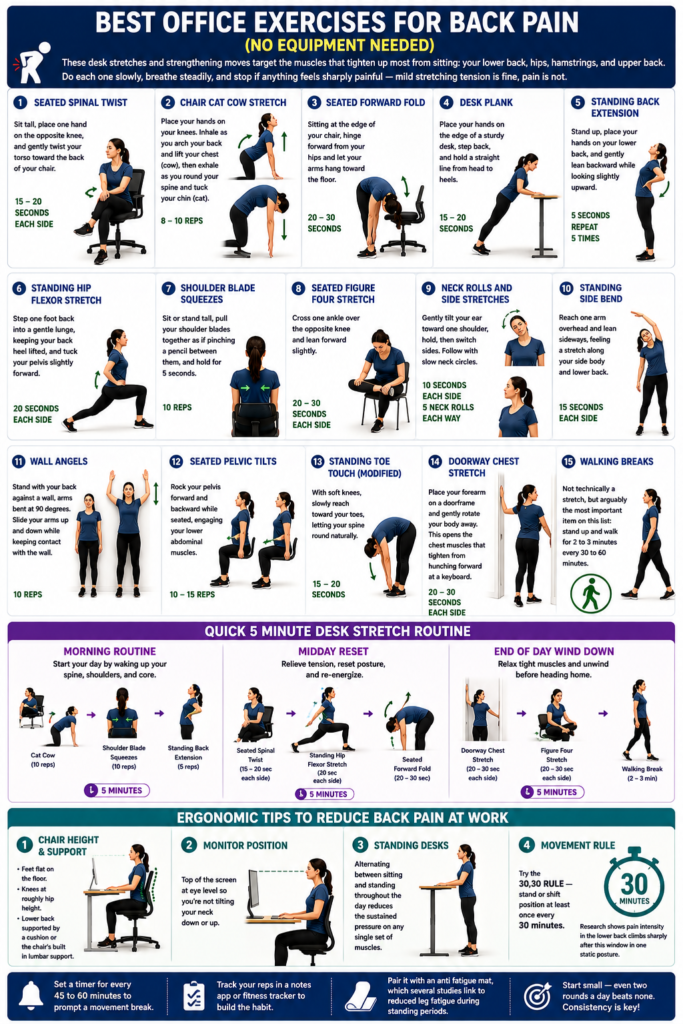
8. Seated Figure Four Stretch
Cross one ankle over the opposite knee and lean forward slightly. This targets the glutes and piriformis, muscles that often refer tension into the lower back.
9. Neck Rolls and Side Stretches
Gently tilt your ear toward one shoulder, hold, then switch sides. Follow with slow neck circles. This relieves the upper back and neck tightness that often travels down the spine.
10. Standing Side Bend
Reach one arm overhead and lean sideways, feeling a stretch along your side body and lower back. Hold 15 seconds per side.
11. Wall Angels
Stand with your back against a wall, arms bent at 90 degrees. Slide your arms up and down while keeping contact with the wall. This strengthens the upper back and improves shoulder posture.
12. Seated Pelvic Tilts
Rock your pelvis forward and backward while seated, engaging your lower abdominal muscles. This is a gentle way to mobilize the lumbar spine and wake up your core.
13. Standing Toe Touch (Modified)
With soft knees, slowly reach toward your toes, letting your spine round naturally. This is a gentler alternative to a full forward fold for tighter hamstrings.
14. Doorway Chest Stretch
Place your forearm on a doorframe and gently rotate your body away. This opens the chest muscles that tighten from hunching forward at a keyboard.
15. Walking Breaks
Not technically a stretch, but arguably the most important item on this list: stand up and walk for two to three minutes every 30 to 60 minutes. It resets circulation, relieves disc pressure, and re-enages the muscles that sitting turns off.
Quick 5 Minute Desk Stretch Routine
Morning routine: Cat cow (10 reps), shoulder blade squeezes (10 reps), standing back extension (5 reps)
Midday reset: Seated spinal twist, standing hip flexor stretch, seated forward fold
End of day wind down: Doorway chest stretch, figure four stretch, walking break around the office or block
Ergonomic Tips to reduce Back Pain at Work
Stretching helps undo tension, but ergonomics prevents it from building up in the first place.
- Chair height: Feet flat on the floor, knees at roughly hip height, lower back supported by a cushion or the chair’s built in lumbar support.
- Monitor position: Top of the screen at eye level so you’re not tilting your neck down or up.
- Standing desks: Alternating between sitting and standing throughout the day reduces the sustained pressure on any single set of muscles.
- Movement rule: Try the 30,30 rule — stand or shift position at least once every 30 minutes, since research shows pain intensity in the lower back climbs sharply after this window in one static posture.
Additional Tips for Long Term Back Health
- Strengthen your core outside of work with planks, bridges, and bird dogs a few times a week — a strong core takes pressure off your spine during the workday.
- Stay hydrated, since spinal discs rely on water content to stay cushioned and absorb shock.
- Build posture awareness by periodically checking whether your ears, shoulders, and hips are stacked in a straight line.
- Consider physical therapy if pain persists beyond a few weeks despite stretching and ergonomic changes — a therapist can identify muscle imbalances specific to you.
FAQs About Office Exercises for Back Pain
1. What is the fastest way to relieve back pain during tabletop activities?
Getting up and walking for 2 to 3 min, mixed with seated dorsiflexion or forward fold, provides the fastest approach using spinal decompression and flow restoration .
2. Can workplace exercises undoubtedly prevent persistent back pain?
Indeed. Regular exercise and posture focused exercise programs reduce the constant pressure that leads to ongoing pain, although they do quality work along with ergonomic adjustment .
3. How regularly should I exercise during work hours?
Aim for small stretch injuries every 30 to 60 minutes, even if it’s just over the squat and rolls your shoulders.
4. Are standing desks higher for back pain?
Standing tables help alternate with the seated ones. Standing all day creates its own stress, so transitioning throughout the day is extra powerful than the extremes.
5.Why does my lower back suffer more at the end of the afternoon?
Accumulated sitting time compresses the spinal disc and stabilizes muscle mass as it fatigues, so discomfort often builds as the day progresses.
6. Do I need special equipment for office sports events?
No, only your chair, table, or bodyweight is used in each exercise in this manual.
7. Is it normal to feel painfully uncomfortable with exercise?
Mild stress is common; There is no sharp or shooting pain. Stop any stretches that cause sharp pain and consult a health professional.
8. How long before I improve my words?
Many people report reduced stiffness within one to 2 weeks of regular stretching and movement breaks.
9. Can a negative posture on the computer cause the pain again?
Indeed. Posture is especially important in addition to total hours — even for short distances, the squatting position emphasizes the same muscle groups.
10. Should I exercise before or after sitting for a long time?
both. A quick stretch before a longer meeting primes the muscle mass, and a stretch afterwards releases the buildup of tension.
Conclusion
Again, pain need not take away from the complexity or time of an office physical activity. A few minutes of exercise, a brisk walk for half an hour and small ergonomic adjustments to the chair and curtains can reduce the stiffness and pain that includes a table therapy Start small: choose 3 exercises from this list, set a reminder to get up for it half an hour, then build up. Your back will thank you with a week of sacrifice.