Introduction| Why every beginner need a structured gym plan| A solid beginners gym workout plan does several things at once| Common mistakes new gym goers make without plan| Key fitness terms you need to know before starting| Setting realistic expectations for your first month| Here the what that actually looks like week by week| Choose a right equipment for your gym routine| Complete gym workout plan for beginners| Essential exercises for every beginners plan| What actually supports you in your gym recovery| How do you know your beginner plan is working| FAQS| Conclusion
Introduction:
Walking into a gym for the first time is genuinely intimidating. The machines look complicated, the weights feel impossibly heavy, and everyone else seems to know exactly what they are doing. Here is the truth: most of them felt exactly the same way on day one. What separated the people who built real strength from the ones who quit by week three was simple. They had a workout plan for gym beginners, and they followed it.
This guide gives you that plan. You will get a complete week by week training structure built on proven exercise science, an explanation of every key concept you need to understand, and the exact movements that deliver the best results for new gym goers. No filler, no fluff. Just a clear, actionable roadmap from your first session to measurable progress.
Why Every Beginner Needs a Structured Gym Workout Plan
Showing up to the gym without a plan is the single biggest mistake new trainees make. A 2019 study published in the Journal of Strength and Conditioning Research found that individuals who followed a structured training program for eight weeks achieved 40% greater strength gains than those who trained without a defined program. That gap is not marginal. It is the difference between seeing results and wondering why nothing is changing.
A solid beginner gym workout plan does several things at once:
Removes decision fatigue. You know what you are doing before you walk through the door.
Applies progressive overload automatically. The plan tells you exactly when to increase weight or reps, which is how muscle grows.
Build habits through routine. Consistency is easier when you follow a schedule rather than improvising.
Reduces injury risk. Movements are introduced gradually, giving your joints and connective tissue time to adapt.
Creates measurable benchmarks. You can track performance week over week and see real improvement.
In practice, the clients I have worked with who follow a written plan are consistently the ones still training six months later. The ones who wing it rarely make it past the eight-week mark.
Common Mistakes New Gym Goers Make Without a Plan
Without a beginner fitness plan, most new trainees fall into the same predictable traps. Recognising them now saves you weeks of wasted effort.
Doing random exercises with no progression. Trying a little of everything and never getting better at anything. Strength requires specificity and repetition.
Avoiding compound movements. Beginners often gravitate toward machines and isolation exercises like bicep curls because they feel safer. Compound movements like squats, deadlifts, and bench press deliver far greater results per session.
Overtraining in week one. Enthusiasm is great, but training six or seven days as a complete beginner creates soreness so severe it becomes a barrier to returning. The National Safety Council reports nearly 500,000 weight training related injuries in the United States each year, and overexertion combined with poor form accounts for a significant portion of those.
Ignoring recovery. Muscles grow during rest, not during the workout itself. A plan builds rest days by design.
Chasing heavy weight before mastering form. This is the fastest route to an injury that sets you back months.
Key Fitness Terms You Need to Know Before Starting
Before you touch a single weight, understanding the language of strength training makes every session more effective. These are the terms you will encounter constantly in any gym beginner workout guide.
Reps (Repetitions):
One complete movement. One squat equals one rep.
Sets:
A group of consecutive reps. Three sets of ten means you do ten reps, rest, and repeat three times total.
Rest Period: Time between sets. For beginners, 60 to 90 seconds is the standard range.
Progressive Overload:
Gradually increase the demand on your body over time through more weight, more reps, or shorter rest. This is the core principle behind all strength development.
Compound Exercise:
A movement engaging multiple muscle groups simultaneously. Examples include squats, deadlifts, and bench press.
Isolation Exercise:
A movement targeting one specific muscle. Examples include bicep curls and leg extensions.
RPE (Rate of Perceived Exertion):
A scale from 1 to 10 rating how hard you are working. Beginners should target an RPE of 6 to 7 per set.
1RM (One Rep Max):
The maximum weight you can lift for a single full repetition. New trainees typically work at 50 to 70% of their estimated 1RM during early training phases.
Setting Realistic Expectations for Your First Month
Social media is full of dramatic transformations, but real, sustainable progress follows a predictable timeline. The American College of Sports Medicine confirms that beginners can expect a 20 to 40% increase in muscular strength within the first few months of consistent resistance training.
Here is what that actually looks like week by week:
Weeks 1 to 2:
Movements feel awkward, soreness is significant, and you are primarily learning motor patterns. This is normal. Do not increase weight yet.
Weeks 3 to 4:
Your nervous system adapts rapidly. The same weights start to feel lighter and your form improves noticeably. This is called neuromuscular adaptation, and it accounts for the majority of early strength gains before significant muscle mass develops.
Weeks 5 to 8:
You begin to feel genuinely stronger. Progressive overload kicks in meaningfully, and you can start adding weight to your lifts in small increments.
Set your first month goal around performance, not appearance. Aim to complete every scheduled session, improve your technique, and add a small amount of weight or reps each week.
Choosing the Right Equipment for a Beginner Gym Routine
You do not need every machine in the building. For a well-structured strength training program for beginners, these are the essentials worth learning first:
Dumbbells:
Beginner friendly, versatile, and excellent for developing stability alongside strength.
Barbells:
The most efficient tool for compound movements like squats and deadlifts. Introduced after basic form is established.
Cable machines:
Allow controlled movement through a full range of motion and are excellent for accessory work.
Adjustable bench:
Used for pressing movements, rows, and step-ups.
Lat pulldown machine or pull up bar:
Essential for building upper back and lat strength.
Resistance bands:
Ideal for warm ups, mobility work, and assistance on pulling exercises.
A practical tip:
spend your first two sessions simply walking through the gym, identifying equipment, and practicing movements with light weight or bodyweight only. Familiarity with the environment removes a significant source of beginner anxiety.
The Complete Workout Plan for Gym Beginners: Week by Week Breakdown
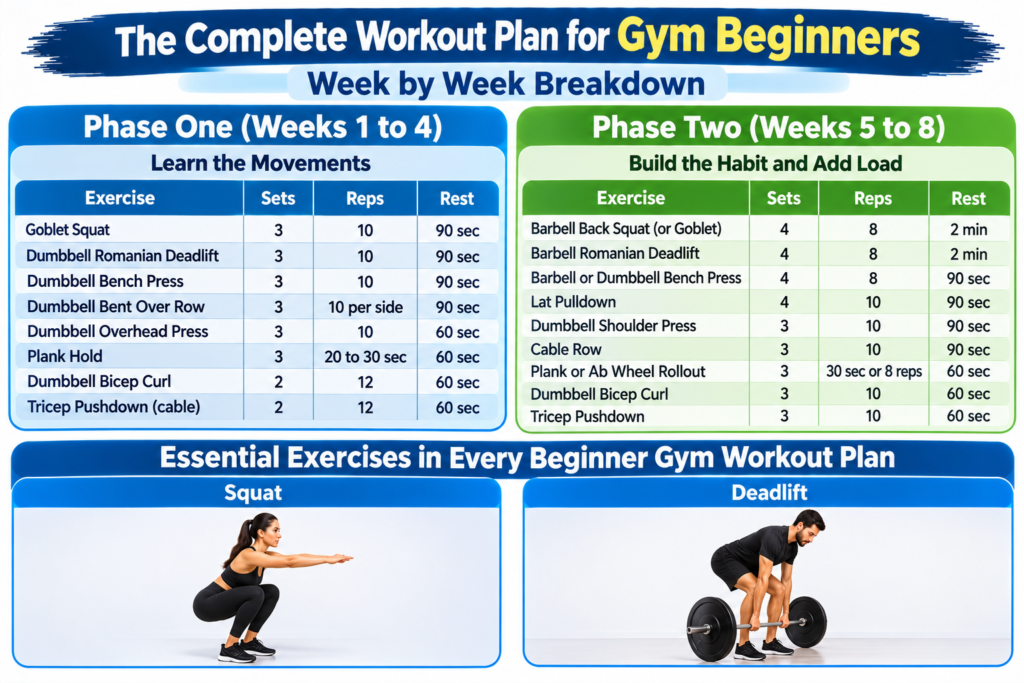
This workout plan for gym beginners uses a three day per week full body training structure. Training three days per week with rest days between sessions gives your body adequate recovery time, which is where actual muscle growth occurs. The plan runs eight weeks and applies progressive overload across two distinct phases.
Phase One (Weeks 1 to 4):
Learn the Movements
During the first four weeks, your primary job is mastering form and showing up consistently. Keep weights light enough that you could do two or three more reps at the end of each set. Every session is a practice session, not a performance.
Training Days:
Monday, Wednesday, Friday (or any three non-consecutive days)
Session Structure (Weeks 1 to 4)
Exercise Sets Reps Rest
Goblet Squat 3 10 90 sec
Dumbbell Romanian Deadlift 3 10 90 sec
Dumbbell Bench Press 3 10 90 sec
Dumbbell Bent Over Row 3 10 per side 90 sec
Dumbbell Overhead Press 3 10 60 sec
Plank Hold 3 20 to 30 sec 60 sec
Dumbbell Bicep Curl 2 12 60 sec
Tricep Pushdown (cable) 2 12 60 sec
Form cues to prioritise:
Goblet Squat:
Keep chest tall, knees tracking over toes, descend until thighs are parallel to the floor.
Romanian Deadlift:
Hinge at the hips, not the lower back. Keep the weight close to your legs throughout the movement.
Bench Press:
Plant your feet flat on the floor, lower the dumbbells to chest height, and press directly upward.
Bent Over Row:
Brace your core, keep your back flat, and pull the dumbbell toward your hip rather than your shoulder.
Phase Two (Weeks 5 to 8):
Build the Habit and Add Load
In phase two, you transition from learning movements to building genuine strength. You will increase weight by 5% increments when you can complete all sets and reps with clean form. You will also add one additional set to each major compound movement.
Session Structure (Weeks 5 to 8)
Exercise Sets RepsRest
Barbell Back Squat (or Goblet) 4 8 2 min
Barbell Romanian Deadlift 4 8 2 min
Barbell or Dumbbell Bench Press 4 8 90 sec
Lat Pulldown 4 10 90 sec
Dumbbell Shoulder Press 3 10 90 sec
Cable Row 3 10 90 sec
Plank or Ab Wheel Rollout 3 30 sec or 8 reps 60 sec
Dumbbell Bicep Curl 3 10 60 sec
Tricep Pushdown 3 10 60 sec
What this means for you practically:
if you bench pressed 20-pound dumbbells for 3 sets of 10 in week four, you move to 22.5 pounds in week five. Small, consistent increases compound into significant strength gains over time.
Essential Exercises in Every Beginner Gym Workout Plan
The five compound movements below form the backbone of any effective gym workout for beginners. Master these and you will have built a foundation that supports every other fitness goal you pursue.
Squat
The squat is the single most effective lower body exercise available to you. It targets the quadriceps, hamstrings, glutes, and core simultaneously. Start with a goblet squat using a light dumbbell, then progress to a barbell back squat once your form is consistent and comfortable.
Deadlift
The deadlift builds posterior chain strength (glutes, hamstrings, lower back) more efficiently than almost any other movement. The Romanian deadlift is the best starting variation for beginners because it teaches the hip hinge pattern without the technical complexity of a conventional deadlift from the floor.
Bench Press
The bench press develops chest, shoulder, and tricep strength. Dumbbells are the better starting tool because they require each arm to work independently, which helps identify and correct strength imbalances early.
Row
Rows train the upper back, rear deltoids, and biceps. In a beginner starter gym plan, rows are equally important as pressing movements. Neglecting upper back training is one of the most common structural mistakes in early training, and it leads to poor posture and shoulder problems over time.
Overhead Press
The overhead press strengthens the shoulders, upper chest, and triceps while demanding core stability to keep you upright under load. It directly translates to functional strength used in everyday movement patterns.
How to Warm Up and Cool Down Properly
Every session in your beginner gym training plan should begin with five to ten minutes of warm-up and end with five minutes of cooldown. Skipping either increases injury risk and slows recovery.
Warm Up Protocol
Three to five minutes of light cardio (brisk walking, rowing machine, or stationary bike at low resistance)
Hip circles, leg swings, and arm circles to mobilise major joints
Two light warm up sets of the first exercise at 50% of your working weight
Cooldown Protocol
Three to five minutes of low intensity walking to bring heart rate down gradually
Static stretching targeting the muscles you trained:
quad stretch, hip flexor stretch, chest opener, and lat stretch (30 seconds per position)
Nutrition and Recovery:
What Actually Supports Your Gym Progress
Your workout plan for gym beginners only works as well as the recovery you build around it. Training creates the stimulus for adaptation. Nutrition and sleep deliver the actual results.
Protein intake:
Research consistently supports consuming 1.6 to 2.2 grams of protein per kilogram of bodyweight per day for individuals engaged in resistance training. For a 75 kilogram person, that is roughly 120 to 165 grams daily. Practical sources include chicken, eggs, Greek yoghurt, cottage cheese, fish, and legumes.
Caloric intake:
If your goal is to build muscle, you need to eat at a slight caloric surplus of approximately 200 to 300 calories above your maintenance level. If your goal is fat loss alongside building strength, a modest deficit of 200 to 300 calories works well for beginners, who have a unique window of simultaneously losing fat and gaining muscle known as body recomposition.
Sleep:
The American Academy of Sleep Medicine recommends seven to nine hours per night for adults. Growth hormone, which drives muscle repair and development, is primarily released during deep sleep. Training hard and sleeping six hours is a combination that actively works against your results.
Hydration:
Aim for a minimum of 2.5 to 3 litres of water daily. Dehydration of even 2% of body weight impairs strength output measurably, according to research published in the Journal of Athletic Training.
Tracking Progress:
How to Know Your Beginner Gym Plan Is Working
Tracking your workouts is the simplest and most underused tool available to beginners. Use a notebook, a phone note, or a free app like Strong or Heavy to log the following after every session:
Exercise name
Weight used
Sets and reps completed
Any notes on form or how the weight felt
Review your log weekly. If you are completing all sets and reps with clean form, increase the weight by 2.5 to 5 kilograms on compound lifts at the next session. This is progressive overload in its most practical form, and it is the engine behind all long-term strength development.
A real world example:
A beginner following this plan for eight weeks might start squatting a 10 kilogram goblet squat for 3 sets of 10 and finish the program back squatting 50 kilograms for 4 sets of 8. That progression is realistic, and it represents a fundamental transformation in functional strength.
Key Takeaways
- A structured workout plan for gym beginners produces measurably better results than unplanned training, with research showing up to 40% greater strength gains over eight weeks.
- The first four weeks should prioritise learning movement patterns over lifting heavy. Neuromuscular adaptation drives the majority of early strength improvements.
- Three full body training sessions per week with rest days between each is the optimal frequency for beginners to balance stimulus and recovery.
- Compound movements (squat, deadlift, bench press, row, overhead press) should anchor every beginner gym workout routine because they deliver the greatest return on training time.
- Progressive overload, adequate protein intake (1.6 to 2.2 grams per kilogram of bodyweight), and seven to nine hours of sleep are the three non-negotiable pillars that make your gym plan actually work.
Frequently Asked Questions
1.How many days per week should a gym beginner work out?
Three days per week is the research backed sweet spot for beginners. This frequency provides enough training stimulus to drive consistent strength and muscle gains while allowing adequate recovery between sessions. Training more frequently as a beginner often leads to excessive soreness and elevated injury risk before your body has adapted to the demands of resistance training.
2.How long does it take to see results from a beginner gym workout plan?
Most beginners notice measurable strength improvements within two to three weeks, primarily due to neuromuscular adaptation. Visible changes in muscle definition and body composition typically appear between weeks six and twelve, depending on nutrition, sleep quality, and training consistency. Setting performance based goals (adding weight to lifts, completing more reps) during the first two months keeps you motivated before aesthetic changes become obvious.
3.Should gym beginners use machines or free weights?
A mix of both works best. Machines guide your body through a fixed path, which makes them easy to learn and a good way to build confidence in your first few weeks. Free weights, such as dumbbells and goblet squats, challenge your balance and coordination and carry over more naturally to everyday movement.
4. How many days per week should a gym beginner work out?
Three days per week is the research-backed sweet spot for beginners. This frequency provides enough training stimulus to drive consistent strength and muscle gains while allowing adequate recovery between sessions. Training more frequently as a beginner often leads to excessive soreness and elevated injury risk before your body has adapted to the demands of resistance training.
5. How long does it take to see results from a beginner gym workout plan?
Most beginners notice measurable strength improvements within two to three weeks, primarily due to neuromuscular adaptation. Visible changes in muscle definition and body composition typically appear between weeks six and twelve, depending on nutrition, sleep quality, and training consistency. Setting performance-based goals (adding weight to lifts, completing more reps) during the first two months keeps you motivated before aesthetic changes become obvious.
6. Should gym beginners use machines or free weights?
A mix of both works best. Machines guide the movement path, which makes them easier to learn and a good way to build confidence in your first few weeks. Free weights, such as dumbbells and goblet squats, train balance and coordination and carry over better to everyday movement. Research shows both can build strength and muscle, so choose whichever lets you use good form, and gradually bring more free weights into your routine.
7. How long should a beginner workout last?
Aim for 40 to 60 minutes, including a 5 minute warm up and a short cool down. That is enough time for five to six exercises with proper rest between sets. Longer sessions rarely add benefit for beginners and often lead to fatigue and sloppy form. If you’re short on time, a focused 30 minute session still counts.
8. How many sets and reps should a beginner do?
The American College of Sports Medicine’s 2009 position stand recommends that novices start with one to three sets of 8 to 12 repetitions per exercise, using a weight that feels challenging but manageable. Rest 60 to 90 seconds between sets, and stop each set with one or two clean reps still in reserve. Begin with two sets, then add a third once the movements feel comfortable.
9. Do beginners need cardio as well as strength training?
Yes, a little. The World Health Organization’s 2020 guidelines recommend 150 to 300 minutes of moderate aerobic activity weekly, plus muscle strengthening on two or more days. You don’t need to hit that on day one. Start with brisk walks or an easy bike ride for 10 to 15 minutes after lifting or on rest days, then build up gradually.
10. Is muscle soreness normal, and should I train when I’m sore?
Mild soreness, which usually peaks 24 to 48 hours after a new workout, is a normal response and fades as your body adapts. Light movement such as walking or stretching can ease stiffness. If soreness is severe or lasts more than several days, take extra rest. Sharp, sudden, or joint pain is different from normal soreness, so stop and check with a doctor or qualified trainer.
Conclusion
A good workout plan for beginners doesn’t need to be complicated. Train three days a week, build each session around a handful of simple compound movements, keep your sets and reps modest, and add weight or reps slowly. The research supports this steady approach: it delivers early strength gains, lowers injury risk, and fits easily into a busy week.
Focus on form, rest well, and track your progress in a notebook or app so you can see your improvement. Results build over weeks and months, not days. Pick your first workout, put it in your calendar, and show up for the first four weeks. That consistency is what turns a beginner into someone who genuinely enjoys training.