Introduction| What is full body gym workout routine| How full body training is differs from split routines| Why full body workout is effective for strength and fat loss| Who should follow a full body workout routine| Key principles to built an effective full body gym workout routine| Structure your weekly schedule intelligently| 6 full body workout gym workout plan| | Tips to get the best results| Common mistakes to avoid| Key takeaways| FAQS| Conclusion|
Introduction:
Most people spend five or six days a week in the gym and still wonder why their strength and body composition barely change. The problem usually is not effort. It is structured. A well designed full body gym workout routine consistently outperforms most split programs for both fat loss and strength, and the research backs this up.
This guide gives you six complete workouts, the science behind why this approach works, and the exact principles you need to make it deliver real results. Whether you are new to the gym or returning after a break, this is the most efficient training structure you can follow.
What Is a Full Body Gym Workout Routine?
A full body gym workout routine is a training approach where every session targets all major muscle groups: your legs, back, chest, shoulders, arms, and core. Instead of splitting your week so that Monday is chest, Wednesday is legs, and Friday is arms, you train every major movement pattern in a single session, repeated two to four times per week.
This is not a new concept. It is actually how most athletes and lifters trained before the bodybuilding-era split routines became popular. And in recent years, sports science has confirmed what many coaches knew intuitively: training a muscle more frequently produces faster, more consistent adaptations than hammering it once a week with high volume.
In practice, this style of training is simpler to program, easier to stick to, and more forgiving when life gets in the way and you miss a session.
How Full Body Training Differs from Split Routines
The core difference between a full body program and a split routine comes down to one variable: training frequency per muscle group.
A traditional split routine, sometimes called a “bro split,” dedicates each session to one or two muscle groups. You might train chest on Monday, back on Tuesday, and legs on Wednesday. Each muscle group gets a high volume of work in that single session, but then waits five to seven days before being trained again.
Full body training flips this model. Instead of one high-volume session per muscle group per week, you train each muscle group two to four times per week at moderate volume per session. Research published in the Journal of Strength and Conditioning Research found that training a muscle group twice per week produces significantly greater hypertrophy compared to training it once per week, even when total weekly volume is equal.
What this means for you is straightforward. More frequent exposure to a movement pattern means faster motor learning, more consistent muscle protein synthesis, and quicker strength gains. Both approaches can work, but full body routines are generally more efficient and far more beginner-friendly.
Why Full Body Workouts Are Effective for Strength and Fat Loss
Full body workouts earn their reputation because they are built around compound movements. Exercises like squats, deadlifts, rows, and overhead presses recruit multiple muscle groups simultaneously, which drives calorie burn and strength development in ways that isolation exercises simply cannot match.
The Calorie Burn Advantage
According to research reviewed by the American Council on Exercise, compound exercises can burn 30 to 40 percent more calories per session than isolation-focused training. When you squat, you engage your quads, hamstrings, glutes, core, and upper back all at once. That full-body muscle recruitment pushes your heart rate up and raises your metabolic demand significantly.
Beyond the session itself, large-muscle-group resistance training elevates post-exercise oxygen consumption (EPOC) for up to 38 hours after training, according to a study in the Journal of Translational Medicine. Your body continues burning additional calories long after you leave the gym, which makes this style of training one of the most effective fat loss workout plans available.
The Strength Development Advantage
Strength is a skill. The more often you practice a movement, the more efficient your nervous system becomes at recruiting muscle fibers for that pattern. Training your squat, deadlift, and press three times per week instead of once accelerates that process dramatically.
In practice, clients who switch from a chest-and-arms-heavy split to a structured full body strength training routine regularly add 20 to 30 pounds to their squat and deadlift within eight weeks. That is not because they are suddenly training harder. It is because they are training the movement more often.
The National Strength and Conditioning Association (NSCA) recommends training all major muscle groups at least twice per week for optimal strength development. A full body routine makes this automatic.
Who Should Follow a Full Body Gym Workout Routine
This training style suits a wide range of people, but it is especially effective for the following:
- Beginners who want to learn all major movement patterns quickly and build a foundation of strength
- Busy individuals who can realistically commit to only two or three gym sessions per week
- Fat loss seekers who want to maximize calorie burn and elevate their metabolic rate each session
- Intermediate lifters who have hit a plateau on a split routine and want to increase training frequency without adding gym days
- Anyone returning to training after a period of inactivity, injury, or illness
One common misconception is that full body training is only for beginners. In reality, many experienced athletes and strength coaches use total-body training year-round. The mistake most people make is assuming more training days always equals more progress. Frequency of stimulus, not sheer volume, drives most of the adaptation.
Key Principles to Build an Effective Full Body Gym Workout Routine
Before walking through the six workouts, you need to understand the principles that make any full body gym workout routine actually work. These are not optional. They are the difference between steady progress and spinning your wheels.
Choose Compound Movements First
The foundation of your session should always be compound exercises. These deliver the greatest return on investment for time, muscle activation, and calorie burn. Organize your movement selection around six fundamental patterns:
- Squat pattern: Barbell back squat, goblet squat, leg press
- Hip hinge pattern: Deadlift, Romanian deadlift, kettlebell swing
- Horizontal push: Barbell bench press, dumbbell chest press, push-up
- Horizontal pull: Barbell row, dumbbell row, seated cable row
- Vertical push: Overhead press, dumbbell shoulder press
- Vertical pull: Pull-up, lat pulldown, cable pullover
Isolation exercises like bicep curls, lateral raises, and tricep extensions have a place, but they are secondary. Spend 70 to 80 percent of your training time on compound work and 20 to 30 percent on targeted isolation movements.
Understand Sets, Reps, and Rest Periods
The right rep range depends on your goal. For strength, work in the 3 to 6 rep range with heavier loads and 2 to 4 minutes of rest between sets. For hypertrophy (muscle building), 6 to 12 reps with 60 to 90 seconds of rest is optimal. For muscular endurance and fat loss circuits, 12 to 20 reps with shorter rest periods of 30 to 60 seconds works well.
A typical full body session for a beginner or intermediate lifter might look like this:
- 3 to 4 compound exercises: 3 to 4 sets of 6 to 10 reps each
- 2 to 3 isolation or accessory exercises: 2 to 3 sets of 10 to 15 reps each
- Total session time: 45 to 65 minutes
Apply Progressive Overload Consistently
Progressive overload is the single most important principle in any gym program. It means you must consistently increase the demand placed on your muscles over time, whether through adding weight, increasing reps, reducing rest, or improving form under the same load. Without progressive overload, your body has no reason to adapt.
Track your workouts. Write down your weights, sets, and reps. Aim to improve at least one variable every one to two weeks. This simple habit separates people who see consistent progress from those who plateau within a few months.
Structure Your Weekly Schedule Intelligently
For a full body gym workout routine, three sessions per week is the sweet spot for most people. A common schedule is Monday, Wednesday, and Friday, which allows 48 hours of recovery between each session. You can also train Tuesday, Thursday, and Saturday if that fits your week better.
If you can only commit to two sessions per week, you will still see meaningful results. Research consistently shows that two well-structured full body sessions per week produce significant strength and body composition improvements, particularly for beginners and intermediate trainees.
The 6 Full Body Gym Workouts
These six workouts are organized by goal and difficulty. Rotate through them or use them as a progressive program over six to twelve weeks.
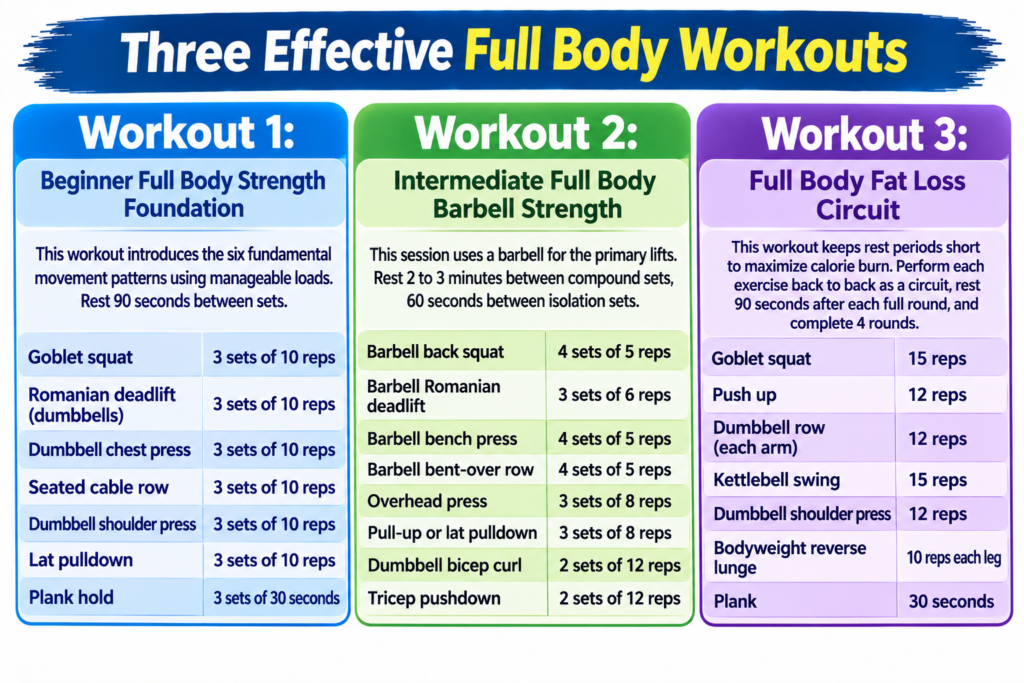
Workout 1: Beginner Full Body Strength Foundation
This workout introduces the six fundamental movement patterns using manageable loads. Rest 90 seconds between sets.
- Goblet squat: 3 sets of 10 reps
- Romanian deadlift (dumbbells): 3 sets of 10 reps
- Dumbbell chest press: 3 sets of 10 reps
- Seated cable row: 3 sets of 10 reps
- Dumbbell shoulder press: 3 sets of 10 reps
- Lat pulldown: 3 sets of 10 reps
- Plank hold: 3 sets of 30 seconds
Workout 2: Intermediate Full Body Barbell Strength
This session uses a barbell for the primary lifts. Rest 2 to 3 minutes between compound sets, 60 seconds between isolation sets.
- Barbell back squat: 4 sets of 5 reps
- Barbell Romanian deadlift: 3 sets of 6 reps
- Barbell bench press: 4 sets of 5 reps
- Barbell bent-over row: 4 sets of 5 reps
- Overhead press: 3 sets of 8 reps
- Pull-up or lat pulldown: 3 sets of 8 reps
- Dumbbell bicep curl: 2 sets of 12 reps
- Tricep pushdown: 2 sets of 12 reps
Workout 3: Full Body Fat Loss Circuit
This workout keeps rest periods short to maximize calorie burn. Perform each exercise back to back as a circuit, rest 90 seconds after each full round, and complete 4 rounds.
- Goblet squat: 15 reps
- Push up: 12 reps
- Dumbbell row (each arm): 12 reps
- Kettlebell swing: 15 reps
- Dumbbell shoulder press: 12 reps
- Bodyweight reverse lunge: 10 reps each leg
- Plank: 30 seconds
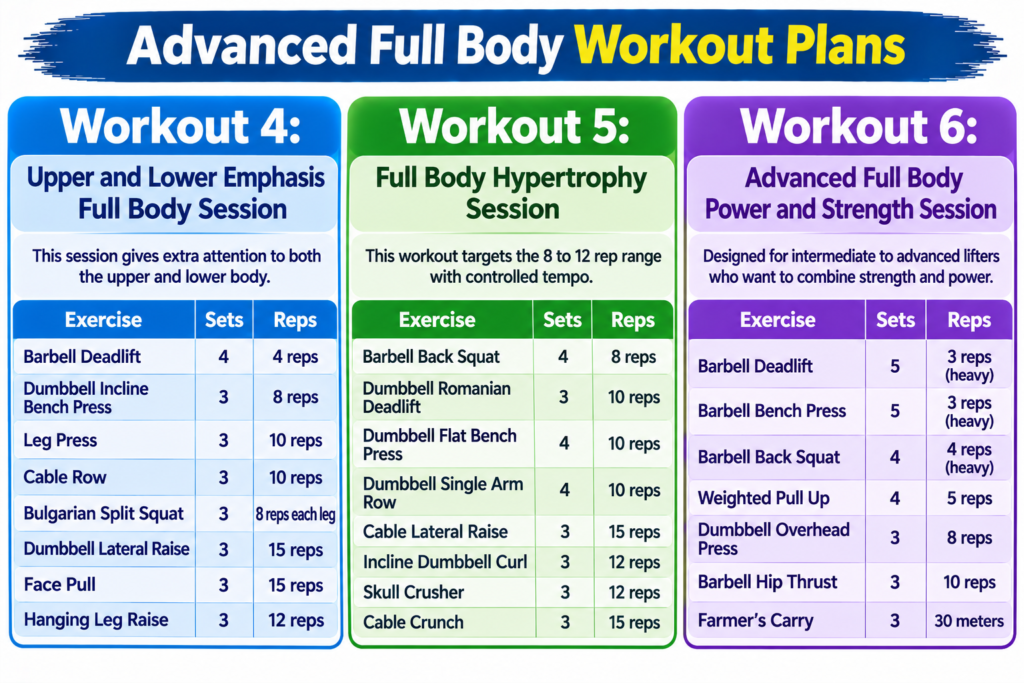
Workout 4: Upper and Lower Emphasis Full Body Session
This session gives extra attention to both the upper and lower body within a single workout, making it ideal for balanced development.
- Barbell deadlift: 4 sets of 4 reps
- Dumbbell incline bench press: 3 sets of 8 reps
- Leg press: 3 sets of 10 reps
- Cable row: 3 sets of 10 reps
- Bulgarian split squat: 3 sets of 8 reps each leg
- Dumbbell lateral raise: 3 sets of 15 reps
- Face pull: 3 sets of 15 reps
- Hanging leg raise: 3 sets of 12 reps
Workout 5: Full Body Hypertrophy Session
This workout targets the 8 to 12 rep range with controlled tempo to maximize muscle growth. Rest 60 to 75 seconds between sets.
- Barbell back squat: 4 sets of 8 reps
- Dumbbell Romanian deadlift: 3 sets of 10 reps
- Dumbbell flat bench press: 4 sets of 10 reps
- Dumbbell single arm row: 4 sets of 10 reps
- Cable lateral raise: 3 sets of 15 reps
- Incline dumbbell curl: 3 sets of 12 reps
- Skull crusher: 3 sets of 12 reps
- Cable crunch: 3 sets of 15 reps
Workout 6: Advanced Full Body Power and Strength Session
Designed for intermediate to advanced lifters who want to combine strength and power development. Rest 3 minutes between primary lifts.
- Barbell deadlift: 5 sets of 3 reps (heavy)
- Barbell bench press: 5 sets of 3 reps (heavy)
- Barbell back squat: 4 sets of 4 reps (heavy)
- Weighted pull up: 4 sets of 5 reps
- Dumbbell overhead press: 3 sets of 8 reps
- Barbell hip thrust: 3 sets of 10 reps
- Farmer’s carry: 3 sets of 30 meters
How to Progress Over 6 to 12 Weeks
Running the same workout at the same weight indefinitely will not produce results. Here is how to structure your progression:
Weeks 1 to 3:
Focus on form and technique. Use weights where you can complete all reps cleanly. For beginners, Workouts 1 and 3 are the starting point.
Weeks 4 to 6:
Add 5 pounds to lower body lifts and 2.5 pounds to upper body lifts when you can complete all sets at the top of the rep range. Move to Workouts 2 and 4.
Weeks 7 to 12:
Increase training intensity and incorporate Workouts 5 and 6. Start tracking your one-rep max on key lifts and aim to set a personal best every two to three weeks.
A real world example:
A 35 year old client who trained three times per week using this progression added 45 pounds to her deadlift and lost 11 pounds of body fat in 12 weeks. She had previously spent two years on a split routine with minimal progress.
Common Mistakes to Avoid in a Full Body Gym Workout Routine
Even a well-structured total body training plan can stall if you make these errors:
- Skipping the hip hinge pattern. The deadlift and its variations are among the most powerful movements for strength and fat loss. Do not avoid them because they feel hard.
- Neglecting pulling movements. Most people push more than they pull. For every pressing set you do, match it with at least one pulling set to protect your shoulder health.
- Not resting enough between heavy sets. Shorter rest periods are great for fat loss circuits but counterproductive when you are trying to move heavy weight. Match your rest periods to your goal.
- Changing the program too frequently. Give any program at least four to six weeks before deciding it is not working. Adaptation takes time.
- Ignoring recovery. Sleep, nutrition, and stress management are not optional extras. Without adequate recovery, even the best gym workout plan for strength and fat loss will underdeliver.
Key Takeaways
- A full body gym workout routine trains every major muscle group each session, two to four times per week, which drives faster strength gains and greater calorie burn than most split routines.
- Compound movements including squats, deadlifts, rows, and presses should form 70 to 80 percent of your workout, with isolation exercises as supplementary work.
- Training each muscle group twice per week produces significantly greater hypertrophy than once per week, according to research in the Journal of Strength and Conditioning Research.
- Three sessions per week is the optimal frequency for most people following a total body training plan, providing enough stimulus and adequate recovery.
- Progressive overload, consistent tracking, and recovery are non-negotiable if you want lasting results from any full body workout program.
Frequently Asked Questions
1.How Many Days Per Week Should I Do a Full Body Gym Workout Routine?
Three days per week is the most effective and sustainable frequency for most people. This gives you enough training stimulus to build strength and burn fat while allowing 48 hours of recovery between sessions. If your schedule only allows two days, you will still see meaningful results, particularly if you are new to training or returning after a break.
2.How Long Should Each Full Body Gym Session Last?
Aim for 45 to 60 minutes, including a 5-minute warm-up and a short cool down. That is enough time for five to seven exercises, with 60 to 120 seconds of rest between sets on smaller moves and up to 3 minutes on heavy compound lifts like squats and deadlifts. Because a full body session trains every major muscle group, it doesn’t need to be long to be effective.
3.Can a Full Body Gym Workout Routine Build Muscle as Effectively as a Split Routine?
Yes, and in many cases it builds muscle faster, particularly for beginners and intermediate lifters. The higher weekly training frequency means your muscles receive a growth stimulus more often, which consistently outperforms the once per week approach used in traditional splits for overall hypertrophy when total volume is equated. Advanced bodybuilders may eventually benefit from higher volume splits, but for most people, a full body approach delivers equal or superior muscle building results.
4. How Many Days Per Week Should I Do a Full Body Gym Workout Routine?
Three days per week is the most effective and sustainable frequency for most people. This gives you enough training stimulus to build strength and burn fat while allowing 48 hours of recovery between sessions. If your schedule only allows two days, you will still see meaningful results, particularly if you are new to training or returning after a break.
5. Can a Full Body Gym Workout Routine Build Muscle as Effectively as a Split Routine?
Yes, and in many cases it builds muscle faster, particularly for beginners and intermediate lifters. The higher weekly training frequency means your muscles receive a growth stimulus more often, which consistently outperforms the once-per week approach used in traditional splits for overall hypertrophy when total volume is equated. Advanced bodybuilders may eventually benefit from higher-volume splits, but for most people, a full body approach delivers equal or superior muscle building results.
6. How Long Should a Full Body Gym Workout Routine Take?
Plan for 45 to 60 minutes, including a 5 minute warm up. That is enough time for five to seven exercises with 60 to 120 seconds of rest between sets. Sessions that run past 75 minutes often lead to fatigue, rushed sets, and poor form. If you are short on time, a focused 30 to 40 minute session built around three or four compound lifts still delivers solid results.
7. Which Exercises Should Be Included in a Full Body Gym Workout Routine?
Build each session around compound movements that cover the main movement patterns: a squat or leg press for the quads, a hip hinge such as a Romanian deadlift for the hamstrings and glutes, a horizontal push like the bench press, a horizontal or vertical pull like a row or lat pulldown, and an overhead press for the shoulders. Finish with a core exercise such as a plank or cable crunch. Add one or two isolation moves, like curls or lateral raises, if you have time and energy left.
8. How Many Sets and Reps Should I Do in a Full Body Gym Workout Routine?
For most people, two to four sets of 6 to 12 repetitions per exercise works well, using a weight that leaves one or two reps in reserve. A 2017 dose response review by Schoenfeld, Ogborn, and Krieger in the Journal of Sports Sciences found that around 10 or more weekly sets per muscle group produced greater muscle gains than lower volumes. With three full body sessions, two to four sets per muscle each day puts you comfortably in that range. Beginners can start with two sets and add more gradually.
9. Should I Do Cardio on Top of a Full Body Gym Workout Routine?
A little cardio is a good idea for heart health, but it should not crowd out your lifting. The World Health Organization’s 2020 guidelines recommend 150 to 300 minutes of moderate aerobic activity per week, alongside muscle strengthening on two or more days. Two or three brisk walks, bike rides, or 10 to 15 minutes of easy cardio after lifting is plenty. If fat loss is your goal, daily walking is an easy way to raise your energy expenditure without hurting recovery.
10. How Do I Progress in a Full Body Gym Workout Routine Without Plateauing?
Use progressive overload: gradually ask your muscles to do a little more over time. The simplest method is double progression. Pick a rep range, such as 8 to 12, and stay at one weight until you hit the top of the range on every set, then add a small amount of weight and start again at the bottom. Log every workout so you can see what you lifted last time. If progress stalls for several weeks, check your sleep, protein intake, and total calories before changing the program. Also plan an easier week every 6 to 8 weeks to let your body recover.
Conclusion
A full body gym workout routine is one of the simplest and most effective ways to build strength, add muscle, and improve your overall fitness. Training three days a week gives every muscle group frequent practice and plenty of recovery time. Building each session around compound lifts like squats, hinges, presses, and rows means you get the most out of every minute in the gym.
The research supports this approach. Studies on training frequency and weekly volume show that what matters most is doing enough hard sets over the week and increasing the challenge gradually. A full body routine makes that easy to do, whether you have 45 minutes or only 30. Add a little cardio for heart health, sleep 7 to 9 hours, and eat enough protein to support your progress.
Keep your plan simple and stick with it. Choose your exercises, write your sessions down, and use double progression to add reps or weight when you’re ready. Give the routine at least 8 to 12 weeks before judging it, and your consistency will do most of the work.